
Few of us need reminding of just how much digital technology has changed telecommunications over the past two decades. If anything, the pace of transformation appears to be accelerating still, meaning it is anyone’s guess what that landscape will look like in another decade’s time.
The digital revolution in telecommunications has created some interesting juxtapositions between the consumer and commercial worlds. In our private lives, we have been less inhibited about embracing digital communications than we have been in business.
Younger demographics in particular have shown no qualms at all about casting off the telephone in favour of video chat, and replacing email with IM and social media. While businesses fret over bothersome things like ROI before taking the digital plunge, in our consumer lives we have wholeheartedly embraced new tech out of sheer pleasure and convenience.The demand now is to have all modes of communication accessible from everywhere via web-based platforms, delivering a rich, real-time experience on handheld devices we barely put down.
The contact centre sits right on the frontline where this contrast between consumer and business digital adoption plays out. Behind the contact centre, the naturally conservative commercial mindset cautions not to take too much risk too early, to wait and see the winners and losers in new tech before making the investment. In front of the contact centre, a completely transformed communications landscape has already emerged.
Digital technology has therefore arguably had more of an impact on the contact centre than any other area of business operation. The reasons for this are not difficult to unpick. In the interests of delivering service the way customers want it, businesses have had to adapt to changing communications preferences.
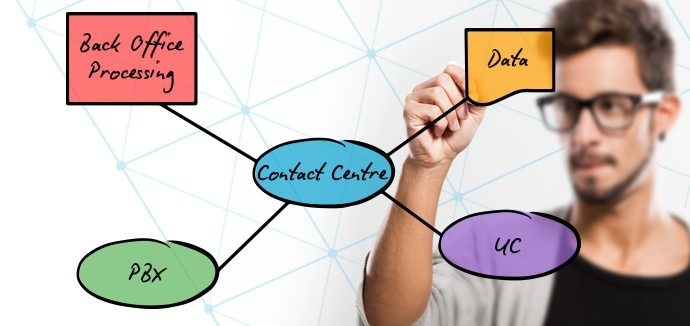
As things stand, digital transformation in the contact centre is still an ongoing process. Traditional telephone-based call centres still just about hold sway, but the race to integrate multi- and omni-channel options is hotting up. Competition on service is pushing businesses to reimagine customer experience in ways which are breaking down the silos between the contact centre and the rest of the business. And we are increasingly seeing the influence of futuristic Artificial Intelligence (AI) and IoT technologies which are increasing the scope for self-service and automation.
Where, then, will this journey of discovery lead the contact centre in the future? To round off our Tech Track series on contact centre solutions, we have identified four key trends, with examples of solutions relevant to each, which we believe will be key in shaping how contact centres function over the next decade.
Into the Cloud
Cloud-based contact centre solutions have been around for some time. While the relative merits of cloud versus on-premises continue to be debated, one thing is for certain - the number of cloud contact centre seats continues to grow rapidly. According to DMG, that growth will hover just under 25 per cent year on year until 2020.
Those sorts of numbers suggest it is only a matter of time before cloud solutions become the new norm in the contact centre. Why? Well, there are a number of factors at play. As products such as Cisco’s Hosted Collaboration Solution (HCS) for Contact Centre demonstrate, there is now very little to choose in functionality between on-premises and cloud platforms. HCS for Contact Centre offers everything you can get from Cisco’s best-in-class Unified Contact Centre Enterprise software, only accessed via an internet connection.
On top of the usual pro-cloud arguments about cost-effectiveness and flexibility, you can also add convenience and efficiency. In its white paper Rethinking Your Contact Centre, 8x8 sets out its future vision for contact centre operations based on optimizing the customer journey, integrating all channels, and using a combination of the latest tech tools and expertise throughout a business to maximise service.
But underpinning all of these possibilities, 8x8 argues, is the need for cloud architecture. It positions its Virtual Contact Centre platform as an end-to-end customer service solution in one single package. Instead of running PBX and other individual channels, plus agent and call management, reporting, recording and so on as separate operations, Virtual Contact Centre does everything in one.
According to 8x8 and many others, only in the Cloud can you strike a balance between the level of complexity this requires and convenience for the end user. As contact demands diversify while the pressure for more responsive, efficient service increases, the Cloud will provide the foundation for building the sophisticated, elegant solutions required.
Omni-channel as standard
You could argue that multi-channel has been a feature of the contact centre since customers first started to email or even fax businesses with queries or service requests. But certainly as mobile use, IM, web chat and social media have grown in popularity, multi-channel contact centres have increasingly become the norm.
Omni-channel is slightly different, however. Instead of treating each mode of communication with customers as distinct - telephone in one box, SMS in another, web chat in its own and so on - omni-channel ignores all distinctions and treats all forms of contact as one.
Enghouse Interactive’s Communications Center, for example, uses a single integrated queuing system for all channels, so no matter how a customer contacts a business, response times are managed in the same way. It also applies the same routing techniques to all forms of communication, meaning you are just as likely to get a response from the right person for your query if you post on social media as you are if you pick up the phone.