Your new contact center platform is performing brilliantly. Handle times are down, agents are happier, and your vendor’s ROI calculator says you’re saving a fortune. Great. Now, can you convince your CFO those savings are real?
That’s the question a lot of CX leaders are struggling with.
Gartner’s August 2026 survey of 199 customer service leaders found that AI spending had increased by 38%, while overall service and support budgets grew by just 2%. That’s a lot more money going into technology, with very little extra room for expensive mistakes.
The trouble with CX technology ROI is that an impressive performance report can hide a disappointing financial return. Saving agent time doesn’t necessarily reduce payroll costs, and a higher automation rate or agentic AI project means squat if customers keep calling back.
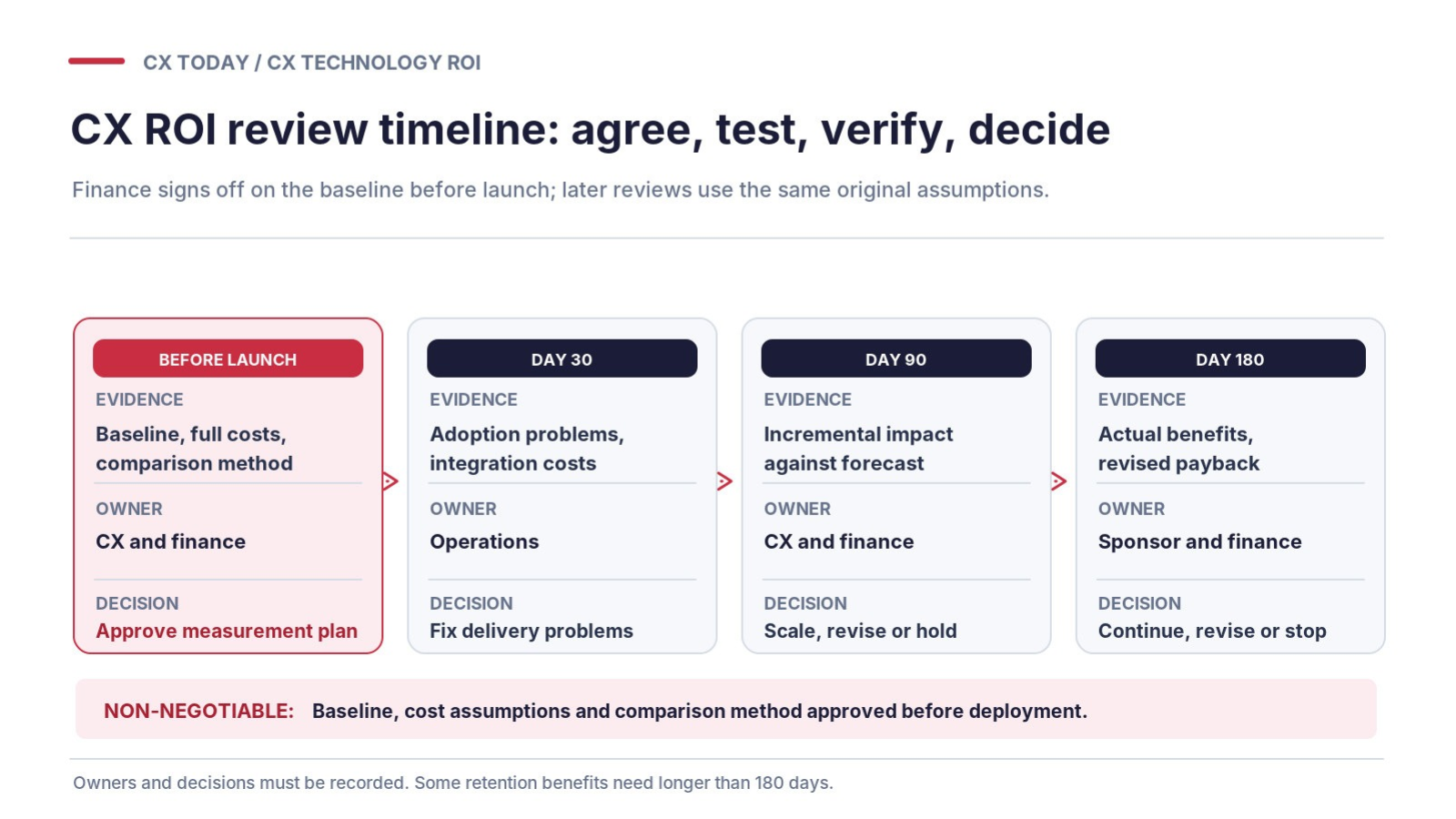
To prove the return, agree on the financial baseline before purchase, track what the technology actually changes, and calculate the attributable benefit after the full costs. If finance can’t trace the result back to the original business case, the ROI claim remains an estimate.
Key Takeaways
-
Start with the financial problem. Know what you’re spending today and what needs to change.
-
Make your numbers defensible. Count the full investment, realistic benefits, payback, and risk.
-
Agree on the evidence early. Set baselines and establish how you’ll measure the investment’s contribution.
-
Keep checking after launch. Early improvements are encouraging. Finance needs proof they’re producing lasting value.
Start With the Decision, Not the Dashboard
I think most of us have seen plenty of CX technology ROI proposals that make it very obvious someone fell in love with a platform, then scrambled to find the numbers to justify buying it. Finance can usually spot that a mile away.
Start with what’s actually costing you money; that’s what CFOs care about. Repeat calls, unnecessary overtime, customers leaving after another botched service experience. Rank your three costliest customer journeys by avoidable demand or profit at risk. The busiest journey isn’t necessarily the most expensive. A handful of failed renewals could cost more than thousands of routine inquiries.
TruGreen learned that lesson the hard way. Management believed price accounted for roughly 29% of cancellations. Listening to customer calls revealed the figure was closer to 6%. Service quality and disappointing lawn results were bigger problems. The company had been tackling the wrong issue all along. As our own Rob Scott said:
“IT leaders rarely lose on features. They lose when the financial story is incomplete or easy to challenge.”
When you’re deciding how to build a CX business case, compare the cost of carrying on with the cost of improving your existing processes. Then compare both against the new investment. Finance deserves an explanation if the most expensive option wins.
Then put your argument in terms finance can challenge:
“We propose investing in [technology] to move [business metric] from [verified baseline] to [target] within [timeframe], at [total cost], with results checked against [agreed measurement method].”
How to Build a CX Technology Business Case in Five Numbers
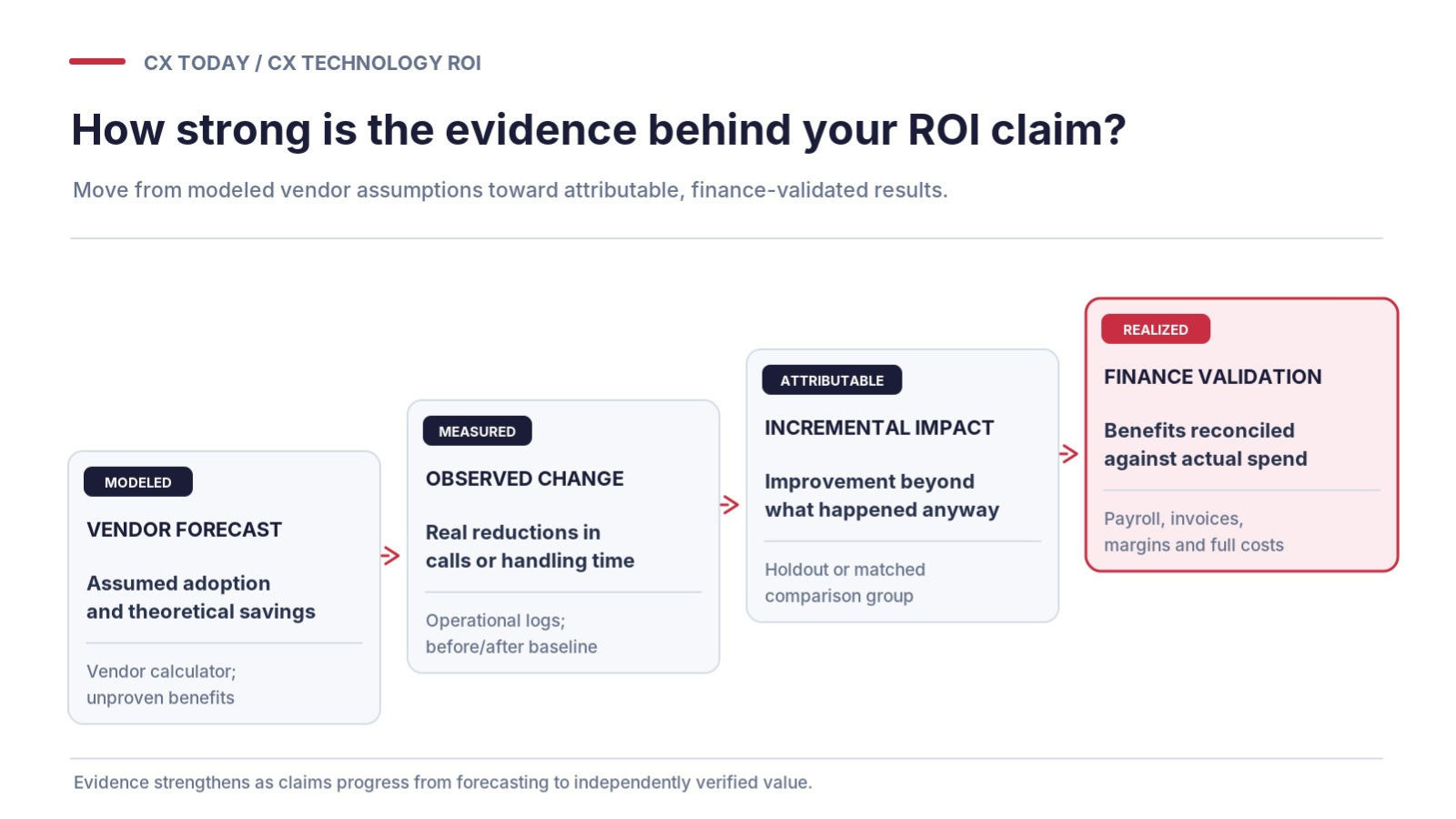
I’d love to know how many CX investments have been approved because a vendor’s calculator assumed everyone would use the software, every automated contact would save money, and nothing would go wrong during deployment.
Change those assumptions and the promised return can disappear pretty quickly.
If you’re working out how to build a CX business case, I’d start with five numbers finance can investigate.
|
Figure |
What finance needs |
Your number |
|---|---|---|
|
1. Baseline |
Current costs, volumes, and performance |
Not available |
|
2. Total cost |
Upfront spending and running expenses |
Not available |
|
3. Financial benefit |
Savings, additional profit, avoided expenditure |
Not available |
|
4. Payback |
When cumulative net cash flow turns positive |
Not available |
|
5. Risk |
What missed targets could cost you |
Not available |
The figures in this CX business case template will look different depending on what you’re buying.
With workforce management software, it’s worth investigating overtime bills and what you’re spending replacing agents. With analytics, ask which customer problems are going unresolved because nobody’s spotting them early enough. Then put a price on those problems.
Don’t let the vendor decide which numbers matter.
Also get a proper account of implementation costs. Someone has to clean the data, connect the systems, train employees, and deal with whatever breaks. Our investigation into hidden AI costs is worth reading before accepting a subscription quote as your total investment.
Calculate ROI, Payback, and Break-Even Performance
Here’s the contact center ROI calculation (it’s something you’ve probably used before):
ROI (%) = (Financial benefits − Total costs) ÷ Total costs × 100
If you’re justifying AI to your CFO, or any other investment, keep the time period consistent. Payback comes when cumulative net cash flow turns positive, after accounting for ongoing costs.
Say your project costs $240,000 over the period you’re assessing. If every verified automated resolution saves $8 in actual expenditure, after variable charges, you’ll need 30,000 resolutions to recover that investment.
That’s a hypothetical example, obviously. The important question is whether you can genuinely remove that $8 from your spending.
Try the calculation again with fewer successful resolutions and higher running costs. See how much room you’ve really got before the project becomes expensive. Keep AI in mind, too. Not just what it costs upfront, but what happens to the bill as usage increases.
Our AI pricing guide goes further into consumption and outcome-based charges.
What Should the CFO See Before Approving the Investment?
US CPA and fractional CFO Lisa Press put it plainly in a CMSWire interview:
“CFOs fund costs that disappear or revenue that stays.”
So give your CFO the original problem, the alternatives you’ve considered, and the numbers behind the proposed return. Agree which benefits finance will recognize. Better still, get the person responsible for each forecast to sign off on it; for instance, if you’re investing in CX security, involve the security team.
Six months down the line, you don’t want an argument about what everyone thought the investment was supposed to achieve.
Which CX Benefits Will Finance Actually Accept?
Whenever you see “10,000 agent hours saved” in a CX technology ROI forecast, it’s natural to get suspicious. What did that time saving lead to? If everyone’s still on the payroll, you’ve gained capacity.
That could be worth a fortune during peak demand, but finance needs to see where the money’s going.
Cashable Savings, Cost Avoidance, and Revenue
|
Benefit |
Financial treatment |
Evidence needed |
|---|---|---|
|
Lower operating costs |
Cash savings |
Payroll, invoices |
|
Released agent hours |
Additional capacity |
Workforce records |
|
Fewer planned hires |
Cost avoidance |
Approved hiring forecasts |
|
Improved retention or sales |
Incremental profit |
Customer cohorts, margins |
|
Fewer fraud losses or incidents |
Expected avoided costs |
Historical losses, risk estimates |
|
Higher CSAT or NPS |
Supporting evidence |
Customer behavior |
Now, there’s no shortage of customers already showing off the right evidence, though usually with some limitations.
Raleigh, North Carolina, reported a 66% reduction in IT service desk costs with ServiceNow, but we found that the calculation included employees reassigned to other work. I’d have liked to see the corresponding change in actual expenditure.
ServiceNow CFO Gina Mastantuono made a related point:
“Customers aren’t paying us for tokens, they’re paying for resolutions.”
Fair enough, but shouldn’t we have failed automations and repeat contacts included in the cost of those resolutions?
There’s also a reason to question permanent staffing reductions. Gartner’s November 2026 survey found that just 21% of 275 service leaders had reduced headcount because of AI. Another 7% had rehired staff after earlier cuts. Investing in automation doesn’t necessarily mean reducing staff.
Watch Out for Inflated Returns
Don’t put retained revenue straight into the profit column. Deduct the associated costs, and make sure you haven’t claimed the same labor savings elsewhere.
Security and compliance investments deserve different treatment. Estimate the financial exposure you’re reducing using actual incident costs and credible probabilities. For automation and AI ROI, go beyond time-saved and see what it actually means for the business.
For instance, one customer using Verint Quality Bot evaluated more than 97% of 200,000 monthly calls, lifted supervisor capacity by 80%, and managed to avoid hiring another 200 analysts. That’s a more valuable case to bring to a CFO.
Which Metrics Prove CX Technology ROI?
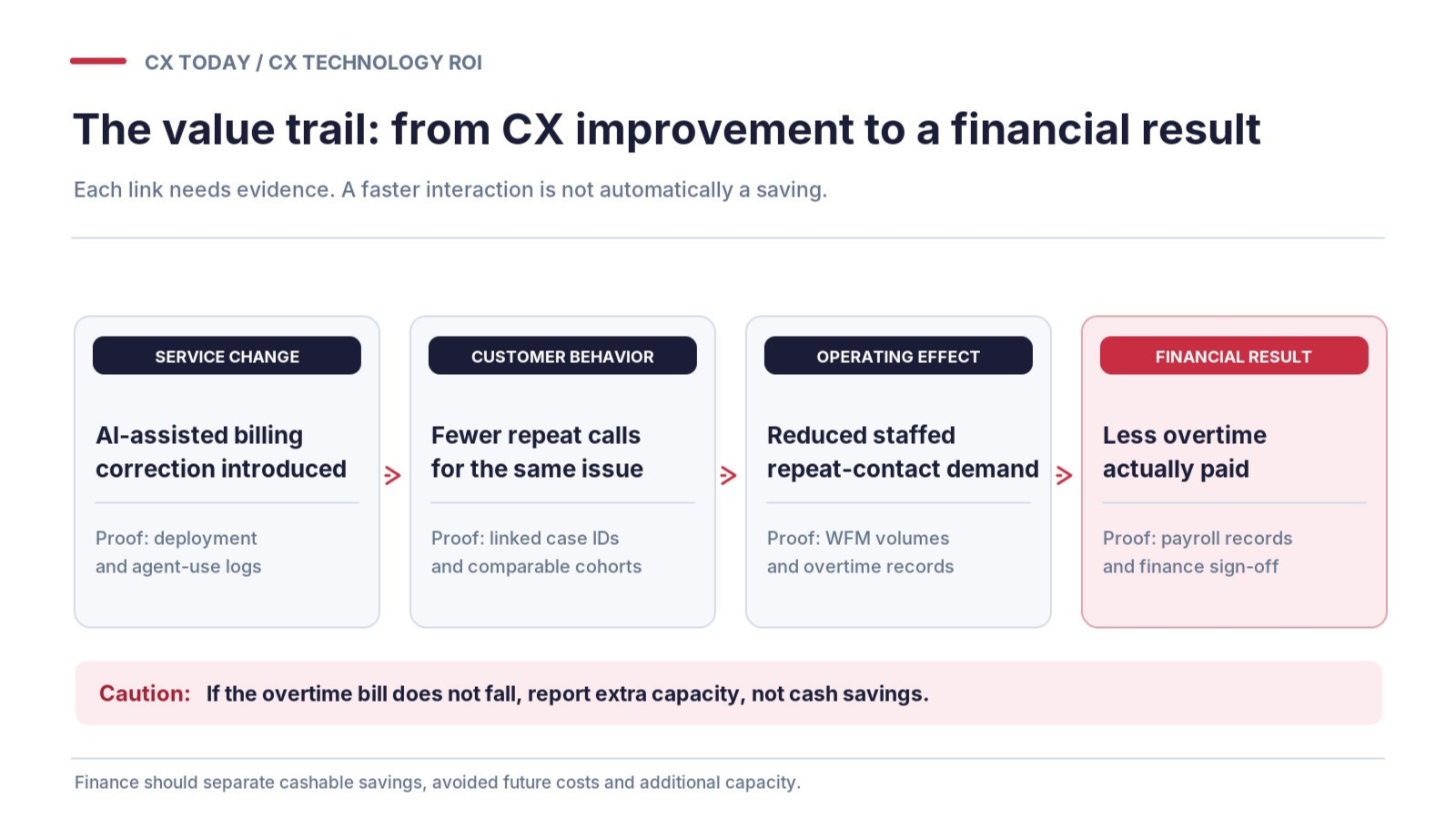
Vendors love a convincing dashboard, but even a 20% increase in productivity doesn’t prove the investment paid off. Where’s the money? Perhaps operating costs fell, the team handled more customers without recruiting, or retention improved. Those are the results worth investigating, depending on what the technology was bought to achieve.
What Should You Measure for Different CX Technologies?
Every platform needs its own measures of success. Start with the operational changes you expect, then work out how you’ll connect them to financial results.