Not long ago, inflight Wi-Fi sat at the very bottom of the airline customer experience. Inflight internet once ranked last out of 21 airline experience benchmarks measured by the American Customer Satisfaction Index - below baggage handling, below seat comfort, and below airline food.
For CX professionals, that is not just a bad score. It is a case study in how a service can be simultaneously essential and chronically broken for long enough that passengers simply stop expecting it to work.
The ACSI Travel Study 2026 tells a meaningfully different story. Customer satisfaction with inflight Wi-Fi has climbed from 66 to 79 out of 100 in a single year - now level with inflight food and beverage, and above seat comfort at 76. That is a remarkable rehabilitation of one of the most maligned elements of the flying experience.
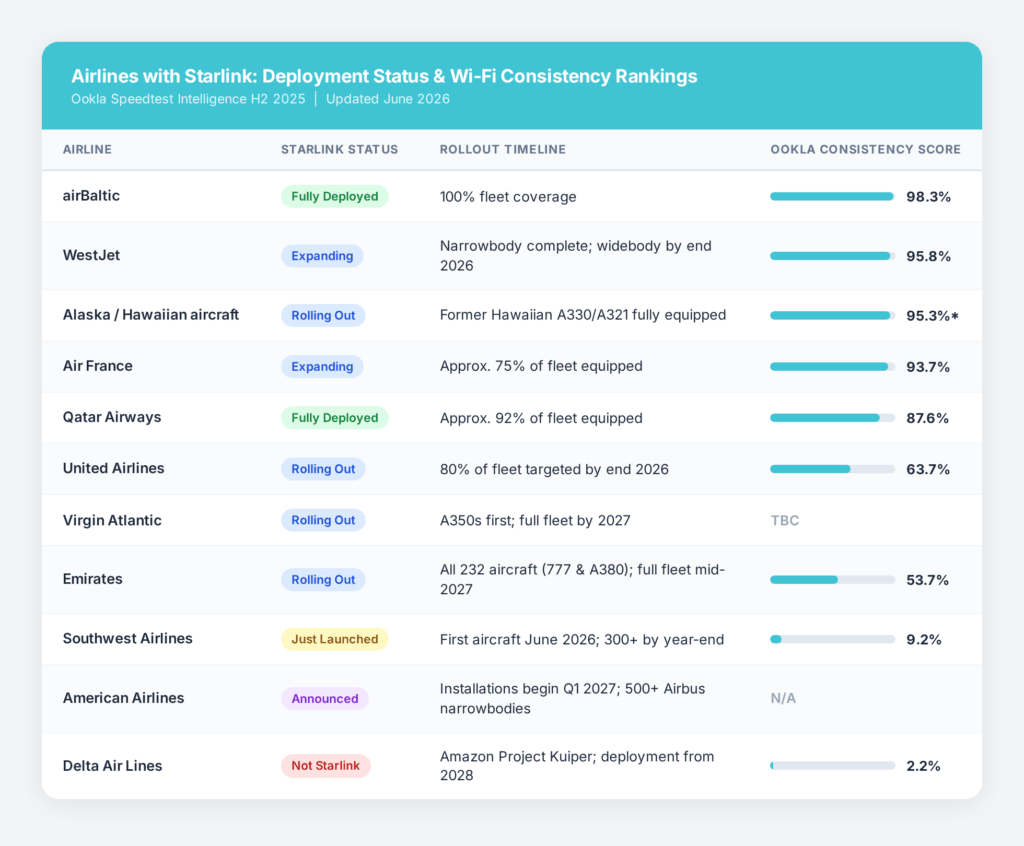
Airlines with Starlink on their fleets are among those driving that improvement, and as the best in-flight internet becomes a genuine booking and loyalty variable, the carriers that have invested in next-generation inflight Wi-Fi are pulling measurably ahead - in independent speed benchmarks, consistency rankings, and passenger satisfaction data alike.
Why Inflight Wi-Fi Became a CX Liability
The problem was never purely one of investment. Airlines and their connectivity partners spent billions on onboard systems throughout the 2010s. The issue was architectural. Two dominant technologies - air-to-ground (ATG) systems, which depend on terrestrial towers and go dark over oceans, and geostationary (GEO) satellites, orbiting roughly 35,786 kilometers above Earth - both carried structural performance ceilings that no amount of additional spending could raise.
GEO-based systems, the most widely deployed in commercial aviation, introduce round-trip signal latency of 600 to 800 milliseconds.
For CX teams, the downstream implications are straightforward: any application requiring real-time data exchange - video conferencing, collaborative platforms, VoIP - is functionally unusable. A passenger who paid $19 for a full-flight pass and then watched a buffering screen for three hours was not experiencing a service failure in the traditional sense. They were experiencing the hard physics ceiling of the underlying infrastructure.
That distinction, understandably, did nothing to soften the negative review.
According to Moment's Inflight Connectivity Benchmark, 80% of passengers now consider inflight Wi-Fi essential to their journey. A service that 80% of customers consider essential, and that consistently underdelivers, creates a specific kind of CX damage - one that compounds across reviews, loyalty metrics, and corporate travel decisions in ways that are slow to repair even after the underlying technology improves.
The Cabin Has Changed. The Passenger Has Changed Too.
Here is the dimension of the connectivity story that the pure technology debate tends to sidestep: the person in seat 24A is not the same traveler who boarded a flight ten years ago.
The normalization of hybrid and remote work has fundamentally altered what passengers need to do while airborne. Where business travel once meant periodic trips between fixed offices, the modern air traveler is increasingly a knowledge worker whose office is wherever they happen to be - including, now, at 35,000 feet. Video meetings, shared documents, cloud collaboration tools - these are not extras for this passenger. They are the job. And the job does not pause because the wheels left the tarmac.
The cost of not meeting this expectation is also becoming quantifiable. For organizations with significant travel budgets, connectivity is an increasingly explicit criterion in preferred carrier agreements. A company whose employees routinely lose productive working time to failed inflight Wi-Fi has a measurable operational justification to shift its corporate travel program to a competitor. The best in-flight internet is no longer a passenger satisfaction metric in isolation - it is a B2B retention issue that shows up in contract renewals and loyalty data.
The LEO Divide: How Starlink Plane Wi-Fi Speed Is Creating a Two-Tier Sky
The performance gap between carriers that have adopted low Earth orbit (LEO) satellite connectivity and those still running legacy systems is, according to Ookla's Speedtest Intelligence data for H2 2025, stark enough to define an entirely new competitive landscape in commercial aviation.
Starlink operates at altitudes of 340 to 560 kilometers - roughly 50 times closer to Earth than a geostationary satellite. That proximity compresses round-trip latency to between 30 and 80 milliseconds, bringing inflight Wi-Fi into a performance range where video calls, cloud tools, and real-time applications can actually function. Starlink plane Wi-Fi speed typically ranges from 100 to 350 Mbps per aircraft, with StarlinkFlights.com recording a passenger-reported peak of 424 Mbps and an in-flight average of 234 Mbps.
Ookla's sharpest finding is what it calls "Starlink's worst day versus the competition's best day" - Starlink's slowest 10% of users still experienced 63.71 Mbps, faster than the median of every other satellite network.
The IPO Wildcard and the Race to Deploy
SpaceX, the parent company of Starlink, remains privately held, with a valuation reported at or above $200 billion across recent funding rounds. There remains fervent speculation about an IPO in the next few days.