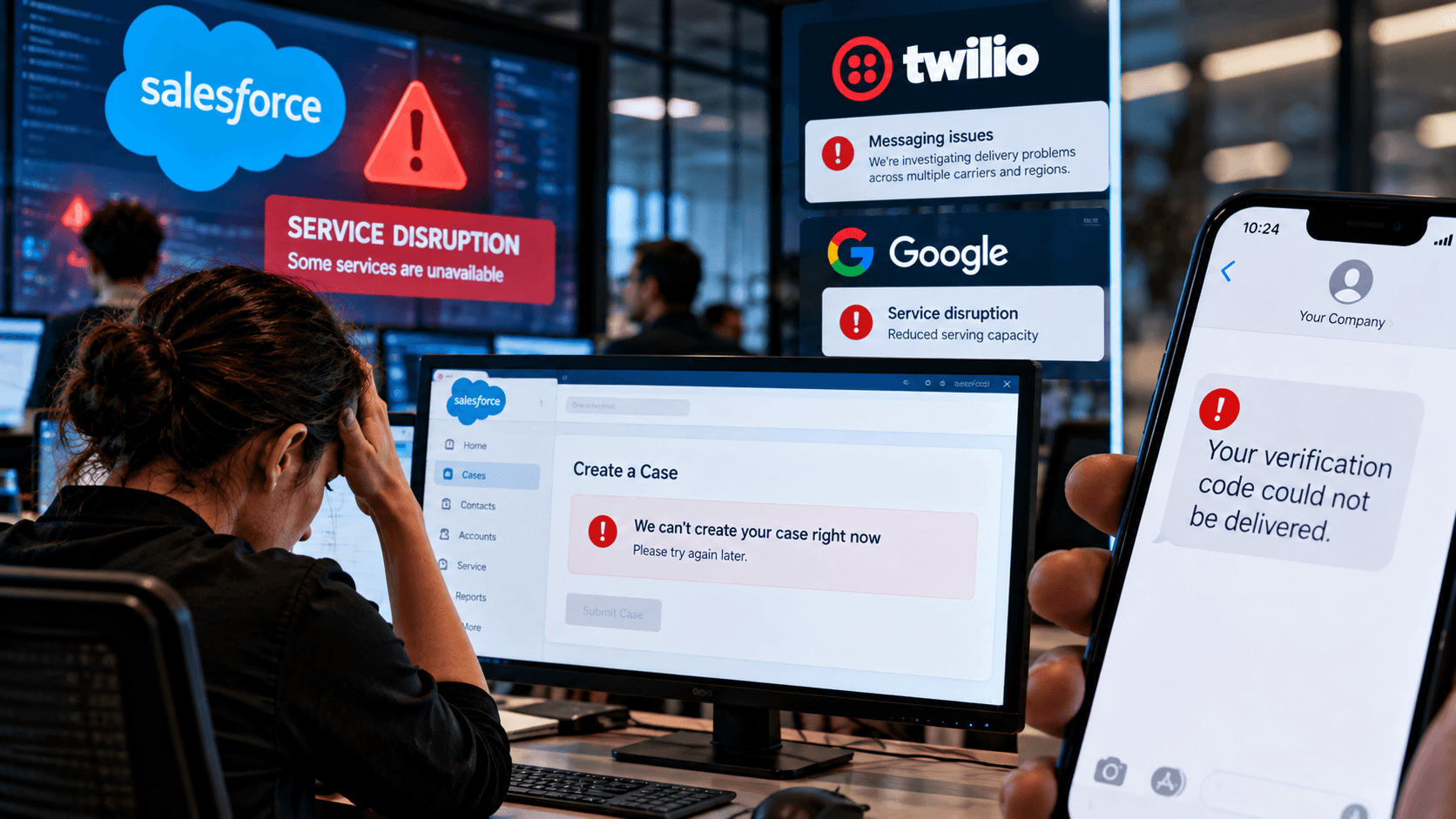
On September 18, Atlassian published the kind of postmortem that makes the Opsgenie end-of-life deadline feel a lot more daunting.
On September 14, Opsgenie, Jira Service Management, and Compass hit a disruption that left affected customers waiting an average of 22 minutes for alerts to be created and notifications delivered. Nothing was ultimately dropped. That sounds reassuring until you picture what 22 minutes means during a payment failure, contact center outage, or broken customer login.
Atlassian traced it to long-running transactions after a configuration change, with heavier US traffic exhausting a core service's thread pool. Automated monitoring caught the problem within a minute, yet alert and notification delivery still averaged a 22-minute delay.
Plenty of CX leaders spend a lot of time talking about detection. The nastier question is what happens after the signal exists and the people who need it still don't get enough information quickly enough.
The timing makes this especially awkward. On April 5, 2027, Opsgenie becomes inaccessible. Atlassian's wording is blunt:
“access to Opsgenie will be shut off”, with unmigrated data deleted.
So, as the six-month countdown begins, Opsgenie migration decisions have suddenly become part of a much bigger argument about CX observability on-call management in 2026: who owns the chain from “something broke” to “someone actually fixed it”?
What Happens to Opsgenie After April 5, 2027?
You’ve got until April 5, 2027. Atlassian says Opsgenie access will be shut off on that date, with unmigrated data deleted afterward. New sales already ended on June 4, 2025. Current customers can add more seats, although renewals can’t extend beyond end of life.
There’s another data issue worth mentioning. Opsgenie Enterprise allowed alert data to be retained indefinitely. After an Opsgenie migration, new JSM alert data expires according to plan: one month on Free, one year on Standard, three years on Premium, and five years on Enterprise. Atlassian specifically calls out investigations, compliance audits, reporting, and AI analysis as reasons customers may need that history. Once expired, it can’t be recovered.
That makes what happens to Opsgenie data after April 2027 a bigger question than “did the records transfer?” A company could move successfully and still discover later that the history its auditors or AI tools expected to use has aged out.
Six months is enough time to fix that. It’s also close enough that leaving the retention conversation until cutover feels reckless.
What Are the Opsgenie Migration Options Before April 2027?
For most customers staying with Atlassian, the Opsgenie migration route is now straightforward on paper: move into Jira Service Management using Atlassian’s automated migration tool. Alerts, schedules, and policies transfer automatically, and Atlassian recommends a JSM plan based on the customer’s existing Opsgenie setup.
There’s a sensible safety net for those worried about ongoing service management and connectivity. Customers can run a 14-day migration demo first, then keep Opsgenie available for 120 days in parallel after the move. That’s a good window to use for a live proving period, especially for teams with messy escalation chains or lots of custom integrations.
Still, there is a second deadline hidden in that safety net. Opsgenie shuts down automatically 120 days after the migration date unless a site admin turns it off sooner. Atlassian says that shutdown is permanent, so those 120 days are validation time, not spare capacity.
The big complication is Data Center. Atlassian’s current tooling doesn’t move Opsgenie data into Jira Service Management Data Center. Customers staying on JSM DC can’t bring that Opsgenie estate into the same environment; Atlassian’s answer is effectively Cloud.
That gives extra clout to Jimi Wikman’s earlier warning that “there does not seem to be a plan” for Data Center users. Atlassian has since clarified the path, but it still isn’t a like-for-like DC destination.
Is Jira Service Management a Full Replacement for Opsgenie?
For core alerting and on-call work, Jira Service Management covers most of what Opsgenie users need. The complications sit around those core functions.
Alerts and schedules migrate, but some familiar behavior changes. Slack incident integrations need rebuilding, Terraform users move to Atlassian’s Operations provider, and push notifications shift to Jira’s mobile app. Slack and Microsoft Teams connections also need reauthorizing, while bidirectional integrations require Premium or Enterprise. Around 24 older integration versions can’t be newly configured in JSM.
Notification rules need copying into Jira’s mobile app, where insistent notifications aren’t available. JSM Operations alerts don’t automatically become incidents either, so that workflow requires automation.
There are incident-migration gaps too. Atlassian says incident templates and responder roles don’t migrate. Stakeholder filters need manual handling, email templates must be rebuilt, and Opsgenie actions and incident rules need recreating in Jira Automation. Opsgenie SSO also doesn’t carry over, with Atlassian Guard required separately.
Atlassian is investing heavily in the destination. New circuit breakers are designed to keep alert creation, notifications, and on-call schedules running when search is degraded, while RovoOps is moving into Slack incident and alert channels.
Still, JSM needs pressure-testing. On October 1, an incident delayed email-to-ticket processing and notifications, disrupted schedules, and left some new support tickets without SLA components before recovery later that morning.
Which Opsgenie Alternatives Are Built for On-Call Management in 2026?
The best Opsgenie alternatives are starting to look less alike. The useful question is what happens once an alert fires, because that’s where the vendors are placing very different bets.
PagerDuty is putting more AI into the responder workflow. SRE Agent Skills reached GA on September 21, giving Advance customers a way to add their own troubleshooting scripts and instructions. Custom Incident Cards for Slack followed two days later, and team-level Advance permissions arrived on October 2. There’s a migration incentive too: up to 80 hours of support for the first 50 qualifying Opsgenie customers.
incident.io is chasing the dead time after the page. Its Investigations product pulls together enrichment and deduplication, and the company says the median time from incident opening to an accurate channel update fell from 6.7 minutes to three. The share getting there within five minutes rose from 8% to 68%.
Freshworks is coming at the same problem from ServiceOps. Its FireHydrant migration utility can import Opsgenie or PagerDuty teams and schedules, flag mapping problems, and support phased cutovers. Grafana has gone the other way, archiving OnCall OSS and concentrating on Cloud IRM. Its September 22–23 incident, when some pages weren’t delivered, is a useful reality check: changing platforms doesn’t make paging failures disappear.
The migration decision is really about how incident response should work. JSM keeps on-call inside Atlassian, PagerDuty is betting on AI-assisted operations, and incident.io is pushing further into investigation. Each needs testing against migration failures, paging reliability, and the policies your business will inherit.
How Can You Move From Opsgenie Without Breaking Alerting?
If you’re trying to migrate from Opsgenie without losing alerts, checking that a notification reaches the new console isn’t enough. August gave us a useful warning. Opsgenie users reported that alerts were still reaching Opsgenie but had stopped forwarding into Microsoft Teams. During the incident, one customer wrote:
“We will be testing Pager Duty as a potential replacement starting today.”
Others in the thread said they were preparing to move as well. That’s anecdotal, but it shows how quickly shaky alerting pipeline reliability can turn into a vendor review. Atlassian marked the Teams issue resolved on September 3, attributing the root cause to an operational error by an external partner. JSM Operations customers weren’t affected. The point still stands: an integration can fail downstream even while alerts keep arriving in the core platform.
There's now an even fresher connectivity check. At drafting, Atlassian's public tracker listed OPSGENIE-2626 as unresolved, with intermittent Slack notification delays of around 10-15 minutes after cache-cluster connection failures triggered retries. No workaround was listed.
The September disruption exposed another weak point. Atlassian’s own incident response relied on backup disaster-alerting paths when its primary Ops infrastructure was impaired. That raises a question I’d expect every CX or IT buyer to ask during an Opsgenie migration: who gets paged when the paging platform itself is having trouble?
A migration stress test should cover alert ingestion, Teams and Slack delivery, SMS and voice, escalation behavior, mobile response, APIs, Terraform dependencies, and an independent fallback route. It should also prove that customer-facing teams receive enough context to explain what’s happening. The failure often sits between systems, where dashboards look healthier than the experience actually is.
Why Should CX Leaders Treat the Opsgenie Shutdown as More than a Migration?
Because incident management for CX starts well before anyone drafts a customer apology. The alerting layer decides how quickly a problem gets an owner, what context reaches that person, and how fast support teams know enough to explain what’s happening.
That’s why the Opsgenie end-of-life belongs on a CX leader’s radar even if SRE owns the tooling. A missed page, broken escalation path, or weak Teams handoff stretches the gap between “something failed” and “someone can explain it.” Customers feel that delay before they care which platform caused it.
There’s a business cost, too. Cisco’s study of 8,065 senior IT and business leaders found 77% had experienced a major outage in the previous two years, while 52% said revenue was the business area most affected. Observability finds the evidence; service management turns it into ownership, escalation, and action. New Relic’s September 22 Observability Forecast, based on 2,575 IT and engineering respondents, puts annualized losses from high-impact outages at $74 million.
A migration is a good excuse to kill off some old habits. Opsgenie setups can collect years of escalation rules, channels, and integrations that made sense once but haven’t been questioned since. Rebuilding all of that by default wastes the opportunity. If the process were designed fresh for 2026, some of those choices probably wouldn’t survive.
If not, cloning Opsgenie perfectly isn’t much of a win. For on-call management 2026, I’d judge every replacement by the customer-facing delay between the first alert and useful action, not the size of its feature list.
FAQs
When does Opsgenie shut down?
The end of life date is April 5, 2027, when the standalone product becomes inaccessible. New sales have already stopped, which means your remaining window is for migration, validation and checking that critical data or workflows haven’t been stranded.
What happens to Opsgenie data after April 2027?
Anything that hasn’t been moved out of Opsgenie will be deleted once access ends. Customers should also check JSM retention limits after the migration, particularly if older incident records matter for compliance, investigations, reporting, or AI analysis.
Is Jira Service Management replacing Opsgenie?
For Atlassian customers, yes, JSM is the main destination for core alerting and on-call functions. The Opsgenie vs Jira Service Management question gets more complicated around integrations, mobile workflows, voice notifications, APIs, and plan-level feature differences.
What are the best Opsgenie alternatives in 2026?
It depends on what you need after the page fires. PagerDuty is putting more weight behind AI-assisted operations, incident.io covers more of the wider incident process, and JSM keeps on-call tied closely to Atlassian’s service-management stack.