
The AI agent rush is creating a new enterprise problem.
Organizations are building agents in Copilot Studio, Agentforce, Bedrock, OpenAI, and a growing list of other platforms.
Yet in many cases, nobody has a complete record of where those agents are deployed, what data they can access, or how much they are costing.
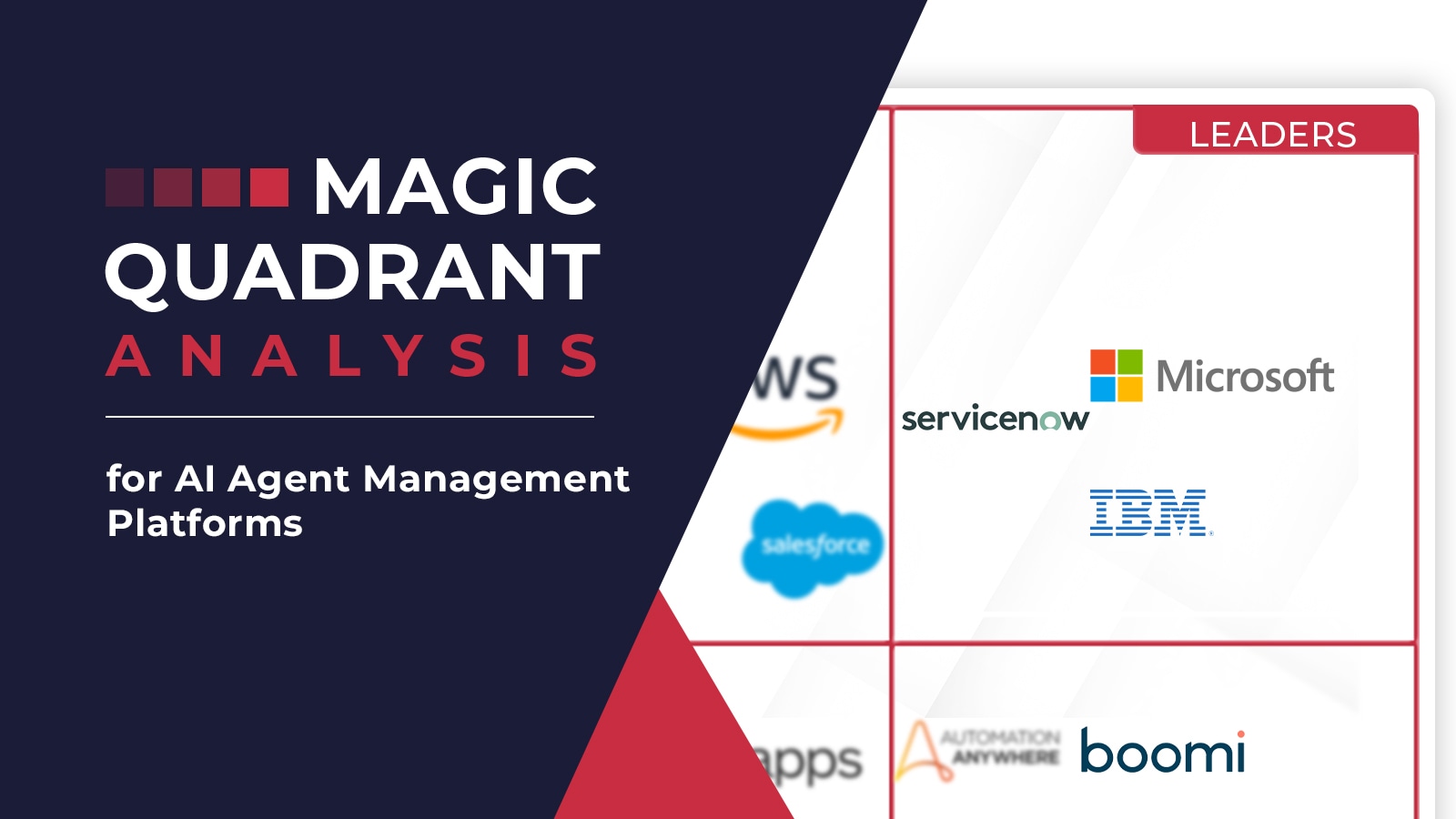
That is the gap Gartner’s inaugural Magic Quadrant for AI Agent Management Platforms aims to address.
The analyst defines these platforms as centralized tools for managing AI agents regardless of where they run.
They bring together security, governance, and FinOps capabilities, allowing companies to monitor a mixed estate of custom-built and marketplace agents.
Perhaps the most striking element is Gartner’s focus on “tokenomics”, the unit economics behind every autonomous decision an agent makes.
Gartner expects that, by 2029, 60% of AI agents will be managed through an agent management platform, while more than 35% of enterprise AI run budgets will be routed based on verified business outcomes.
In other words, agent management is quickly becoming less about keeping an inventory and more about preventing cost blowouts, compliance failures, and autonomous errors before they happen.
What Is an AI Agent Management Platform?
AI agent management platforms, or AMPs, provide a control plane for an enterprise’s agentic AI estate.
Key capabilities include agent discovery and registration, lifecycle management, guardrail enforcement, agent evaluation, identity and access management, integration controls, and cost tracking.
The best platforms also connect agent spend with actual business value, rather than simply reporting token consumption.
In a nutshell, it is relatively easy to launch an agent; it is much harder to prove that it delivers a return, behaves as intended, and does not introduce risk to other systems.
Let's take a look at how the vendors performed.
Gartner Magic Quadrant Leaders
The inaugural leaders are:
-
Microsoft
-
IBM
-
ServiceNow
Microsoft
Microsoft’s Agent 365 platform garnered plaudits for its deep links to Entra, Defender, Purview, Intune, Copilot Studio, and Azure. Gartner highlighted its identity-led approach, which gives agents nonhuman identities and applies access controls before they reach enterprise data and tools.
The vendor’s scale and ability to rapidly extend governance capabilities are also significant advantages.
IBM
IBM takes a Leader position with its combined watsonx Orchestrate and watsonx.governance proposition. Gartner praised its ability to tie agents and multi-agent workflows to measurable business outcomes, alongside its strong regulatory posture, including support for sovereign and air-gapped deployments.
The integration of orchestration, observability, risk, and compliance is another major strength.
ServiceNow
ServiceNow rounds out the Leaders. Gartner highlighted the vendor's capacity to treat agents, models, data sets, and MCP servers as managed configuration items, which allows the platform to tie them to owners, business services, risk processes, anGartner Magic Quadrant CCaaS 2026 Still Sells Influence, Not OutcomesGartner Magic Quadrant CCaaS 2026 Still Sells Influence, Not Outcomesd change-management workflows.
The Quadrant also praised ServiceNow’s broad discovery capabilities and its combination of risk, compliance, cost, and value analytics.
Gartner Magic Quadrant Challengers
The inaugural Challengers are:
-
Amazon Web Services
-
Salesforce
-
Gravitee
Amazon Web Services
AWS’s Bedrock AgentCore stands out for infrastructure-level security, with Gartner highlighting its Cedar authorization policies, runtime guardrails, and global serverless footprint, which includes GovCloud and sovereign cloud options.
Its frequent release cycle is another positive. Yet the platform is developer-centric and lacks pre-built vertical workflows. Companies managing agents outside AWS may also face additional integration work.
Salesforce
Salesforce’s Agent Fabric and Agentforce bundle gives customers a cross-platform control plane that can discover and govern agents across AWS, Microsoft, Google, ServiceNow, SAP, Snowflake, and other environments. Gartner also noted strong operational support and industry-specific governance frameworks.
The concern is cost predictability. Salesforce combines subscriptions, credits, and usage-based metering, which could create procurement challenges for large-scale, multistep agent deployments. .OneReach.ai
OneReach.ai has built its proposition around multi-agent orchestration, shared memory, and human oversight. Gartner praised its dedicated support model, 24/7 coverage, and fixed-capacity pricing, which may appeal to enterprises trying to avoid unpredictable token bills.