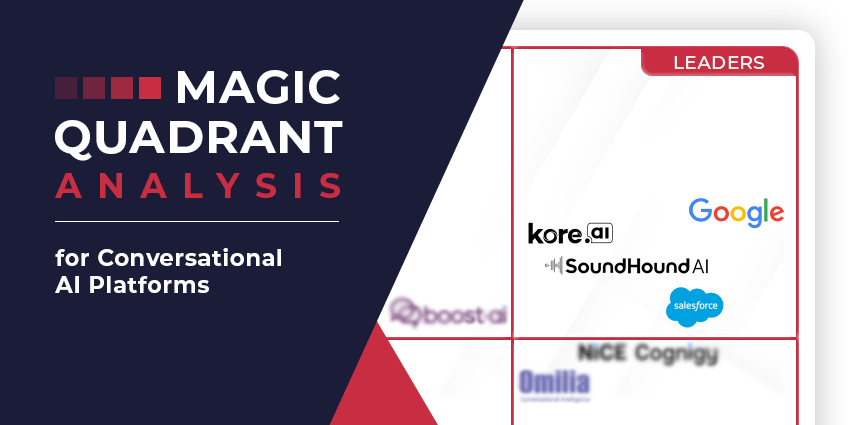
Gartner has published its 2026 Magic Quadrant for Conversational AI Platforms, and the market looks considerably different from a year ago.
Two new vendors have entered the quadrant – Salesforce and Netomi – with both landing in strong positions on debut.
Several others have shifted, sometimes dramatically: SoundHound AI has climbed from Visionary to Leader; Boost.ai, which sat in the Leaders quadrant just twelve months ago, has dropped to Challenger; and Cognigy, now rebranded as NiCE Cognigy following its acquisition, has fallen from Leader to Visionary.
LivePerson, meanwhile, has been removed from the report entirely.
That is a lot of movement for a single year. It reflects, more than anything, the continued disruption that generative and agentic AI is causing in a market still working out what maturity actually looks like.
What Is a Conversational AI Platform?
Conversational AI platforms enable businesses to build applications that simulate human interaction across voice and digital channels.
Modern platforms offer low-code and no-code builders, multimodal support, agentic AI architectures, and built-in analytics as standard.
While customer service automation remains the primary use case, most vendors in this year's report also cover employee experience, sales, and marketing automation – reflecting a broader ambition that has become standard positioning across the category.
Gartner evaluates 14 vendors across four quadrants: Leaders, Challengers, Visionaries, and Niche Players.
Here's how each fared:
Gartner Magic Quadrant Leaders
Leaders couple a broad, satisfied customer base with operational strength and a genuine commitment to innovation. They tend to set the pace rather than follow it. This year's Leaders are:
- Salesforce
- Kore.AI
- SoundHound AI
Google retains its place at the top of the quadrant for 2026, with Gartner considering its AI innovation capabilities to be in a different league from most of its peers.
Driven by Google DeepMind's advances in large language models and multimodality, its proprietary chip infrastructure gives it a scalability advantage few vendors can come close to matching.
Gartner also credits Google's breadth of AI operations, pointing to a wide range of educational programs and organizational capacity that exceeds most evaluated vendors.
Salesforce
Salesforce is a new entrant to the Magic Quadrant in 2026, making its debut directly in the Leaders quadrant. That's a significant opening statement from a vendor that has spent the past 18 months building out Agentforce with considerable noise behind it.
Gartner picks out the CRM giant’s pricing clarity as a genuine strength, with its transparent, tiered structure built around Agentforce Flex Credits providing buyers with a legible path to scaling consumption.
Its industry strategy is another plus, with over 300 prebuilt AI agent templates and vertical-specific solutions like Agentforce Health giving it strong cross-sector coverage from the off.
Kore.AI
Kore.AI retains its place in the Leaders quadrant and continues to earn it through product innovation. Its R&D investment stands out in the report, with proprietary tools like Arch and the Agent Blueprint Language offering builders something genuinely distinct from the standard low-code experience available elsewhere.
Service delivery is another core strength. SLA agreements that align with enterprise requirements, backed by a wide network of implementation partners, give it credibility beyond the product itself.
SoundHound AI
SoundHound AI's jump from Visionary to Leader is the most notable positional change in this year's report.
The vendor has spent the past year integrating capabilities from its acquisitions of Amelia and Interactions, and the results have been substantial enough to convince Gartner of a leadership position.
Its extended product suite, native ASR engine, and real-time voice-to-voice models give it a voice AI proposition that few in the quadrant can match. The move to a partner-first revenue architecture also reflects a strategic maturity that wasn't always evident in previous evaluations.
Gartner Magic Quadrant Challengers
Challengers bring solid execution and a dependable product, but they tend not to define where the market is heading.
This year's Challengers are:
- Netomi
- Boost.AI
Netomi
Netomi joins the Magic Quadrant for the first time in 2026 and lands straight in the Challengers quadrant.
Gartner outlined the vendor’s customer retention performance as a genuine differentiator, with retention rates that consistently outperform most competitors. Transparent pricing gets a nod too.
The concern is geography. The bulk of Netomi's customer base sits in North America, with limited presence in EMEA, APAC, and LATAM. For global enterprises thinking about long-term partnerships, that concentration is a limiting factor.
Boost.AI
Boost.AI's drop from the Leaders quadrant is the headline caution in this year's report.
The vendor's core strengths remain real. Professional services quality and rapid activation times rank among the best in the evaluated group, and its pragmatic, outcomes-focused approach continues to resonate with regulated industries.
However, Gartner raised some concerns about the vendor’s momentum: its customer base growth was more limited in 2025, its latest funding round was smaller than comparable investor-backed vendors, and its investment in fundamental research is relatively modest.
Gartner Magic Quadrant Visionaries
Visionaries demonstrate a clear understanding of where the market is heading, backed by an innovative roadmap. Where they often fall short is operational maturity, global reach, or execution.
This year's Visionaries are:
- NiCE Cognigy
- IBM
- Omilia
NiCE Cognigy
Cognigy appeared in last year's report as a Leader. A year on, under the NiCE banner, it sits in the Visionary quadrant.
Indeed, the acquisition itself is flagged as a source of risk, specifically the potential for roadmap deviations and R&D reductions that can follow a major corporate transaction.
The underlying product still commands respect. Gartner recognizes NiCE Cognigy's service levels across a broad range of deployment channels; its diverse cross-industry customer base; and its structured, customer-led R&D approach backed by patents filed in 2025.