Like every other part of the CX technology stack, the customer engagement market is being reshaped by AI. Gartner’s 2026 customer relationship management (CRM) Customer Engagement Center (CEC) Magic Quadrant suggests the next battleground is governed autonomy.
Vendors are now being assessed on their ability to connect customer engagement, case management, knowledge, workflows, enterprise data, and voice into platforms that can resolve service requests across the front and back office.
Yet, for buyers, the distinction between an AI assistant and a more autonomous AI agent may be largely irrelevant, Nerys Corfield, Director at Injection Consulting, told CX Today.
“I’m not convinced the predicted move towards governed autonomous resolution vs AI-assisted service changes much for CX leaders. For their customers it’s still a bot. They don’t know, nor care how autonomous it is; they just care if they have been understood and their issue resolved.”
The bigger question is whether businesses have enough confidence in their own data, decision-making, and operating processes to let AI act on them.
"What it does call into question is how much businesses trust their own decision-making processes enough to hand them over to AI," Corfield said.
"For years we have been talking about empowering the front-line advisors by giving them the authority to give credits based on data points, business rules and instinct. How many organizations have genuinely clear, consistent business rules with no ambiguity?" Corfield said. "So, before this is put into place they need to be assured about the robustness of the processes and data the autonomous (agentic) AI is let loose and they also need have defined—please let’s not let the success of autonomous resolution be confined to containment—the quality and fairness of the output should be front and center.”
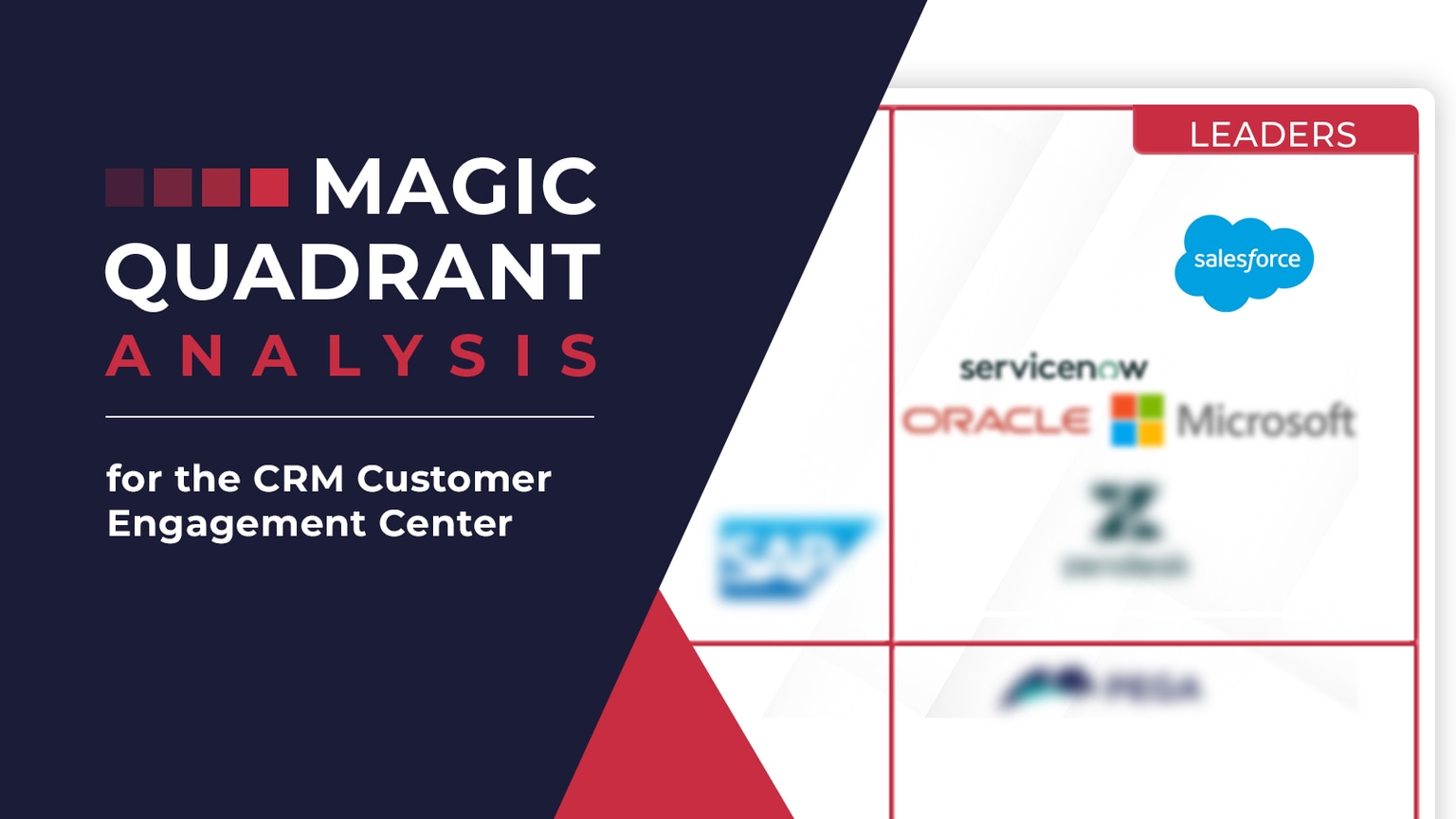
This year’s report places Microsoft, Oracle, Salesforce, ServiceNow, and Zendesk in the Leaders quadrant. SAP remains the sole Challenger, Pegasystems is the sole Visionary, while Creatio, eGain, Freshworks, and Zoho are positioned as Niche Players.
While the five Leaders remain unchanged from last year, Gartner’s focus has moved on considerably. Last year’s report captured a market being reshaped by agentic AI. In 2026, the emphasis is on governed production: whether AI agents can use trusted knowledge, take approved actions across enterprise systems, manage exceptions, and deliver measurable resolutions without sacrificing control.
The Definition of CRM Customer Engagement Center (CEC)
What is a CRM CEC? Gartner defines it as a cohesive software suite built around case management, designed to support customer service and intelligently orchestrate the processes, systems, data and resources required to fulfil a customer’s request.
More than service-ticketing systems, CEC platforms are the layer that connects external customer interactions, across digital and voice channels, with the internal work required to deliver an outcome.
To qualify as a CRM CEC, Gartner says vendors must offer core capabilities including:
-
Case management
-
Digital engagement
-
Knowledge management
-
Workflow and business process management
-
AI-driven engagement automation
-
Real-time intelligence
-
Intelligent voice support
-
A customer system of record
-
Platform ecosystem and integration capabilities
That broad definition perhaps explains the unusual mix of vendors in the quadrant.
“What a hotchpotch of vendors on this Quadrant. Broad enterprise platforms, workflow specialists, and service-focused providers—they are solving different problems, yet here they all mixed in the same quadrant," Corfield pointed out.
"But, if you feel sorry for Gartner trying to make the category hang together, spare a thought for the buyer trying to make buying decisions and get their CX solution stack to hang together.”
For buyers, the Magic Quadrant should not be read as a shortlist in itself. A platform’s position is less important than whether it supports the organisation’s existing data estate, operating model, service processes, and capacity to manage the technology.
Gartner Magic Quadrant for CRM Customer Engagement Center 2026: Leaders
This year’s Leaders are:
-
Salesforce
-
ServiceNow
-
Microsoft
-
Oracle
-
Zendesk
Salesforce
Salesforce continues to lead the market through Service Cloud, its broad CRM footprint, industry offerings, partner ecosystem and growing Agentforce proposition.
Its core strength is a unified customer platform that combines CRM data, workflow automation, and AI agent orchestration, according to Gartner. That gives organizations a common foundation for human-led and autonomous service, rather than treating AI as a disconnected add-on.
Salesforce’s industry strategy and global partner ecosystem are also differentiators. Its vertical applications include sector-specific objects, data models and workflows that can reduce the work required to build tailored service operations from the ground up. Clients can access industry extensions, prebuilt applications agent actions and specialist delivery resources, reducing the need to build every extension internally and speeding up deployment.
However, Gartner warned that sophisticated AI deployments may require a combination of Service Cloud, Data 360, MuleSoft, Digital Engagement and third-party services, which can complicate architecture and cost management. Consumption pricing for AI, data and automation also mean that organizations will need robust financial governance as volumes and automated resolutions scale.
ServiceNow
ServiceNow’s Customer Service Management platform remains a Leader thanks to its workflow-centric approach.
While many CEC platforms focus primarily on managing the customer interaction, ServiceNow is designed to connect that interaction to the operational teams, systems, assets, products and fulfilment processes needed to resolve it.
That makes it a particularly compelling option for complex cases involving multiple tasks, service levels, operational participants and back-office functions.
Recent innovations include CRM Workspace, ServiceNow Otto for agentic self-service and generative AI-supported service, and Super Intelligence Control Tower for cross-platform governance.
Yet, ServiceNow is more mature in service management and workflow orchestration than in broad front-office CRM. Organizations looking for one established platform across marketing, sales, service and contact center may need additional products or integrations.
Gartner also cautioned that implementations require disciplined governance. Some partners remain more experienced in IT service management than customer service operations, creating a risk that CX requirements are shaped too heavily by ITSM practices.
Microsoft
Microsoft remains a Leader, with Dynamics 365 Customer Service supported by a broad portfolio spanning Microsoft 365, Power Platform, Azure, Teams, Fabric and Copilot capabilities.
That shared architecture is a significant advantage for organizations that are already standardized on Microsoft technology, enabling customer service teams to extend established identity, security, collaboration, low-code, data and AI investments into their service operations.
Gartner also highlighted Microsoft’s global execution capacity and its ability to draw innovation from across its wider business.
However, the breadth of Microsoft’s portfolio can also create complexity. A complete CEC deployment may involve multiple products, administration models, consumption measures and licensing arrangements.
Buyers should ensure that their implementation partner has genuine experience across CRM, contact center, telephony, low-code development and AI, not simply broad Microsoft credentials.
Oracle
Oracle’s Fusion Service remains a Leader, particularly for large organizations with Oracle applications at the heart of their operational estate.
Its key differentiator is its connection to Oracle Fusion ERP, supply chain management and HCM. That shared data model allows service teams and AI agents to access operational context and execute selected actions without repeatedly switching systems or handing work across departments.
Oracle is also investing heavily in agentic capabilities, including Fusion Agentic Applications, AI Agent Studio and natural-language prompt-to-workflow functionality.
The strongest fit remains organizations already invested in the Fusion stack. While Oracle supports third-party integrations, its architectural advantage is strongest when customer service, finance, supply chain and workforce processes all run on Oracle.
Gartner also noted that several engagement capabilities, including some voice, digital, social and community features, may depend on third-party products and services.
Zendesk
Zendesk rounds out the Leaders quadrant with a clear focus on service engagement, workforce tools, and AI-powered outcomes.
The vendor continues to evolve from a ticketing platform into what it calls a resolution platform, combining AI agents, copilots, knowledge, actions, workforce management, quality management and omnichannel engagement.
Its strength lies in delivering a unified workspace for digital and voice interactions, according to Gartner, helping agents and AI maintain context as customers move across channels.
Zendesk’s AI strategy includes outcome-based pricing, while its roadmap includes Zendesk Bridge, a headless service capability intended to support external AI-agent integration.
However, Gartner noted that Zendesk does not provide the same depth of dynamic case management as platforms built around highly complex, long-running or exception-heavy processes.
That makes it best suited to organizations that want sophisticated omnichannel service and automation without adopting a broad enterprise application suite, rather than those requiring deeply recursive process orchestration.
Gartner Magic Quadrant for CRM Customer Engagement Center 2026: Challengers
This year’s sole Challenger is:
SAP
SAP remains a Challenger, with Service Cloud offering case management, omnichannel service and integration with SAP S/4HANA processes.
Its strongest differentiator is operational context. For organizations using SAP’s enterprise applications, service teams can access information related to installed products, warranties, orders, inventory and service activity, then initiate fulfilment work from within the service flow.
That makes SAP particularly relevant for manufacturing, utilities, wholesale distribution and other asset- or process-intensive industries.
SAP is also expanding its AI capabilities through a microservices-based architecture on SAP BTP, a Case Management AI Assistant and an AI-assisted service workspace.
Still, the vendor’s strategic advantage is strongest inside the SAP ecosystem. Organizations with alternative operational backbones may face additional integration work and less differentiated value.
Gartner also flagged a gap in native knowledge management depth, with advanced knowledge authoring, lifecycle management and AI grounding often requiring third-party technology.
Gartner Magic Quadrant for CRM Customer Engagement Center 2026: Visionaries
This year’s sole Visionary is:
Pegasystems
Pegasystems remains a Visionary, with Pega Customer Service focused on complex workflow automation, case management, real-time decisioning and governed AI.
Pega has long been a strong fit for highly regulated organizations with long-running, exception-heavy processes. Its platform brings together cases, rules, next-best-action decisioning and agentic AI within structured process controls, which is key as organizations look to move AI agents into production. Pega’s proposition is not just to automate tasks, but to ensure AI-generated actions remain subject to policy, workflow, and governance requirements.
Its latest innovations include Pega Infinity ‘26, Predictable AI Agents and Agentic Process Fabric with MCP workflow endpoints.
The trade-off is complexity, Gartner said. Pega deployments often require specialist architecture, case-management and decisioning skills that may be harder and more expensive to source than general CRM administration expertise.
Gartner also highlighted pricing transparency as a consideration, alongside the potential migration effort for customers moving to Pega’s Constellation user interface.
Gartner Magic Quadrant for CRM Customer Engagement Center 2026: Niche Players
This year’s Niche Players are:
-
Creatio
-
eGain
-
Freshworks
-
Zoho
Creatio
Creatio’s no-code platform gives it a differentiated position for organizations that want to change service applications, workflows and customer experiences without treating every update as a traditional development project.
Its Unlimited Enterprise packaging may also appeal to organizations looking to reduce user-based licensing friction as they extend platform access across the business.
However, Gartner noted that Creatio has fewer documented large-scale CEC deployments than the largest enterprise vendors. Buyers with complex multinational needs should also validate local delivery capacity, particularly in Asia/Pacific.
eGain
eGain stands out for its knowledge-first approach to service and AI.
Its proposition centers on governed enterprise knowledge, answer accuracy, compliance, traceability and AI quality controls. Tools such as eGain Evaluator are designed to assess retrieval quality, answer relevance, and grounding before changes reach production, making eGain an important consideration for knowledge-intensive and regulated sectors, according to Gartner.
However, it is less of a full CRM transformation platform than the enterprise suite vendors. Organizations with deeper requirements around account data, entitlements, transactions and operational context may need to integrate eGain with a broader CRM or enterprise system.
Freshworks
Freshworks continues to offer an accessible route into omnichannel service, AI-assisted resolution and service operations.
Freshdesk Omni provides core capabilities including case intake, service-level tracking, linked tickets and skill- or workload-based routing, with an emphasis on simpler administration and faster deployment.
Its Freddy AI roadmap is expanding into natural-language workflow creation, multistep simulations and agent-to-agent collaboration.
Yet Gartner believes the vendor remains better aligned to SMB and midmarket requirements than highly customized, multinational or regulated enterprise environments. Buyers should also account for the cost implications of higher-tier plans, AI add-ons and growing interaction volumes.
Zoho
Zoho Desk remains a value-focused option for organizations seeking ticketing, digital engagement, knowledge, self-service, automation and reporting through transparent subscription plans.
Its broad baseline functionality and comparatively low total cost of ownership are central strengths, particularly for standardized service teams and existing Zoho CRM customers.
Zoho is also pursuing agentic AI capabilities through Zia Agent Studio and its MCP Server.
However, Gartner noted that the vendor has less visibility in complex enterprise CEC deployments and a smaller high-touch professional-services footprint than the market Leaders. More complex cross-department workflows and integrations can also require additional development skills and tools.
Key Takeaways: The Shift from AI Assistance to Governed Autonomous Resolution
The Real Buying Challenge Is in the Joins
The collective cautions attached to the vendors are perhaps more revealing than their positions on the chart. Across the field, Gartner identified complex integrations, fragmented administration, uneven partner expertise, specialist skills requirements, and costs that rise as organisations add more products, capabilities, and AI consumption.
“The collective cautions for these vendors are revealing; complex integration, fragmented administration, variable partner expertise, specialist skills required and costs that keep growing extra limbs. Buyers need to start with the customer issues they need to resolve, the processes behind them and the systems they already have. Then establish what works today, what needs another product and who takes responsibility when the joins come apart.”
Voice is a particularly important test. Gartner lists intelligent voice support as a mandatory CEC capability, but the report also flags third-party dependencies or gaps in advanced voice and telephony capabilities for several vendors.
“Fragmented workflows across end-to-end customer experience lead to unnecessary points of potential failure, overlapping costs and differing views on product responsibilities. This quadrant and the CCaaS quadrant need to come together sooner rather than later. Buyers are trying to deliver one customer experience across both. Offering native voice is a start, but it does not automatically give you an established voice routing engine or the ability to orchestrate interactions across bots, people and channels. Buyers need to test those claims against real customer journeys, including when things go wrong. A telephone icon in a demo is not sufficient evidence.”
Key Takeaways: Prioritise a Top-Right Customer Experience
Gartner’s 2026 CRM CEC Magic Quadrant makes clear that the market is moving beyond managing conversations and towards orchestrating resolutions.
Generative AI has already improved agent assistance, response drafting, interaction summaries, and knowledge retrieval. The next phase is AI agents that can use trusted knowledge and customer data, invoke approved actions, follow business rules, manage exceptions and hand work back to human employees without losing context.
But the question for CX leaders is whether the organization has the process clarity, data quality, governance model, integration architecture and in-house capability to make agentic AI useful and fair in production.
This is especially relevant for organizations that sit between the smallest, most standardized service operations and the largest enterprises with deep technical benches. As Corfield noted:
“Spare a thought for the lost middle: organizations with complex customer needs but without an army of architects and administrators. A globally regarded, top-right solution can be an expensive way to acquire complexity they cannot support. The ambition should be a top-right customer experience. Customers won’t admire your position in a quadrant while chasing you for the third time.”
Gartner estimates that the global CRM customer service and support software market generated $47.4BN in vendor revenue in 2025. It forecasts end-user spending will rise from $48.8BN in 2025 to $84.2BN by 2029.
The opportunity is substantial. But buyers should begin with the real customer problems they need to solve, map the processes and systems behind them and test vendors against complete customer journeys; particularly the moments when automation fails, an exception arises or a customer needs to reach a person.
Discover more CX Today rundowns of other Gartner Magic Quadrant reports below: