

Community budgets are heading into 2027 with a strange mismatch. CMX found that barely 17% of respondents to its value-confidence question could quantify their communities’ business impact, down from 24% last year. Another 40.7% named proving ROI as their biggest budget challenge, according to Bettermode’s breakdown of the 2026 report.
Meanwhile, Gartner’s client inquiries about customer communities rose 33% year over year through March, according to Gainsight. That leaves a question nobody wants from finance: if our platforms know so much about customers, why can’t we prove what our communities are worth?
Gainsight’s been adding some interesting connections. Its Forethought AI Agent integration became generally available to eligible Customer Communities customers on October 14, so members can ask more questions or escalate to support without starting over. On October 19, Customer Communities MCP followed, allowing authorized employees to examine performance and work with content through AI assistants. I can see the appeal, but I’d still want figures showing how often customers found answers and avoided another support call.
CMX’s 2026 Community Industry Report makes that more important. AI use jumped from 81% to 93%, and 84.5% called community critical, yet only around 43% expected budgets to grow. As CMX put it:
“The data exists. The story doesn’t, yet.”
CMX surveyed 305 professionals, although only 174 answered the value-confidence question. This year’s budgets split sharply too: 36.6% reported increases, while 22.8% reported cuts. That’s why the question-level sample deserves a place alongside the headline percentage.
For community measurement in 2026, I’d focus on whether customers actually got help and whether the contact center avoided work. Those are the community ROI metrics I’d defend when the 2027 budget conversation gets uncomfortable.
How Do You Measure Customer Community ROI?
I’d start by asking: can we explain exactly how we arrived at that number?
Gainsight’s Community MCP can surface engagement, response times, content performance, and user behavior through natural-language questions. Handy when you’re digging into results, but Gainsight still points customers to dashboards and Data Lake exports for audited, period-locked figures. An AI answer isn’t automatically a finance-ready report. Its October 14 MCP update also added content creation, idea management, and moderation tools. Useful, provided someone measures the hours they actually save.
September 24 brought a better warning. Gainsight added Product Update content to its default Self-Service Score calculation and told customers their existing scores would change. Admins can reverse it, but imagine celebrating improved self-service with finance before discovering the definition changed halfway through the reporting period.
Khoros has its own cautionary examples. Communities 26.6 release notes describe Scheduled Rules reporting success despite finding no matching members, alongside mishandled private-message deletion events in analytics. Fixes are welcome, although a successful automation log still isn’t proof a customer got help. Aurora’s Metric Explorer and Search Analytics were scheduled for staging tests October 19–20, ahead of a planned November 3–4 production rollout requiring testing and enablement.
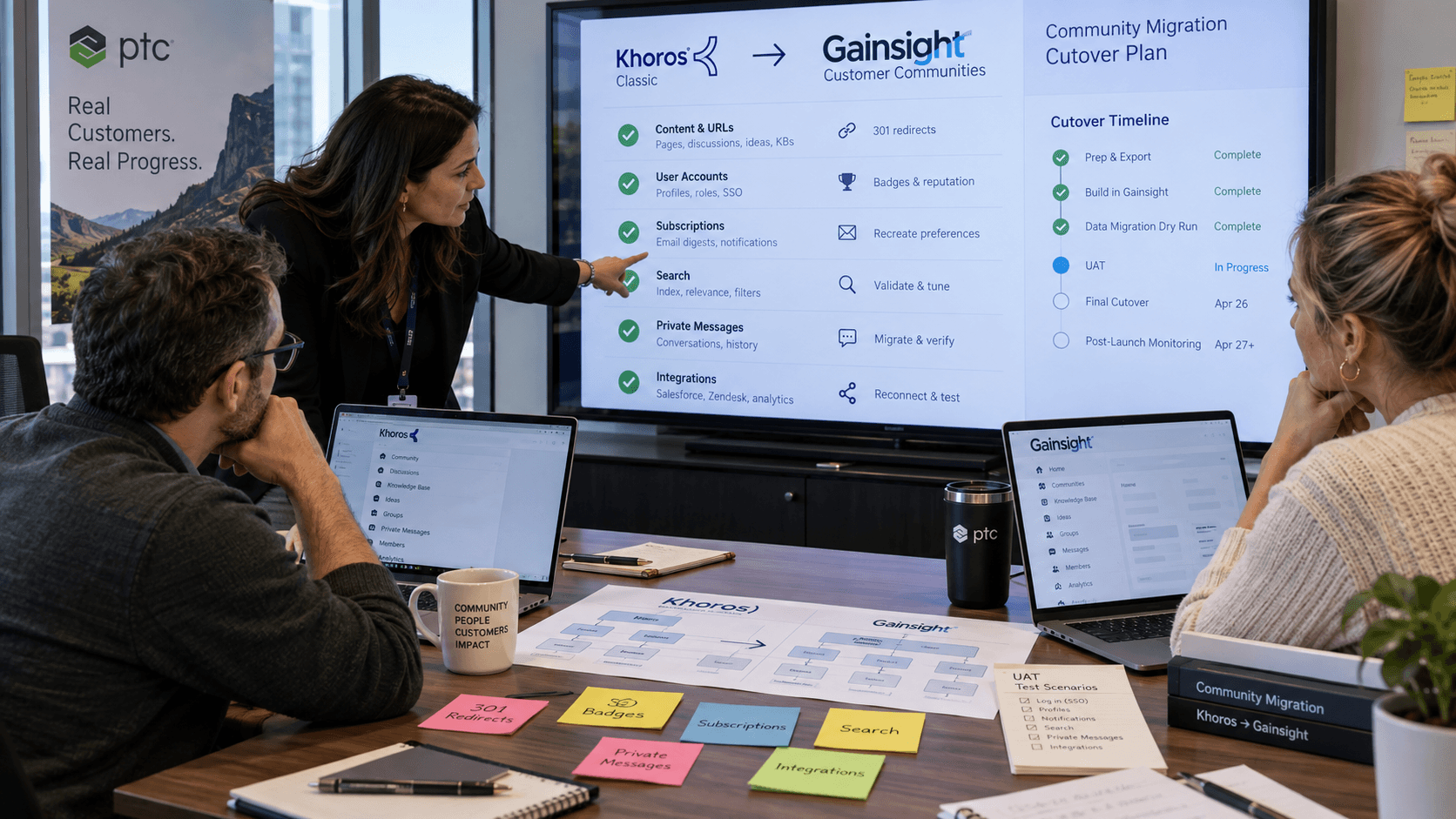
We’ve already covered how to measure community ROI through support costs, retention, and product adoption. The tougher question now is how much confidence those numbers deserve, particularly after a platform migration changes what gets counted.
I’d separate financial proof from correlations and operational indicators, then check what’s included, what’s excluded, and whether definitions have shifted. If I can’t reconcile the figure with support records, I’m not putting it in front of the CFO.
Which Community ROI Metrics Do CFOs Trust?
There are five community metrics I’d feel comfortable taking into a budget meeting. Although I’d bring the calculations too.
Verified peer-support value comes first. Show which problems customers solved and how many would’ve otherwise reached support. A thousand thread views might look wonderful, but they don’t mean you’ve saved a thousand tickets.
Community-influenced revenue deserves a place, provided we’re careful with the credit. If members renew or expand more often than comparable customers, investigate. Claiming community influenced every account that visited a discussion? Good luck defending that one.
Gainsight’s Oleeo customer story projects over $245,000 in first-year ROI potential, partly from an anticipated 20% reduction in certain support inquiries. Reasonable for planning, but projected savings aren’t money already saved.
Adoption or customer-health differences can tell us more. Are community members onboarding faster or using features they’ve actually paid for? CMX’s 2026 figures, summarized by Bettermode, found 57.6% of teams with CRM-connected community data rated their communities highly successful, versus 30.6% without CRM. Interesting, although that’s a self-reported correlation, not proof of causation.
Time to first useful answer is another favorite. A response in thirty seconds sounds great until the customer spends another hour finding a fix.
Then there’s contributor concentration. If three regulars provide most accepted solutions, what happens when they disappear?
Those last two measure service quality and operational risk. I’d bring them to finance, but I wouldn’t sneak either into a dollar ROI total.
What Is Peer Support Deflection Worth?
Peer support deflection is worth the support work customers genuinely avoided. Proving they’d have opened a ticket without the community is harder.
Zendesk’s October 7 analysis of 165 million intent-labeled tickets found 25% of incoming traffic was administrative noise, including spam and system notifications. Of genuine requests, 49% involved repeatable tasks and 31% stemmed from problems elsewhere in the business. Communities can handle routine questions. Claiming they prevented every billing mistake or delivery failure is pushing your luck.
There’s another reason not to celebrate deflection too loudly. Zendesk’s October 11 follow-up found 73% of its identified high-value interactions involved potential retention opportunities. That’s a specific subset, not all tickets. Sometimes a quick escalation is worth more than a tidy deflection rate.
CData’s Gainsight case reports over $650,000 in support savings, assuming roughly $200 per case and one avoided ticket per ten pageviews. Community manager John Summers agreed the case cost with finance:
“As a mid-sized company, those are significant savings for us.”
I’d still challenge that one-in-ten assumption. As Gainsight acknowledged in September, someone who abandons a search can look just like someone who got their answer. Neither necessarily opens a ticket.
For peer support deflection, I’d calculate:
Verified peer resolutions × credible would-have-contacted-support rate × avoidable cost per resolved case
That’s modeled gross value. Subtract platform, staffing and moderation costs, then divide net benefit by the investment and multiply by 100 for ROI.