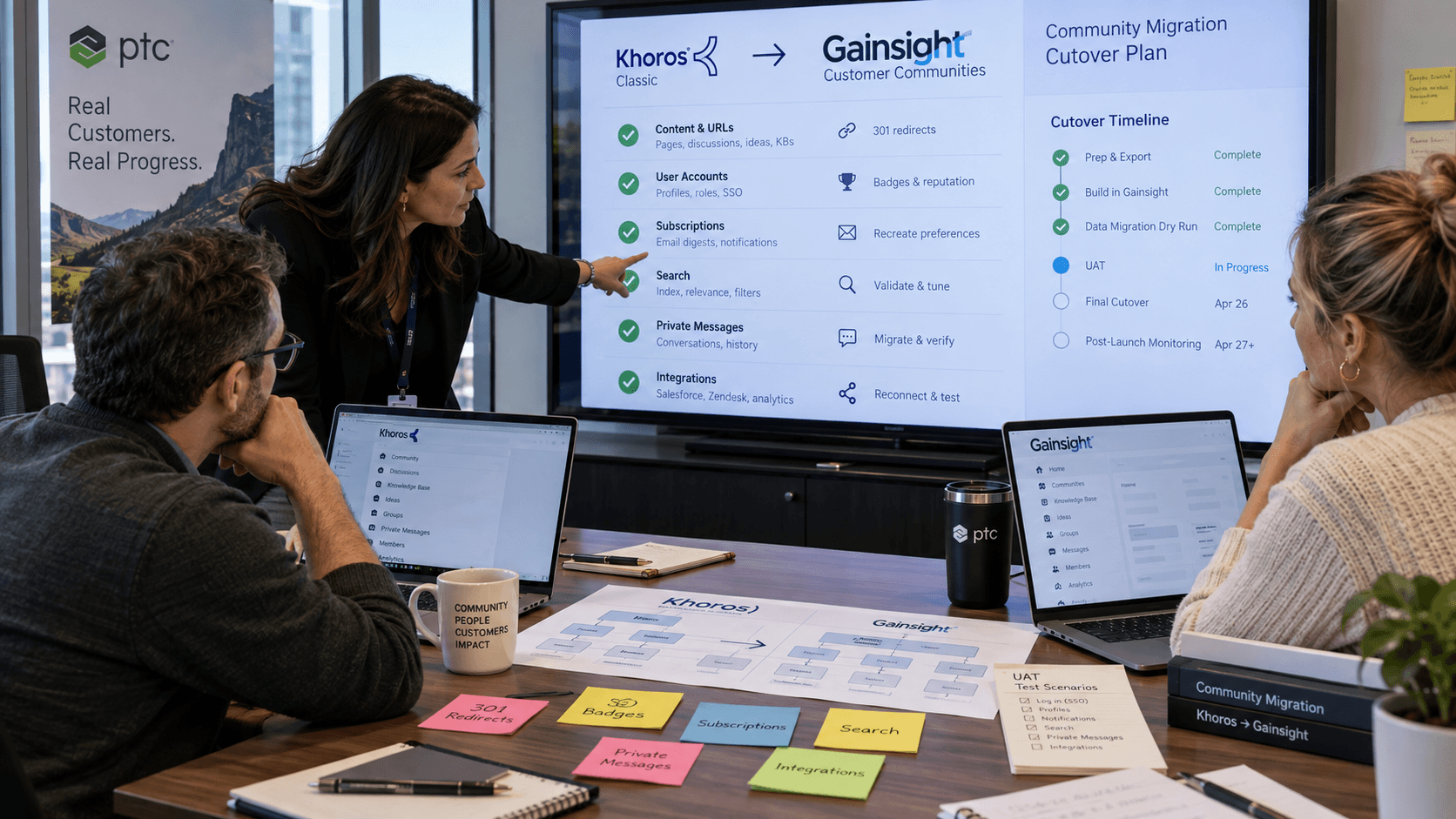
There’s a pretty odd fight happening among customer community platforms. Gainsight wants Khoros customers to leave, while Khoros wants Classic customers moving internally to Aurora AI.
Khoros Communities 26.5 finished rolling out on September 23–24, adding new Aurora capabilities, although some headline features remain in Early Access. Khoros is also offering Classic customers free migration services to Aurora AI through the end of 2026.
Then there’s Atlassian. On September 22, Atlassian Forums moved from Khoros to Higher Logic Vanilla after its previous platform contract ended. Atlassian called it a platform migration, “not a feature-for-feature upgrade.”
Technically, the move went well. Atlassian says more than 99.5% of topics and replies migrated and were validated. Yet redirects, image permissions, profile statistics, and follows still needed attention.
Atlassian summed it up, saying:
“We moved houses, not renovated.”
That’s the warning for buyers. Strong data migration doesn’t guarantee a familiar member experience.
PTC’s Khoros-to-Gainsight move had already shown how subscriptions, messages, and media can change during migration. Atlassian adds another enterprise example. Its forums spent at least 10 days in read-only mode, and a September 29 update still listed follows to rebuild, profile-stat fixes, Loom issues, and missing search alerts.
That isn’t evidence of a failed migration. It shows how member routines, and even familiar community metrics, can change after the archive arrives.
Why Are Companies Migrating From Khoros to Gainsight?
The answer to that will depend on who you ask, but it seems like most Companies are moving from Khoros to Gainsight mainly because they want community tied more closely to customer success, retention, and product adoption. Khoros’s acquisition by IgniteTech in May 2025 has also prompted some enterprises to reassess their platform strategy.
Gainsight says it has completed more than 25 Khoros migrations. That’s vendor-reported, but it’s demonstrative of the wider replatforming trend, as is the fact that Atlassian recently chose Higher Logic Vanilla for its community strategy instead of Khoros.
Interest in customer communities is picking up. Gainsight recently pointed to Gartner data showing inquiries rose 33% between April 2025 and March 2026. As communities take on more support work and influence more buying decisions, buyers aren’t only looking at what happens inside the platform. They want to know where all that customer context goes next.
That’s where Gainsight has the best pitch. Its September 24 release added automatic community-role assignment from customer-success data, while mapped profile fields can sync every four hours.
FeverBee’s Richard Millington describes Gainsight CC as built to run community “as a customer success engine rather than a marketing channel.” For teams measuring community against retention or adoption, that tighter connection may matter more than recreating every legacy feature.
None of this means Khoros is giving up. In April, we covered the launch of Aurora and Iris AI, where Eric Vaughan argued:
“AI answer engines are rapidly widening the gap between market leaders and those failing to understand the changes required to keep up.”
So the choice isn’t between an active platform and a dead one. It’s between different ideas of what community should become next.
The destination market is broader, too. Millington says Gainsight, Higher Logic Vanilla, and Discourse are the Khoros alternatives he sees most often. It’s practitioner observation, not market-share data, but it reinforces the wider replatforming story.
What Does a Community Platform Migration Cost?
We talk a lot about community ROI, but migration costs deserve just as much attention. The obvious ones are licensing, technical work, and staff time. PTC’s Khoros-to-Gainsight move exposed the less visible bill: the habits, signals, and routines members expect to survive.
After reopening, PTC temporarily used pre-moderation. Private messages didn’t transfer, hosted videos had to move onto PTC servers, and some subscriptions needed rebuilding. Existing badges came across, but some kudos badges disappeared, and changes to the ranking system meant individual ranks could shift.
PTC preserved old thread links with permanent redirects, but it’s worth remembering data can migrate while the experience around it changes. That doesn’t mean the migration itself went badly. PTC moved 15 years of community history and launched on its three-month timeline. Technical lead Andy Kenefick said:
“It was a really pleasant surprise how smoothly everything went.”
So, that tells us a well-run technical migration can still leave members adjusting to changed subscriptions, rankings, or routines.
There’s also the question of what should move at all. Gainsight’s September guidance says, “The goal is to migrate as little as possible.” It’s vendor advice, but the principle holds. Stale or duplicate material can make search worse and leave AI answer tools working from noisier source content.
Gainsight calls the member friction around a move the “migration tax” and argues that teams should plan the first 90 days before they plan the migration itself. Its September 9 guidance treats recovery as a workstream, with an owner, measurement plan, and extra launch capacity ready before members arrive.
What Should Be on a Community Platform Migration Checklist?
A migration checklist can get very technical very quickly. Posts, permissions, redirects, integrations. All important. But the better starting question is simpler: what are members used to having today that they’d complain about losing tomorrow?
PTC’s move makes that pretty clear. The archive is only one part of the job. Before signing anything off, somebody needs to own each of these:
-
Export: Do posts, DMs, attachments, subscriptions, reactions, and audit records actually leave the old platform?
-
URLs: Which links will change, and who’s checking redirects after launch?
-
Identity: What happens to profiles, ranks, badges, and accepted answers?
-
Media: Will videos and embeds survive intact?
-
Search: Can members still find the same answers afterward?
-
Operations: Does anything go read-only or move behind pre-moderation during cutover?
-
Connections: Will CRM, support, SSO, education and analytics keep behaving as expected?
-
Recovery: If traffic or participation drops, who spots it and what happens next?
There’s another AI consideration now too. Migrated content may end up feeding answer engines, which means broken permissions, stale material and dead citations become more than housekeeping problems.
Regulation belongs on the same list. Discord changed its age-assurance model on September 22 while Brazil’s ANPD kept its live-video suspension in place. Access and moderation rules can change underneath the platform.
One last question is worth asking: can the team test member-facing changes before launch? Gainsight’s September 30 newsletter says Feature Previews can trial selected structural, CSS, and layout changes in sandbox first.
How Should You Judge the Destination Platform?
Migration due diligence shouldn’t stop at whether the data fits; the destination has to suit the community you actually run, and the one you plan to build next.
Start with the operating model. Richard Millington’s FeverBee review says Gainsight CC’s place inside the wider Gainsight ecosystem “cuts both ways.” For B2B teams tying community to customer success, that connection can be valuable. Gainsight reinforced it on September 24 by adding automatic community-role assignment from CS data, followed on September 25 by multiple SSO options and automatic image moderation.
But integration depth usually comes with trade-offs. As Millington puts it:
“You give up flexibility to get something faster to stand up and harder to break.”
That’s why buyers need to compare workflows and integrations with the community’s actual business case, rather than judging platforms on feature volume.
Khoros 26.5 gives us another example. Its federated search can reach sources such as Confluence and internal knowledge bases, with Answer Assist expected to use those sources later. The destination decision increasingly affects how community content feeds enterprise search and AI answers, not simply how the forum looks.
Buyers will need to ask which workflows, integrations, and future use cases the platform is being built around, then compare those with the community’s actual business case. I’d recommend checking our guide to measuring customer community ROI here. Decide which business result the migration is supposed to improve before judging the software.
How Much Weight Should Buyers Give the Roadmap?
A roadmap can tell you plenty about where a platform is headed. It can also make tomorrow’s features look suspiciously close to today’s. That’s why buyers need to separate what is generally available from what still sits in Early Access, Beta, or a future release.
Federated Search in Khoros 26.5 is a good example. It’s currently available through Aurora Early Access behind a feature flag. The feature re-checks source permissions for each viewer and can hold back external results until cookie consent is given where required. That’s useful progress, but Early Access still isn’t the same buying proposition as a feature every customer can switch on today.
The same test applies to Gainsight. Its September 29, 2026 update puts the Community MCP Server in Beta, while Jira integration, direct-message moderation, AI Widget Builder, and MCP GA are still ahead. AI profile moderation and the Forethought integration have already shipped.
There is useful evidence of what admins can work with now, too. Gainsight’s September 30 newsletter points to MCP workflows for pulling out insights, drafting responses, and building dashboards from community data.
For buyers, the test is pretty simple: does the platform fix the problem you’ve got now, and is it heading somewhere that matches what you expect your community to become?
Is the Customer Community Platform Market Consolidating?
Yes, although ownership is consolidating faster than buyer choice. Acquisitions have been happening for a while. Gainsight acquired inSided in 2022, Higher Logic bought Vanilla in 2021, and IgniteTech acquired Khoros in May 2025.
Yet Gartner’s May 2026 Market Guide still identifies 10 representative B2B customer community vendors. The market is concentrating, but it hasn’t collapsed into a handful of destinations. Atlassian choosing Higher Logic Vanilla reinforces that point. This isn’t a straight slide from Khoros into Gainsight.
Khoros still has considerable scale, too. It says its technology has powered more than 4,000 community deployments since 2001, while its current strategy brings community together with social and brand care. Those are Khoros-reported figures, but they help explain why the competitive fight goes beyond forum features.
Probably the more interesting thing is what these platforms are becoming. Gartner now describes integrations with CRM, customer-success, LMS and support systems as part of the market’s capability set, while federated search is already a recognized self-service feature.
Khoros 26.5 makes that direction tangible. Its federated search can reach sources such as Confluence and internal knowledge bases, with Answer Assist expected to use federated sources later.
That race is broader than Khoros and Gainsight. Higher Logic Vanilla already exposes live community data through an MCP server governed by existing user roles and permissions. Discourse followed on September 18 with its own built-in MCP server, again keeping access within the permissions the user already has. For migration teams, permission portability is starting to matter alongside content portability.
So consolidation isn’t simply reducing the number of logos on a shortlist. It’s creating larger platforms competing to own more of the customer knowledge, engagement, and intelligence layer around community.
Where Is the Value of Community Data Moving?
The knowledge inside communities is becoming more valuable outside the community platform itself. We recently pointed out that nearly half of shoppers verify AI recommendations on Reddit before buying. Reddit also says one in four redditors buys immediately after seeing a decision validated there. That’s a good insight into the value of portability right now.
Community conversations can now feed search, AI answers, revenue systems, and customer intelligence long after the original discussion. Common Room shows where that is heading. Zoom completed its acquisition in July and made Common Room by Zoom available through its AI-powered revenue OS in September. Its architecture combines community and social activity with product usage, CRM and customer data, turning conversations into signals attached to people and accounts.
As Zoom’s Abhisht Arora put it:
“We’re extending Zoom’s system of action upstream.”
PTC shows what that looks like after a migration. Gainsight says PTC had its Communities MCP server and a custom Copilot agent running within days, giving product managers access to insight from community conversations.
Gainsight is pushing that model further. Its September 15 Agentforce and Slack announcement says MCP workflows can span Customer Success, Skilljar, Customer Communities and Product Experience. Its September 29 Skilljar showcase also previews recommendations built from learning and community signals.
The catch is measurement. CMX’s 2026 report says 93% of community professionals now use AI, while confidence in proving ROI has fallen.
That makes pre-migration baselines more important. If community data is going to influence systems beyond the forum, teams need to know which numbers they trust before the move.
Should You Migrate Your Customer Community Now or Wait?
The question is less “when to migrate” and more “what would make staying more expensive or limiting than leaving?”
Gainsight expanded Community and Knowledge Base structures to five levels on September 17, then added CS-based role assignment, more flexible SSO, and automatic image moderation on September 24–25. Interestingly, its own documentation says:
“Gainsight recommends capping structures at three levels, or four at most.”
That caveat matters because more features aren’t enough on their own. A migration needs a reason. Maybe the current setup is blocking a business goal, important integrations need constant patching, or the daily friction for members and admins has become expensive enough to hurt.
Waiting can make sense when the existing platform still supports the community you run and current releases are addressing the problems that matter. Khoros completed its 26.5 rollout on September 23–24, although some Aurora capabilities remain in Early Access.
The next near-term checkpoint comes quickly. Pulse Europe runs in London on October 19–20, with Customer Community sitting alongside Customer Success and Education on the agenda. Any new CC roadmap detail or migration numbers there will be worth checking if this piece is updated after publication.
My view? These platforms are moving too quickly for a migration decision based on last year’s headaches. Waiting isn’t the risk. Waiting without knowing what would make you leave is.
How Should You Measure a Successful Community Migration?
A successful migration needs a better test than whether the content arrived intact. Before launch, establish baselines for the behaviors that matter: can members still find useful answers, follow the right spaces, recognize their status, and continue contributing without unnecessary friction?
That’s where PTC and Atlassian are useful examples. Both show that technically successful transfers can still change the routines surrounding the content.
For enterprise community management teams, I’d watch how much normal member behavior survives the move, alongside whatever business outcome justified the migration in the first place.
Traffic and content volumes matter, but they don’t tell the whole story. A community can preserve years of discussion history while losing some of the learned habits that made it useful.
That’s what makes the current Khoros to Gainsight fight worth watching. The biggest asset being moved isn’t really the archive. It’s the community that learned how to live around it.
FAQs
Why are companies moving away from Khoros?
There is no single reason. PTC’s published account points to concerns about strategic direction after Khoros’s acquisition, technical resourcing and an approaching renewal window. Atlassian cited degraded security and performance plus a contract deadline, then chose Higher Logic Vanilla rather than Gainsight. The common thread is reassessment, not one universal Khoros failure.
Posts can migrate while member habits do not. PTC had private messages that could not transfer, video and subscription changes, and altered ranking behavior. Atlassian preserved core content and reputation but old follows did not carry across. Teams should map identity, notifications, media, URLs and moderation workflows alongside the archive itself.
There is no reliable universal timeline. PTC moved 15 years of history and launched on a three-month schedule. Atlassian put its forums into read-only mode for at least 10 days during cutover, but the wider project included earlier planning and post-launch fixes. Content volume, integrations and identity mapping can change the timetable substantially.
A clean data transfer is only the first test. Establish pre-launch baselines for search success, member activity and whatever business result justified the move, then watch whether normal behaviors recover after cutover. The strongest proof is that members can still find answers and contribute while the community improves the outcome the business paid to change.