If you’re looking to support your sales or marketing team with the latest & greatest tech tools, then you’ve come to the right place.
Sales and marketing departments have entered a new era. One defined by rising customer expectations, fierce digital competition, and intense pressure on revenue performance.
As growth slows and investor scrutiny increases, commercial leaders must deliver more profitable and customer-centric outcomes. Technology now sits at the heart of that mission.
Long gone are the days of the salesperson with only charm in their utility belt. Modern sales teams are harnessing digital tools to personalize their message, deeply understand their target buyers, and streamline their own workflows.
When it comes to marketing, the modern buyer wants more than catchy slogans and tech demos. More independent than ever, buyers respond to marketers who can provide real data and relevant content.
This guide explores the capabilities, considerations, and opportunities within the evolving sales & marketing technology landscape. Its goal is to equip leaders with clarity, structure, and direction. To help them find the right tools to keep up – or dominate – in a competitive enterprise landscape.
This comprehensive guide will help you understand:
- What is Sales & Marketing Technology?
- The Key Trends Defining This Sector
- The Different Categories Within Sales & Marketing Tech
- What is in the Sales & Marketing Tech Stack?
- Why Enterprises are Struggling with New Tech Adoption
- Vendor Selection: How Do I Do It?
- 2030 and Beyond: The Future Trends Defining Sales & Marketing
- Where Do I Go to Find Out More?
Sales & Marketing Technology, Explained: The Engine Behind Modern Growth
Sales and Marketing Technology refers to a connected ecosystem of tools and platforms. Their aim is to help organizations attract, engage, convert, and retain customers across the full buyer journey.
Its purpose is to unite data, digital channels, and revenue teams so businesses can strengthen customer lifetime value.
In today’s competitive climate, technology has become the backbone of modern commercial strategy.
The New Rules of Revenue: Trends Reshaping Sales & Marketing
Analysts have identified three key areas where sales & marketing leaders are looking to improve – driving interest in new technology:
“CSOs must balance revenue generation with operational efficiency as investor demands rise.” - Gartner
“Leaders must prioritize improving revenue processes and customer-centric strategies.” - Forrester
“The 2025 trend to watch for is the Personalization Renaissance.” - Mintel
In other words, three capabilities have now become competitive differentiators. Better revenue generation, better personalization, and better processes among sales and marketing teams.
Forward-thinking enterprises have responded to these challenges in a similar way – harnessing artificial intelligence. Here are three recent case studies where these areas were addressed with new AI products.
- Better revenue generation:
- PWC identified one key differentiator enabling some marketing teams to deliver nearly 80% more shareholder value than competitors. Their trick? Harnessing and investing in AI.
- “Used narrowly, AI can make marketing less expensive - faster content, smaller budgets, leaner teams. Used strategically, it can make marketing indispensable - unlocking new growth, higher profitability, greater enterprise value”, it concluded.
- Top performing marketing teams were found to regularly invest in new AI-powered capabilities. This in turn generates revenue, and funds marketing teams to invest in more tools – creating a cycle of enterprise success.
- Better personalization:
- A European telecom company found that customers receiving personalized messages took action 10 percent more than those who received generic advertising materials.
- According to a 2025 McKinsey report, the company used GenAI to personalize messaging based on age, gender, and data usage.
- McKinsey reported that it has “seen some marketers deploy gen AI to personalize content development 50 times faster than a more manual approach”.
- Better processes:
- Enterprise IT platform Workday saw 3,500% ROI after adopting an automation solution for client contracts.
- By connecting data across platforms, the Workday team saved hundreds of thousands of hours in its global projects.
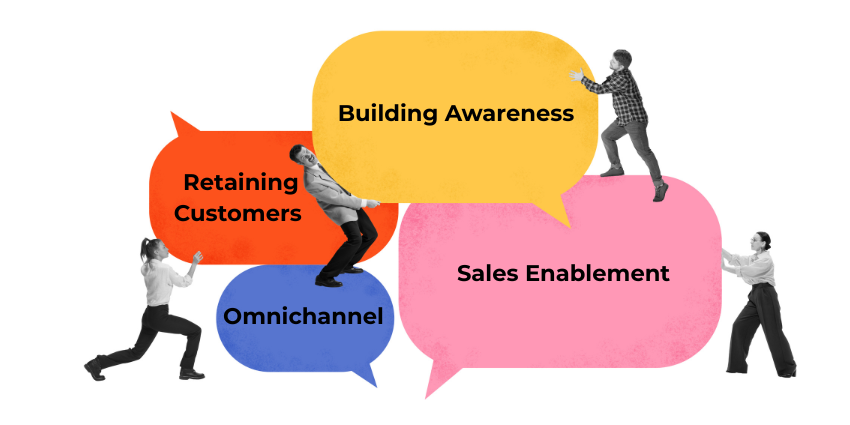
The Four Categories of the Sales & Marketing Technology Landscape
Whether you’re an inbound marketing expert, a sales team leader, or a CIO, you have an important role to play in harnessing and optimizing these technologies.
The team at CX Today have distilled this wide-range of products into 4 core categories.
- Building Awareness (Acquisition) Tools that help organizations attract attention, generate demand, and capture leads through content, campaigns, and data-driven targeting.
- Sales Enablement (Closing Deals) Platforms that empower sales teams with insights, automation, messaging, and training to shorten sales cycles and increase conversion.
- Retaining Customers (Client Success) Technology that strengthens onboarding, engagement, renewal, and advocacy - protecting recurring revenue and reducing opportunities for churn.
- Omnichannel Connection (Linking Everything Together) Integration and automation technologies that unify data to deliver consistent experiences end-to-end.
Your Tech Arsenal: Understanding the Tools That Fuel Revenue
Vendors are looking to support a broad spectrum of job titles within sales & marketing, with an aim to automate, optimize, and manage workloads. With the four categories as a dividing structure, here are some of the typical solutions that are found in the modern sales & marketing tech stack:
Building Awareness
This is the front door of the enterprise growth engine. Awareness tools help brands capture attention, generate qualified leads, and convert insights into pipeline opportunities.
- Social media and content sharing: These platforms look to generate leads through inbound marketing where interested readers are prompted to engage further with the brand. This is particularly valuable for industries that rely on thought-leadership to grow brand awareness, such as professional & business services (consulting, legal, accounting).
- Lead capture: This can include strategic forms where brands can gather intent data and contact details to set priority accounts for further marketing. It may also include web deanonymization, where brands can reach out to visitors to its site for sourcing potential leads.
- Smart webpages & content journeys: Modern customers want more independence and feel more confident doing their own research. These platforms can help personalize and enhance how customers reach the decision stage, providing relevant content without being overbearing.
- Related vendors: HubSpot, Hootsuite, 6sense, Uberflip
Still not sure how to define a 'martech tool' ? Not to worry, our handy explainer breaks down how to create the ideal customer journey with this technology.
Sales Enablement
Once awareness is established, sales enablement technology equips revenue teams to engage prospects intelligently and close business deals efficiently. This leads to shorter sales cycles and higher conversation rates.
- CRM systems: A strategic approach to converting sales relies on a centralized database which highlights opportunities, past interactions – in sync with the awareness-building marketing teams.
- Smarter sales pitches: Salespeople are in a stronger position to increase conversions when they have personalised decks, playbooks, and pitches. These solutions help manage and track these sales content pieces.
- Training and Coaching: These solutions put salespeople in a meeting with AI avatars, letting them practice their pitch in a risk-free environment. And after a genuine sales meeting, they can analyse transcripts to find areas for improvement.
- Related vendors: Highspot, Seismic, Showell, Microsoft Dynamics 365
Want to find out more about the power of sales enablement technology? Check out the 5 Superpowers of the Sales Copilot.
Retaining Customers
Retention and expansion are now as critical as acquisition. Customer success technology ensures that value delivery continues beyond the sale, and helps Chief Revenue Officers to better predict financial forecasts.
- Customer Success Platforms: With data analytics and dashboards, these solutions can help client teams to understand the health of the accounts they manage. From there, they can upsell promising accounts or prevent churn.
- Product Usage Analytics: One of the core ways to retaining customers is to ensure their onboarding and usage is going smoothly. These tools track this information and enhance the work of support teams who address problems.
- Post-purchase communication tools: Once customers are onboarded, client teams can use a lifecycle communication tool to keep customers engaged and prime them for upsell pitches.
- Related vendors: Qualtrics, Amplitude, Totango, Braze.
Is customer churn your biggest concern? Read our best practices guide for harnessing data analytics and retaining key customers.
Omnichannel Connection
The final layer - and the most transformative - focuses on unifying data and experience across the organization. These platforms make marketing, sales, and service work as a single, insight-driven system.
- Customer data & identity management: With these intuitive systems, client teams have a top-down 360° view of all customer touchpoints. This enables personalized content and predictive insights across the client journey.
- Smarter digital engagement: When clients communicate with a company’s AI bots or human agents, omnichannel systems enable seamless conversations across sessions and channels.
- Integration & automation layers: Acting as the connective tissue itself, these tools enable information to automatically flow to the right places and at the right times, feeding the 360° vision.
- Related vendors: Salesforce, Zeta Global, Sprinklr, Zapier.
Omnichannel success comes down to a unified customer experience. Check out our deep dive into when Marketing, Sales & Service finally connect.

Mind the Gaps: Adoption Pitfalls That Can Stall Your Tech ROI
While these solutions can open new doors for marketing & sales teams, adoption is not always a straightforward path. And the stakes are high.
Putting aside financial consequences for the business, members of a buying committee may lose credibility if they support a purchasing decision that later fails to bear fruit.
Going one step further, an unsuitable adoption journey can spark a negative reaction from customers, regulators, and investors.
Vendors often pitch that their tools are simply ‘plug and play’. The reality is that enterprises must consider these adoption challenges:
Privacy and first-party data:
Concerns around user privacy have been growing steadily, and this has resulted in a clamp down on legacy forms of data collection, such as third-party cookies.
- Marketing teams today are expected to comply with all new privacy regulations. They should aim to responsibly collect consented data while fostering valuable personalization.
- Enterprise buyers must consider GDPR, CCPA, and other AI regulations – or risk the resulting backlash.
Preventing underutilization:
A 2022 study from Gartner found that marketers were only utilizing 42% of their martech stack, a 16% drop from two years prior. The most common reason for this was an overlap of tech solutions, rendering part of the stack obsolete.
- With this in mind, sales and marketing teams can first consider how legacy solutions can be upgraded. Implementing a whole new solution may result in waste and underutilization.
Employee satisfaction and skills:
One of the most common adoption challenges across every aspect of tech is ensuring the satisfaction of the humans that will be interacting with it day in and day out.