The contact center technology market is crowded, with more players from a CRM, UCaaS, and even CPaaS heritage sensing an opportunity to win business in the space.
Most, if not all, are banging the AI drum. In 2024, some thudded much harder than others. Yet, in 2025, AI integration is much deeper in the tech stack and more consistent across vendors.
The use cases aren’t surprising, including self-service, AI assistance, conversational intelligence… these were all big last year too, but now are more embedded and refined.
Still, some are ahead of others, but the gap in terms of capability is closing, and spotting what sets the vendors apart gets trickier.
Against this backdrop and the explosion in contact center options, the ISG Buyers Guide goes deeper into the changing market and the vendors leading from the front.
ISG’s Inclusion Criteria and Methodology
 ISG prides itself on offering a broader scope of the contact center industry, evaluating 33 vendors, which all provide technologies that route customer interactions to human and AI agents.
All evaluated providers offer that base capability, agent desktops, and other "elements of yore". Yet, ISG also honed in on the "expanded universe of tools that support and extend" the modern contact center platform.
Those include advanced analytics, conversational AI for self-service, knowledge management, and workforce optimization (WFO) tooling.
Either through first- or third-party systems, there are potentially hundreds of vendors that meet these requirements. So, ISG also specified that providers must have at least $50MN in annual or projected revenue, 50 employees, and 25 customers spread across two or more continents, alongside other criteria.
With its shortlist of vendors, ISG evaluated each across seven core categories. The first five relate to the product experience:
- Adaptability
- Capability
- Manageability
- Reliability
- Usability
The final two relate to customer experience:
- Validation
- Total Cost of Ownership/Return on Investment (TCO/ROI)
In doing so, ISG sorted through product demos, documentation, and a lengthy questionnaire to score the participants, shedding light on how their offerings match up.
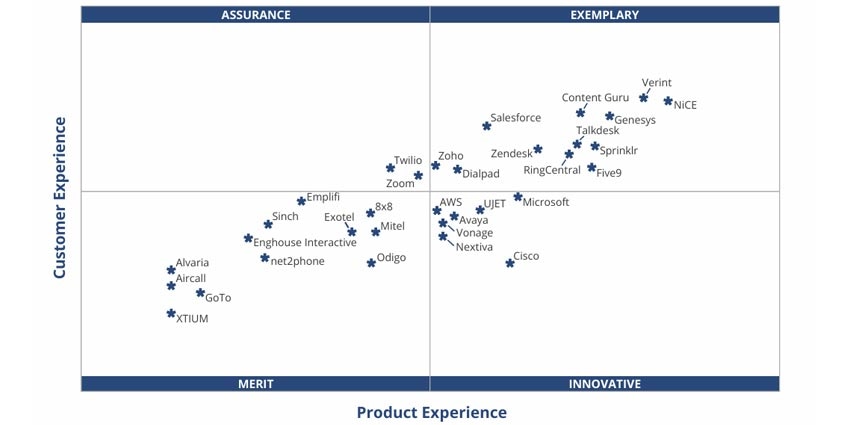
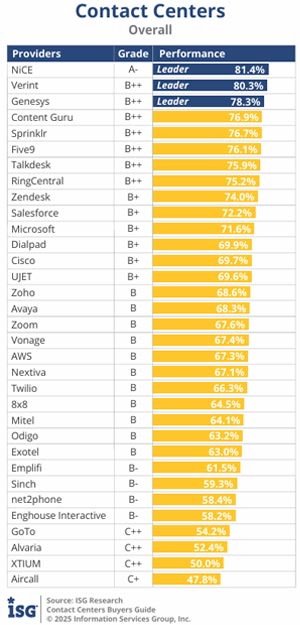
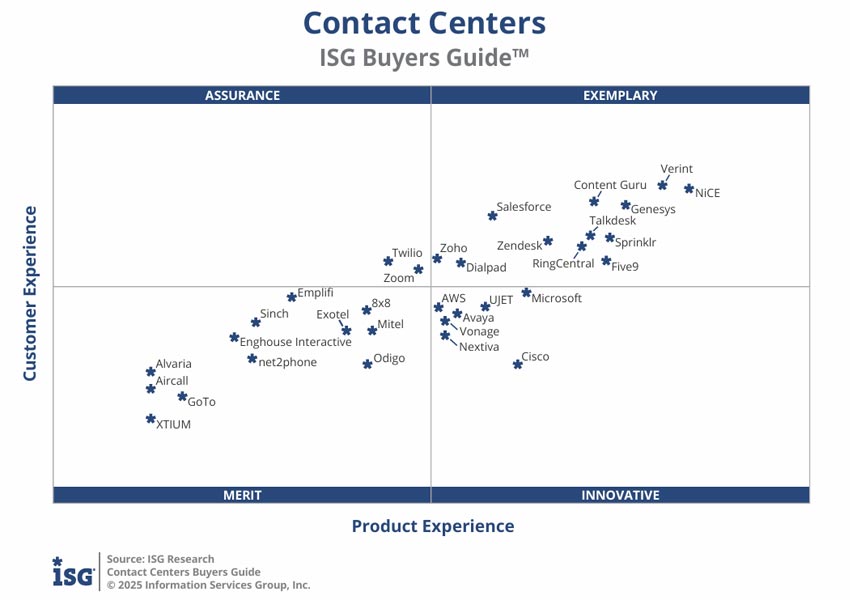
The matrix below unpacks how each provider performed, while ISG’s overall scores are also available in the table to the right.
Top Takeaways from the ISG Buyers Guide 2025
Alongside its overall scores, ISG provides more information in its report regarding each vendor's strengths and weaknesses.
Yet, the additional industry insights it shares most differentiates the analyst’s evaluations, giving buyers greater context on which to consider vendors and the broader market.
The following seven top takeaway extracts some of that insight, with additional commentary from the report’s lead author, Keith Dawson, Director of Research for Customer Experience at ISG.
1. Contact Center Buyers Have More and More Options
Vendors with a background in CRM, UCaaS, and other adjacent fields are making a beeline for the CCaaS space. That has given buyers a much broader range of options, from companies with very different origins and approaches. This means buyers can orient their decisions differently.
Dawson noted: "Some may still start with routing engines, but others begin with data infrastructure, CRM, or CDP, then build outward. A big decision point now is whether to focus on voice or digital first. That choice is leaving some traditional vendors behind."
To that point, while voice remains crucial, digital is becoming the dominant channel. “It’s the present as much as the future,” summarized the analyst. That shift is happening faster than many legacy brands seemingly anticipated.
2. CCaaS Decision Making Is Shifting
Contact centers used to have their own IT offshoots, focused primarily on telecoms. IT leaders would happily leave customer support in a silo because it meant dealing with voice and phone numbers, which was tricky and, frankly, mind-numbing.
Yet, enterprise IT and the CTO now play a central role in CCaaS buying decisions. They arbitrate across marketing, sales, and service to ensure tech stacks integrate properly. That means buying decisions are increasingly collaborative.
"You can’t just buy a contact center solution in isolation anymore. IT, marketing, and service all need to be involved, because compatibility and integration are critical," said Dawson. "A poor choice can hold an organization back for years."