

Retail’s next interface isn’t arriving as an app update, it’s showing up on the shop floor. Physical AI is driving the biggest transformation in the retail experience since ecommerce.
Some of the biggest brands in retail, including Samsung and McDonalds,
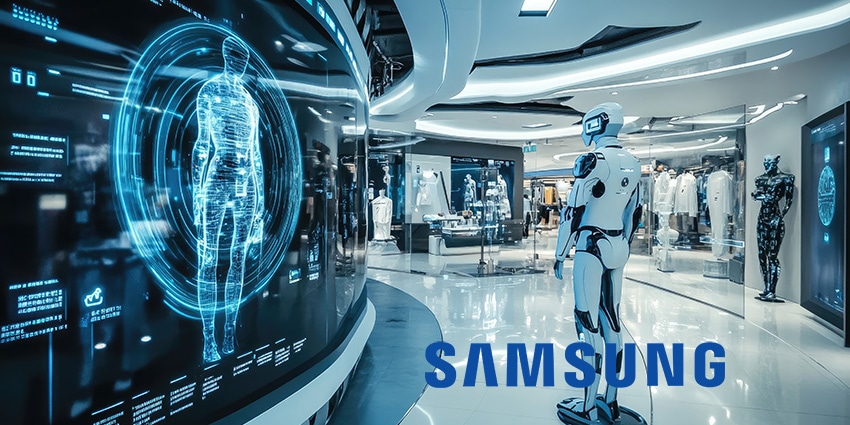
Samsung has launched a retail ecosystem showcase in Gurugram, India to introduce AI-powered in-store experiences and its glasses-free 3D Spatial signage. The lightweight display technology is designed to pull shoppers into richer product storytelling without headsets, QR codes, or downloads, and enable integration across retail stores, bank branches, and premium environments. It’s a signal that the battle for customer attention in physical retail is shifting from digital touchpoints to something closer to digital presence that responds in real time to customer needs.
Puneet Sethi, Vice President, Enterprise Business, Samsung India, stated:
“The future of physical environments is being redefined by the convergence of immersive experiences and intelligent systems. As businesses move from static formats to dynamic, data-driven engagement, the ability to seamlessly integrate AI, content and display technologies becomes critical.”
Samsung’s cloud-based Samsung VXT solution for digital signage enables content teams to convert static images into 3D-optimised content using prompts, supporting real-time, remote content management across locations from retail stores to bank branches.
Samsung’s 3D push is part of the broader reinvention of the retail experience, as brands look to improve the shopping journey from capturing attraction to providing real-time promotion, enhancing satisfaction to bring customers back to the store for future shopping.
Alongside immersive 3D merchandising, retailers and transport service providers are accelerating experiments with remote-operated avatars and humanoid robots in customer-facing roles.
Seen together, these pilots highlight different and potentially converging visions for how customers will browse, ask for help, and get served in the next generation of stores, when the “face of the brand” can be a screen, an avatar, or a machine.
Three Visions of the New Retail Interface
Retail digitalization has so far largely meant adding self-service options such as scan-and-go, mobile ordering, loyalty apps, and automated checkouts. But those tools don’t fundamentally change how customers experience the brand in physical space.
This new wave of tech innovations aims to do that by putting digital intelligence into forms customers instinctively respond to such as faces and motion.
3D Turns Store Merchandising Into a Live Experience
Samsung’s 3D spatial signage as part of a broader move towards AI-enhanced retail environments that combine innovations in display technology with analytics, personalization and operational tooling.
If ecommerce won on infinite shelf space and rich product information, then physical retail needs to win back attention with presence and persuasion, without asking customers to download another app or use wearables.
Like Samsung, Sony has demonstrated its Spatial Reality Display (SRD), which it has integrated with Ameria's AI-powered Touchfree Interaction Technology, to create life-like 3D visuals that can detect proximity, gestures and gaze to enable fluid interactions so that shoppers can interact with and personalize products.