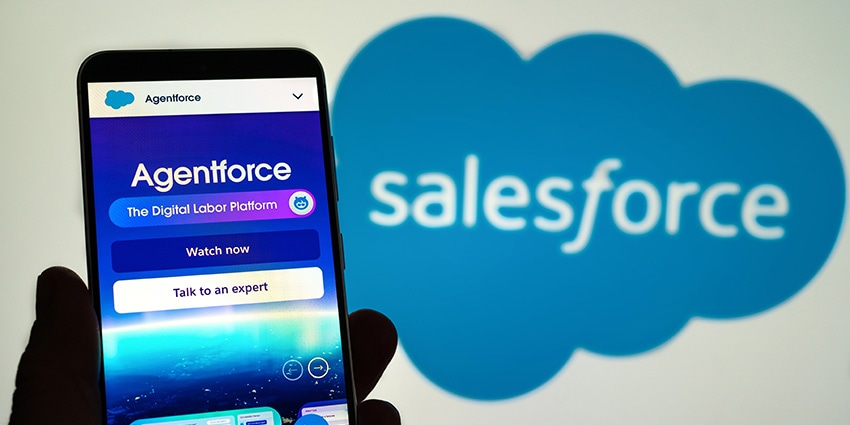
Salesforce has opened a new AI center in London, positioning the site as a hub for customers, partners, public sector organizations and startups to explore agentic AI use cases.
“We’ve moved past pilots,” said Zahra Bahrololoumi CBE, CEO of Salesforce UKI, speaking at the center’s opening. “We’re now in the era of execution, and execution at scale.”
The move forms part of Salesforce’s five-year, $6BN investment in the U.K., which the company said is focused on AI innovation, customer adoption and workforce development. It also indicates how the company is positioning Agentforce, its agentic AI platform, as enterprises move from experimental use cases into more operational deployments.
The vendor said Agentforce is now deployed by more than 23,000 customers globally, with U.K. organizations including Heathrow Airport, Pets at Home, NHS Shared Business Services, the National Trust and police forces across England among those using the technology.
Speaking during a panel discussion at the opening, Paul O'Sullivan, UKI Chief Technology Officer & Head of UK AI Center at Salesforce, said AI adoption is starting to shift from theoretical opportunity to measurable use cases.
“We’re starting now to really see tangible business or citizen value associated with how AI can help. Technology trapped inside the box means nothing to no one.”
“Technology out there in the hands of the humans that need it, or use it, is where we’re going to see the most amount of value.”
Agentforce Use Cases Move Into Customer and Citizen Service
Salesforce highlighted several use cases that center on service automation, where AI agents are being deployed to handle customer, employee and citizen interactions.
In policing, the AI agent “Bobbi,” built on Agentforce and deployed by Thames Valley Police and Hampshire & Isle of Wight Constabulary, handles more than 200 non-emergency conversations daily and resolves 75 percent of those interactions autonomously, according to Salesforce. Bahrololoumi also cited broader adoption across three UK police forces, saying Bobbi is helping to resolve 82 percent of inbound non-urgent enquiries without escalation to a human officer.
In healthcare, NHS Shared Business Services has used an AI-powered help center built on Agentforce to reduce case resolution times from five days to 24 hours, the vendor said.
Salesforce is positioning agentic AI as a way to help public services absorb routine demand while freeing up employees for more empathetic or judgment-led work.
Bahrololoumi said:
“Rapid adoption of our AI agents is supporting stretched public services and giving organizations across the U.K. the capacity to deliver more.”
NHS Shared Business Services has reduced its case resolution times from five days to 24 hours using an AI-powered help center built on Agentforce.
These deployments illustrate Salesforce’s argument that agentic AI is moving into core service workflows.
Salesforce Points to Its Own AI Center as an Internal Test Case
Salesforce has increasingly used the “customer zero” message around its AI strategy, emphasizing that it is deploying Agentforce and related AI capabilities within its own operations before encouraging customers to adopt similar models.
O’Sullivan described the AI center’s resident team as an example of how the company is using AI internally to increase output without necessarily scaling headcount at the same rate.
“If we think about the resident team in the AI center, it’s eight people. Those eight [engineers], augmented with AI, have evolved to learn how to orchestrate AI in a way in which they can get more value and throughput and get more done.”
Still, customers are likely to judge internal productivity examples against more practical questions, including where AI can safely remove friction, where human oversight is required and how organizations can measure the impact beyond activity or output.