In today’s competitive B2B landscape, sales automation and AI sales tools are moving from “nice-to-have” to mission-critical components of revenue operations.
Adoption is accelerating: most sales teams see measurable returns when they implement AI-enabled automation. Meanwhile, marketing leaders are embedding these capabilities deeply into campaign workflows to improve efficiency and outcomes.
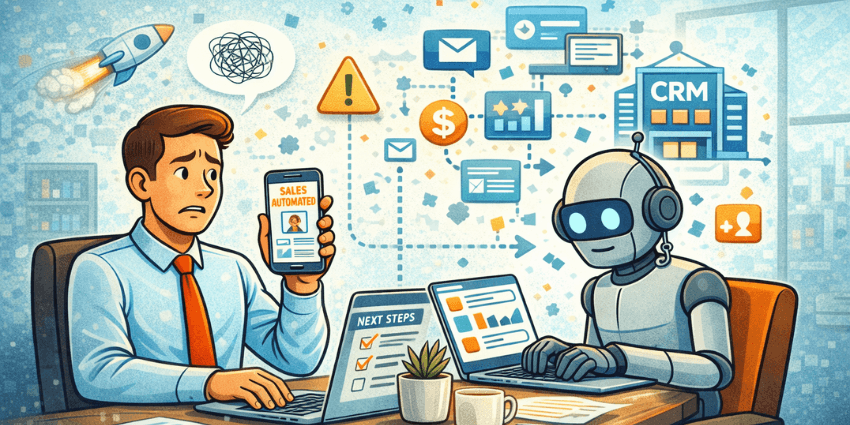
However, buying committees must look beyond buzzwords. While automation promises scale and speed, poorly implemented systems can depersonalize the martech customer journey, disrupt sales cadence, and erode trust with prospects.
The question isn’t just “should we automate?” — it’s “how do we automate in ways that enhance engagement, preserve human relationships, and deliver measurable value?”
This article outlines a strategic framework to evaluate and adopt sales and marketing automation solutions without alienating customers or internal stakeholders.
Related Articles:
- How Customer Communities Became a New Revenue Channel
- The Future of AI in Marketing: Inside the 2030 Martech Toolkit
- Machine Customers and Sales: How CROs Can Prepare for the $30 Trillion Opportunity
The Case for Sales and Marketing Automation
Modern buyers are digital-first and self-directed.
Industry research shows that AI and automation - especially when paired with human insight - are transforming how organizations identify and engage prospects.
AI-powered systems are capable of analyzing massive datasets. From there, they can tailor messaging in real time, and free revenue teams to focus on higher-order tasks.
From automated lead scoring that prioritizes the hottest prospects to predictive analytics that flag at-risk deals, AI sales tools are redefining go-to-market motions. But the transformation is only as good as the strategy and governance behind it.
Build Personalization Into Automation
Automation shouldn’t be a blunt instrument that replaces personalization with volume. Instead, it should enhance relevance at every touchpoint. Advanced platforms can tailor outreach based on behavior, segmentation, and interaction history - effectively scaling a one-to-one experience. McKinsey notes that generative AI is pushing sales and marketing systems beyond simple execution to contextual, adaptive engagement.
For example, tools that dynamically adjust messaging sequences based on prospect responses not only increase engagement rates but also ensure that automated interactions feel purposeful and relevant.
Prioritize solutions that allow for:
- Dynamic content generation based on customer intent signals
- Predictive next-best actions rather than static workflows
- Machine-assisted personalization that complements human judgment
This lowers the risk of alienation by preserving the customer-centric experience throughout the martech customer journey.
Integrate, Don’t Fragment
A common pitfall in sales and marketing automation is tool sprawl.
Disconnected systems breed data silos, inconsistent experiences, and fractured analytics. Committee members should prioritize platforms that integrate seamlessly with the core CRM, marketing automation systems, and analytics engines.
A unified data infrastructure ensures that customer signals flow bi-directionally - enabling AI sales tools to act on accurate, real-world insights rather than incomplete snapshots.
Great automation relies on data quality. Without a single source of truth, even the most sophisticated AI generates noise rather than value.
Enterprise buyers should ask vendors to demonstrate their integration depth, data governance controls, and ability to support real-time decision-making across touchpoints.
Struggling to hit your marketing KPIs? We created a practical guide on how AI can help revenue teams to hit their targets in 2026.
Preserve the Human Touch
Economists and business schools alike underscore that even in AI-augmented environments, high-value deals are won through relationships - not robots. AI should help sellers, not replace them.