A modern contact center is no longer a back–office function. It’s an operational system that directly shapes customer trust, revenue protection, and service efficiency. Interactions create data. Every agent action shapes brand perception. Platform decision affects resilience, security exposure, and how quickly the organisation can adopt automation and AI.
Navigation
- What is a Modern Contact Center?
- The Cloud Contact Center Industry
- Implementing a Platform
- Long-term Value
Yet many enterprises still rely on legacy contact center technology. Some run 'first-wave cloud' deployments that solved immediate problems but didn’t create a future–ready architecture. These environments often struggle with elastic scaling, deep CRM integration, AI orchestration, hybrid workforce support, and the security controls needed to defend customer–facing channels.
In 2026, the conversation has shifted. Whether businesses should move their contact centers to the cloud or not is no longer a question. They’ve moved on. Now they're asking for a modern contact center architecture that safely enables AI at scale.
Breaking this down, the modern contact center requires two things: building on cloud-native CCaaS foundations; and the ability to govern AI so that it reduces risk from fraud, synthetic voice, regulatory exposure, and poor customer outcomes.
The CCaaS market is expanding rapidly, projected to grow from $6.7 billion in 2024 to $7.91 billion in 2025 at ~18% CAGR and approaching $15.82 billion by 2029, reflecting why legacy contact centres that can’t evolve are being left behind.
So how do businesses achieve this? This guide targets CX, contact center, and IT leaders. It’s also for vendors supporting contact center modernisation. It offers a practical view of what ‘modern’ really means, how buyers evaluate platforms, and how organisations migrate from legacy to cloud and from CCaaS to AI–enabled operations.
What is a Modern Contact Center?
What Defines a Modern Contact Center – and Why CCaaS Comes First
See What the Data Says on Contact Center and CCaaS
Direct answer: A modern contact center starts with a cloud-native foundation – typically a CCaaS platform – because that foundation enables real-time data access, rapid change, resilient scaling, and safe AI integration across channels.
'Modern' has moved on from omnichannel – now a given in the contact center. This also applies to refreshed IVR. ‘Modern’ is now the ability to evolve continuously without expensive infrastructure cycles, brittle integrations, or fragmented data. Traditional environments were built for predictable call volumes, static teams, and limited integration needs. Many still run reliably. Reliability alone isn’t enough when expectations include instant personalisation, rapid deployment, and intelligence inside daily workflows.
CCaaS (Contact Center as a Service) provides the baseline for modernisation. It replaces fixed infrastructure with software-driven capabilities delivered through the cloud. That enables faster updates, API-led integration, and unified interaction handling across voice and digital channels.
Crucially, CCaaS is not 'cloud hosting' but a model that supports interoperability, analytics, and continuous improvement. That’s why advanced capabilities such as AI routing, agent assist, automation, sentiment signals, and real-time performance insights work far better on CCaaS than on retrofitted legacy stacks.
Vendors at the discovery stage are asking:
- 'Is our current platform holding us back?'
- 'What’s the real difference between cloud-hosted legacy and cloud-native CCaaS?'
- 'How quickly can we migrate without disrupting service?'
How a Modern Contact Center Operates: CCaaS Architecture and AI in Practice
Discover Behind the Scenes of How Modern Contact Centers Work
Direct answer: A modern contact center runs on a cloud routing and orchestration layer that unifies channels and data. AI services then sit inside workflows for self-service, agent support, analytics, and automation under clear governance.
In a CCaaS-led model, cloud-native routing engines orchestrate interactions. The platform handles demand spikes elastically. Teams can adapt business rules quickly. Customer context becomes accessible across touchpoints when teams design integrations and identity controls properly.
Operationally, voice and digital channels stop behaving like separate 'systems.' Modern platforms treat conversations as a single interaction fabric. That enables consistent policies for authentication, escalation, compliance monitoring, and quality management, regardless of channel.
Open integration is central. CCaaS platforms typically connect to CRM, ITSM, identity and access management, analytics, WFM/WEM, and knowledge systems via APIs. The payoff is reduced data duplication, fewer manual steps for agents, and better visibility into customer journeys and operational performance.
How AI fits (when done well): teams shouldn’t bolt AI on as a novelty layer. In the modern contact center, AI supports routing decisions, agent workflows, and QA processes. Common use cases include conversational self-service, intelligent call distribution, real-time transcription, agent assist, automated summarisation, sentiment/effort signals, and automated quality evaluation.
Matt Hughes, Head of Product, Puzzel notes:
“Agent–assist tools are becoming the backbone of modern customer service.”
People and governance note: AI doesn’t remove accountability. High-stakes interactions still require human judgement, clear escalation paths, and auditability; especially in regulated industries. Modernisation succeeds when organisations treat AI as an operating capability, not a feature.
Why Legacy Platforms Constrain Cost Control, Risk Management, and Growth
Direct answer: Legacy contact center platforms increase cost-per-interaction, reduce agility, and widen risk exposure because they rely on fixed capacity, brittle integrations, limited automation, and weaker real-time security controls.
For many organisations, cost pressure is the first sign of constraint. Limited automation and fragmented data make volume growth translate into headcount growth. That pushes costs upward and reduces flexibility during seasonal peaks, crises, or demand volatility.
Risk exposure has changed too. Older platforms often fail to meet resilience expectations and security patch cadence. They also struggle with modern identity controls. Meanwhile, customer-facing environments face more AI-enabled social engineering, synthetic voice, and impersonation attempts.
Modern security challenges now include AI-generated voice fraud; roughly one in three US consumers reported encountering synthetic-voice fraud, a trend that legacy verification systems are poorly equipped to defend against. Slow detection and response hurts. Hard-to-centralize interaction data also weakens security posture.
Strategically, legacy constraints show up as stalled innovation. AI initiatives stay stuck in pilot mode because the underlying stack can’t provide clean data access, consistent orchestration, or scalable compute. That’s why 'adding AI' to legacy often becomes expensive and fragmented.
Discovery-stage takeaway: rising costs, rising risk, and stalled innovation usually share the same root cause. The architecture can’t evolve at the pace the business requires.
The Cloud Contact Center Industry
Modern Contact Center Use Cases by Industry and Role
Find out how Contact Centers are Used Globally
Direct answer: CCaaS and AI use cases vary by industry risk and operating model—regulated sectors prioritize governance and assistive AI, while high-volume sectors prioritize scaling and automation with strong escalation design.
Use cases become clearer when you map them to two realities: the risk profile of customer interactions; and the economics of volume.
Regulated industries (financial services, healthcare, public sector) often modernize to improve control: compliant recording, audit trails, secure authentication, and consistent policy enforcement across channels. AI adoption is often behind the scenes: agent assist, transcription, automated QA, fraud pattern detection, and knowledge retrieval. These tools augment agents without removing human accountability.
High-volume industries (retail, travel, logistics, telecoms) modernize to reduce friction at scale: intelligent routing, proactive notifications, high-performing self-service, and automation for common intents. Here, teams judge the modern contact center by containment quality, transfer efficiency, and how reliably it escalates complex cases to skilled agents.
Role-based priorities differ. Operations leaders focus on service levels, throughput, and forecasting. IT and security evaluate identity controls, resilience, data governance, and integration overhead. CX leaders focus on trust, effort, and experience consistency. Successful programmes align these perspectives early. That helps avoid 'feature-first' decisions that break later in delivery.
Contact Center Trends Reshaping the Market in 2026
Discover the Contact Center Trends for 2026
Key Contact Centre & CCaaS Events to Watch in 2026
Direct answer: By 2026, the market is shifting from cloud adoption to value extraction – buyers prioritize AI maturity, embedded governance, fraud resilience, and agent augmentation over headline features.
Legacy-to-cloud migration remains a dominant theme. Many enterprises still run ageing stacks that limit uptime, agility, and data access. That keeps CCaaS transformation on executive roadmaps. It’s even more urgent as service complexity rises and customer tolerance for friction declines.
AI has moved into a more mature evaluation phase too. Uma Challa, Senior Director Analyst at Gartner shares some insight.
“Gartner predicts that by 2028, at least 70% of customers will use a conversational AI interface to start their customer service journey."
Capabilities like agent assist, automated QA, and interaction analytics now feel like baseline expectations. The differentiator is delivery. Is AI embedded into core workflows with oversight? Or is it bolted on as disconnected add-ons that create data, security, and operational friction?
Security and trust have escalated. Synthetic voice and impersonation threats are pushing identity verification, anomaly detection, and governance into board-level conversations. Workforce dynamics remain central. Efficiency targets are rising, but attrition and training costs make 'automation at all costs' risky. The best programmes use AI as augmentation. They reduce cognitive load and repetitive work while protecting service quality for complex and emotional interactions.
How to Choose the Right CCaaS Platform for Your Organisation
Read the Best Contact Center Platform Reviews
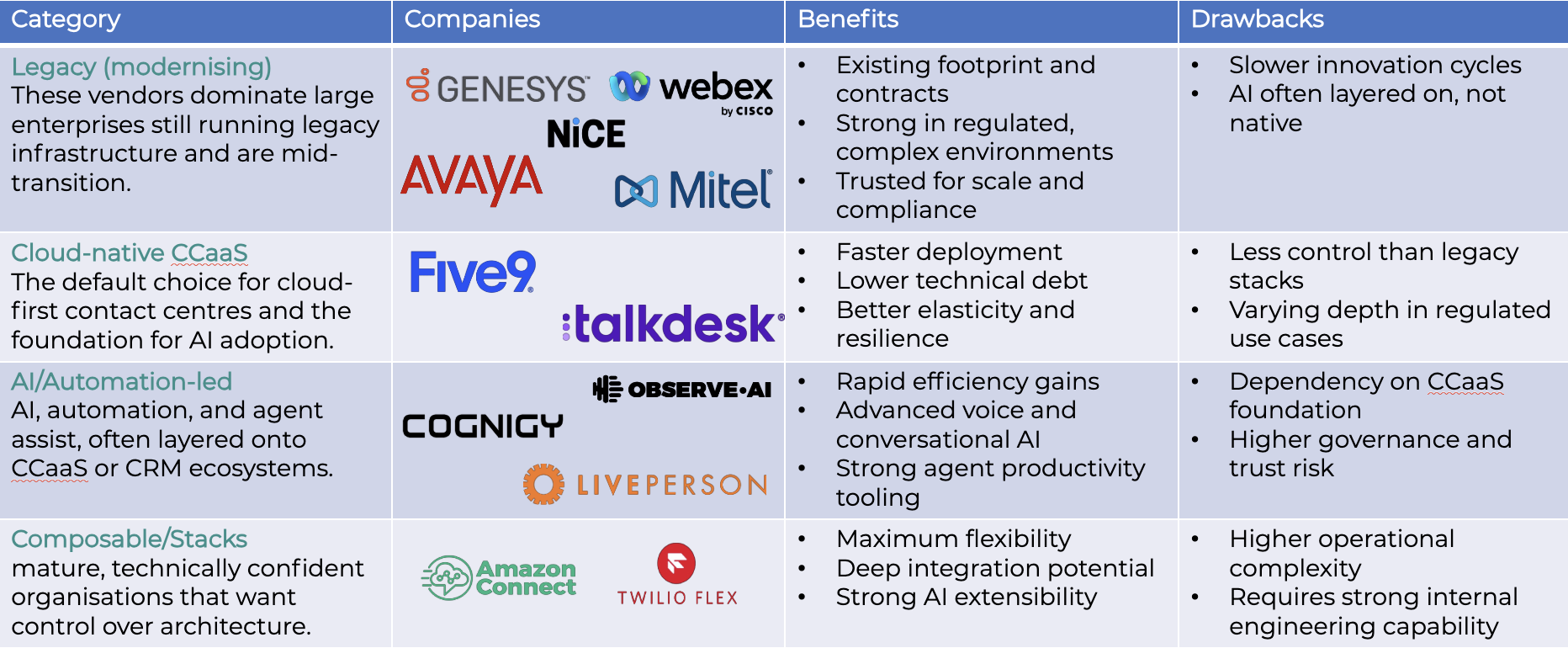
Compare Tier 1 CCaaS AI-led Platforms
Direct answer: The right CCaaS platform depends on migration status, integration requirements, risk profile, and AI governance maturity – not just channel coverage or feature checklists.
CCaaS selection is a long-term architectural choice. It determines how quickly you can adapt workflows, how safely you can scale automation, and how well you can integrate customer context across systems.
If you’re migrating from legacy: prioritize staged migration support, coexistence options, proven reliability, and integration depth. Buyers here value continuity and predictable delivery. 'Advanced AI features' matter less if the organisation can’t operationalize them yet.
If you’re already on CCaaS: the question becomes platform maturity:
- How does the organisation govern AI?
- Does the platform handle data consistently across channels?
- Are routing and automation decisions observable, explainable, and controllable?
- Can teams apply policy across the interaction lifecycle – from authentication to summarisation to QA?
Risk management questions to ask: identity controls, role-based access, data residency options, audit logging, encryption, incident response, and governance for third-party AI services. For global enterprises, regional compliance support and administrative control models become differentiators.
Suite vs composable: integrated suites can reduce complexity and speed deployment. Composable approaches offer flexibility but demand stronger governance and integration discipline. The 'best' option matches operational maturity and the long-term ownership model.