

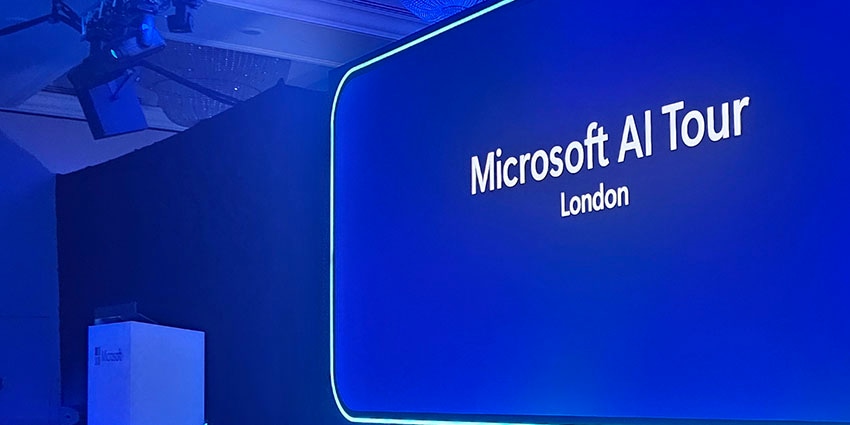
AI isn’t just an add-on to customer experience; it’s becoming the architecture beneath it. That was the message the London edition of Microsoft’s AI Tour presented for leaders planning their AI roadmaps — the future belongs to agent-operated, human-directed enterprises.
Microsoft is placing Copilot at the heart of productivity and customer engagement, and presenting it as the front door to its enterprise AI ecosystem. The company believes it’s how employees and customers will interact with intelligence across the cloud.
As Rob Smithson, AI Business Process Lead, Microsoft UK told CX Today in an interview at the event:
We're putting Copilot into CCaaS, and that's the first contact center that's being built with generative AI from the ground up. So it's very much part of our strategy. It's very much an enabler for users and a differentiator, because it's not something that's integrated with third-party systems. It's top-to-bottom Microsoft.
“The different apps that we have — Dynamics 365, ERP, all of those sorts of things — the user may interact with them through Copilot in the future. And those different programs will essentially provide data back to the UI so that they're able to ask questions about that.”
Taking a “customer zero" approach, in which it tests out offerings internally, Microsoft has already deployed Copilot across its global customer support organization.
“We already use it ourselves in our own customer care across the world, and we've seen significant improvement of things like net promoter score,” Smithson said. “Listening to customers’ feedback around the service that they give us is very powerful. So we see Copilot as a huge enabler of that.”
For technology buyers, this represents an evolution in how contact center platforms are designed. Instead of bolting AI onto legacy systems, Microsoft is building its CCaaS offering with generative AI baked in, a “human + agent” architecture that unites automation, context, and real-time insights.
Overall, AI is no longer about automating single workflows or adding smart chatbots to customer service. It’s about orchestrating entire experiences through agents that can understand, act, and adapt.
Supporting all of this is Copilot Studio, Microsoft’s low-code environment for building, managing, and extending AI agents. It’s the bridge between the standard out-of-the-box Copilot experience and more complex enterprise needs.
As Reuben Kippner, Director of Power Platform for Microsoft EMEA, told CX Today:
“Copilot Studio is the extensibility layer. So where we’re providing an enormous amount out of the box, organizations that need to tailor it to different systems, that's the toolset that they use. So it fits very neatly.”
Kippner added that Microsoft will continue to develop role-specific agents across industries and departments.
You'll increasingly see Microsoft augment Microsoft 365 Copilot with very role- and task- and process-specific agents. So for a salesperson, we have Copilot for Sales, Copilot for Service, and so on. We’re going to enrich out-of-the-box capabilities but provide people the ability to go and build their own.
That layered approach, blending ready-to-use copilots with customizable AI agents — is central to Microsoft’s message to buyers. It allows organizations to start small, experiment safely, and then scale as they gain confidence and capability.
A Platform for Buyers, Not Just Builders
For leaders, this unified strategy offers a practical path forward. Instead of adding disconnected AI tools, Microsoft Copilot interacting with data, workflows, and insights across the enterprise. This approach directly addresses one of the most common frustrations for customer service teams: fragmented experiences and inconsistent data.
Smithson explained:
“The biggest frustration for customers is when they call up and the company doesn’t know them, doesn’t know the context behind their business or why they're calling. And this gives them the opportunity to do that very quickly, with very rich data from multiple different sources.”
By centralizing data across Dynamics, Microsoft 365, and Azure AI, Copilot can deliver the context agents need instantly — whether it’s a customer’s purchase history, service record, or previous interactions.
An example of this shift is HM Revenue & Customs (HMRC), the UK's tax, payments and customs authority, which is tasked with supporting millions of taxpayers through phone, web, and chat interactions while maintaining strict compliance. The organization has started to roll out its 35,000 Copilot licenses this week.
“In HMRC, we've got a strategic preference for buy over build,” said Wayne Robinson, AI Lead at HMRC, in a panel discussion.
“I say that mainly for two reasons. The first is, you've got finite build resource, so they are quickly going to become a choke point and a bottleneck, bearing in mind the massive demand we're all seeing. And the second reason, arguably the one I'm more concerned about, is assuming a future where you've got hundreds, if not thousands of AI services running on your estate, and bearing in mind the rate of change that we're all seeing as well, if you've got to manage all of those bespoke AI builds, that's going to become an absolute nightmare very quickly.”
For HMRC, the sweet spot between buy and build, “the Goldilocks zone”, is using Copilot Studio with Microsoft Power Platform, Power Automate and Power Apps.
“That's going to allow us to move a lot quicker, but you're still building in one in one tech stack, which I think is going to make your life a lot easier,” Robinson said.
The London Stock Exchange Group (LSEG) is an example of how Microsoft’s AI stack enables co-innovation to redefine how customers access and apply data at scale.
Emily Prince, Group Head of Analytics & AI at LSEG described a shift in thinking, one that’s not about applying AI to an existing issue, but about reimagining the problem.
“This isn't simply a case of, here's an established problem, we're going to apply AI to it. It was actually starting to say, well, what was the total problem that we were trying to solve for, and what is the most intelligent way that we can actually solve that problem?”