If you want your enterprise to have impact, martech (marketing technology) tools have become indispensable. They are the heat that lets enterprises cook up meaningful and measurable customer experiences.
From managing campaigns to personalizing interactions across channels, the right suite of tools enables teams to operate with efficiency, insight, and agility.
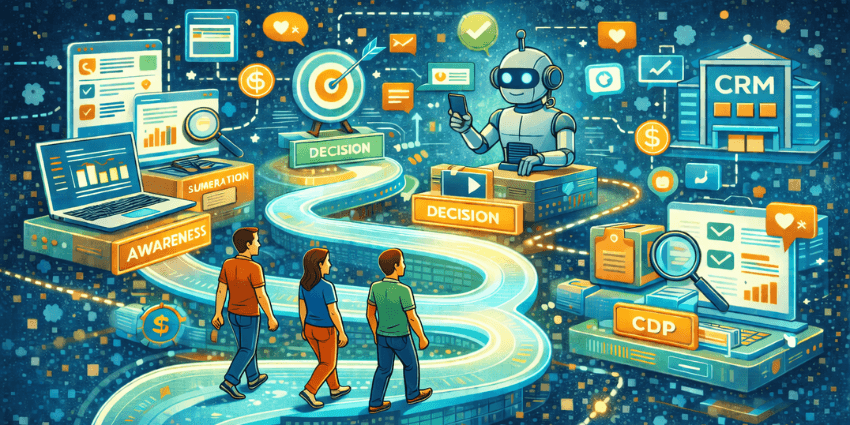
Martech solutions not only support execution but increasingly shape the strategic customer journey - guiding prospects from awareness to conversion and retention.
As marketing technology evolves, investment in advanced capabilities such as AI in martech is transforming how teams engage audiences and optimize outcomes.
Let’s explore how to evaluate and build a future-ready architecture that balances current needs with long-term strategy.
Related Articles:
- Sales Automation Without Sales Alienation: A Strategic Guide for Enterprise Buyers
- Oracle Introduces AI Agents to Transform Marketing, Sales, and Service Teams
What Are Martech Tools and Why They Drive the Martech Customer Journey
At its core, martech tools encompass all technology that helps marketers automate, analyze, and optimize interactions across the customer lifecycle.
This includes automation platforms, customer data platforms (CDPs), content management systems (CMS), analytics solutions, and AI-enhanced personalization engines. Together, they form a martech customer journey architecture.
With this in place, customers will feel relevance at every touchpoint, consequently increasing satisfaction, conversions, and lifetime value.
How AI in Martech Is Redefining Personalization and Insight
One of the most revolutionary shifts of late is the rise of AI in martech - enabling more personalized, adaptive, and predictive customer experiences at scale.
Artificial intelligence has the power to analyze huge datasets and reveal behavioral patterns that manual processes cannot.
The result? Dynamic personalization across channels, real-time behavioral triggers, and automated responses that elevate engagement without adding manual workload.
For example, AI-augmented predictive analytics can forecast which content a customer is most likely to engage with next, while machine learning engines can tailor messaging based on evolving user behavior.
Key Categories of Martech Tools for Orchestrating Customer Engagement
To build a comprehensive martech stack that supports consistent and frictionless engagement across the martech customer journey, enterprise buyers should prioritize the following categories of tools:
- Customer Data Platforms (CDPs) — centralize first-party data to create unified customer profiles.
- Marketing Automation & Campaign Tools — streamline outreach and segmentation.
- Analytics & Attribution Tools — measure performance and tie efforts to business outcomes.
- AI-Enhanced Engagement Tools — power personalization, recommendations, and predictive insights.
- Content and Experience Platforms — manage CMS, digital asset delivery, and cross-channel experiences.
Selecting solutions from these categories ensures coverage across essential phases of the customer journey and supports seamless orchestration between systems.