

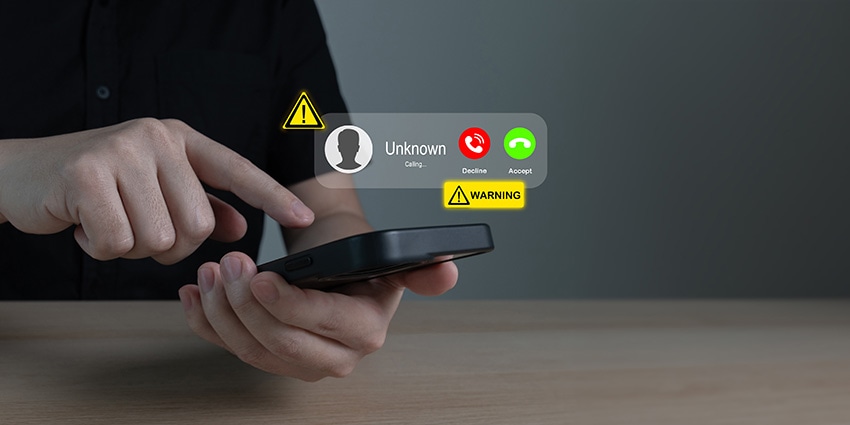
Telephony fraud isn’t new, but it’s becoming more complex, costly, and damaging, especially for businesses that rely on voice communications as a cornerstone of their customer experience.
As the telecoms ecosystem shifts to IP and cloud-based systems, fraudsters are exploiting vulnerabilities that can hurt companies’ reputations as well as their finances.
The UK’s biggest mobile networks have responded by signing a new Telecommunications Fraud Charter with the government, ahead of the upcoming UK Government Fraud Strategy, to introduce various measures aimed at reducing telecoms fraud. The signatories include BT EE, Virgin Media, O2, VodafoneThree, Tesco Mobile, Talk Talk, Sky, and trade association Comms Council UK (CCUK).
The networks have committed to upgrading their systems within the next year to stop overseas call centers spoofing UK phone numbers, making it clear when calls impersonating legitimate organizations originate from other countries.
Around 96 percent of UK mobile users decide whether to pick up a call based on the number shown onscreen, and three-quarters are unlikely to answer calls from an unidentified international number.
The mobile networks will develop call tracing technology to track down the origin of suspicious or fraudulent calls across interconnected networks and give police the information they need to find scammers operating in the country and dismantle their operations.
They will also design scalable, collaborative data-sharing models between telecoms service providers as well as banking and technology firms to make it harder for scams to go on undetected.
The agreement includes a B2B voice and telephony sub-charter focused on assisting business customers. CCUK, which represents the UK’s IP communications and Voice over Internet Protocol (VoIP) industry, will develop business victim support principles and best practice guidance to help members handle how to identify and respond to fraud.
Telecoms Fraud Increases Cost of Business Communications
Telephony fraud takes many forms, including spoofed numbers, call hijacking, PBX hacking, and toll fraud. And those threats are only increasing with the proliferation of AI tools. As fraudsters become more sophisticated, every interaction now carries a layer of doubt. Criminals use legitimate-looking numbers or brands to trick customers, or infiltrate business phone systems to route high-value calls overseas.
“The scammers are getting much more sophisticated. So although there's great general awareness, I think it's so easy to still get caught out,” Tracey Wright, Managing Director at Magrathea Telecoms and CCUK chair, told CX Today.
The immediate financial losses can be steep. A single incident of toll fraud can leave rack up thousands in unauthorized charges. But the broader damage—disrupted operations, lost productivity and compromised customer trust—is longer lasting.
Telecoms companies themselves take a hit because of the perception that they have failed to protect their customers or secure their networks.
“[T]he impact on telecoms businesses… is quite serious and quite considerable. Not only in the financial sense of losing money on bad payments, but the reputational risk is considerable,” Wright explained. “It doesn't take long at all for consumers to pick up on what they perceive as a bad actor in the market.”
Companies are engaged in a constant battle against sophisticated and fast-moving schemes. While some forms of fraud are relatively easy to identify, others are far more subtle, using legitimate communications channels to trick unsuspecting customers.
“[T]he mass calling episodes, selling things that don't exist… are quite easy to detect. We're still seeing those, unfortunately; they slip through the net quite frequently,” Wright said. “It is constant whack-a-mole. These people move around the industry, blast these calls out, get caught, shut down, and move on.”
The more insidious threat comes from fraud that crosses multiple communication platforms.
“[T]he more challenging one to properly understand is where the telecoms network is used as part of social engineering. So you've already had an email or WhatsApp, or someone's been sent a phone number in a text message… It's much harder to detect because it might just be one or two phone calls and not look like anything suspicious.”
While the industry is improving its ability to identify and block fraudulent traffic, many cases still slip through.
“As a service provider, we collect a lot of information from customers on those things. And unfortunately, it is almost a daily occurrence that we get reports,” Wright said.
Many companies underestimate how fraud can ripple through the customer experience. When customers start doubting the authenticity of incoming calls, legitimate outreach can suffer. That erosion of trust can quickly translate into fewer answered calls, slower issue resolution and increased customer frustration.
Still, striking the right balance between robust security and a frictionless customer experience isn’t easy. Too much verification can frustrate users, but too little invites risk. The goal for most companies is to integrate protective measures without customers even noticing.
Breaking Down Barriers to Cross-Industry Data Sharing
The biggest challenge for telecoms service providers in thwarting fraud is sharing intelligence quickly and securely. There are significant barriers to creating an effective data-sharing framework across providers and industries.