For years, many contact centers have worked with specialist workforce optimization (WFO) providers for workforce management (WFM) and quality assurance (QA).
Some are satisfied with the native WFO tools within their CCaaS platform. Yet, those that wish to access cutting-edge capabilities have traditionally partnered with specialist WFO providers.
In regards to WFM alone, such capabilities include hundreds of forecasting algorithms, scalable planning options and scenarios, and break and job optimization features.
These are only a handful of examples. As such, the gap between specialist WFO offerings and those served up by CCaaS providers remains significant.
Nevertheless, AWS is closing it, thanks to its advanced AI models. Here's how.
Furthering Forecasting with AI
With traditional contact center forecasting methods – such as triple exponential smoothing – forecasters must make many assumptions.
Indeed, planners divide annual contact volumes across months, weeks, days, and eventually into 30- or 60-minute reporting periods – based on trend and seasonality.
As such, many uncertainties are baked into the process, and achieving consistently high forecast accuracy rates remains a distant prospect.
Thankfully, Amazon Connect has developed a machine learning model that scours through historical data to automatically predict future demand and average handling times.
Planners may also manually tweak the forecasts to factor in their own experience.
Yet, the solution also supports planners with very little experience. End-user Anjanette DeCoudreaux, Director of Participant Services at Ameriflex, confirms this. She stated:
Our business users without workforce management experience find the capabilities easy to use.
Also, DeCoudreaux noted: "AWS has been proactive in providing optimization recommendations and responsive to our development requests."
Below is how a short-term forecast within Amazon Connect, showcasing the anticipated contact arrival pattern across a single day for an SMB.
Hovering over a particular reporting period, the planner digs deeper into the specifics of how many contacts they can expect across which channels.

Advancing Capacity Planning with AI
Many contact centers deploy homegrown, disparate forecasting tools to predict demand. Yet, some operations still rely on an Erlang Calculator and spreadsheets for staffing calculations.
If a business has fewer than 30 agents, such tools may still do the trick – especially if they only combat phone calls and sporadic email.
Nevertheless, when the headcount increases, these become increasingly tricky to manage. Moreover, they are error-prone, only record static data, and risk the integrity of that data.
Capacity planning tools – like those within Amazon Connect - are much more efficient.
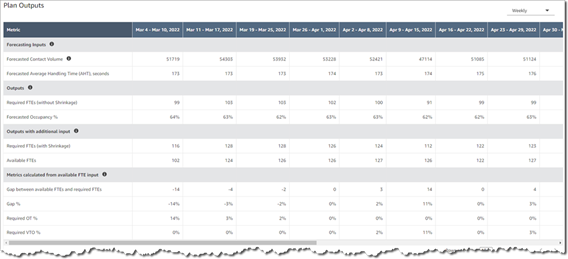
They calculate staffing requirements across voice and live chat by taking the forecasted demand and centralizing metrics – such as average handling time, shrinkage, and absence.
Such requirements match up to a target service level and agent occupancy rate, allowing the contact center to safeguard customer and agent experience.
Moreover, they harness machine learning to improve continually.