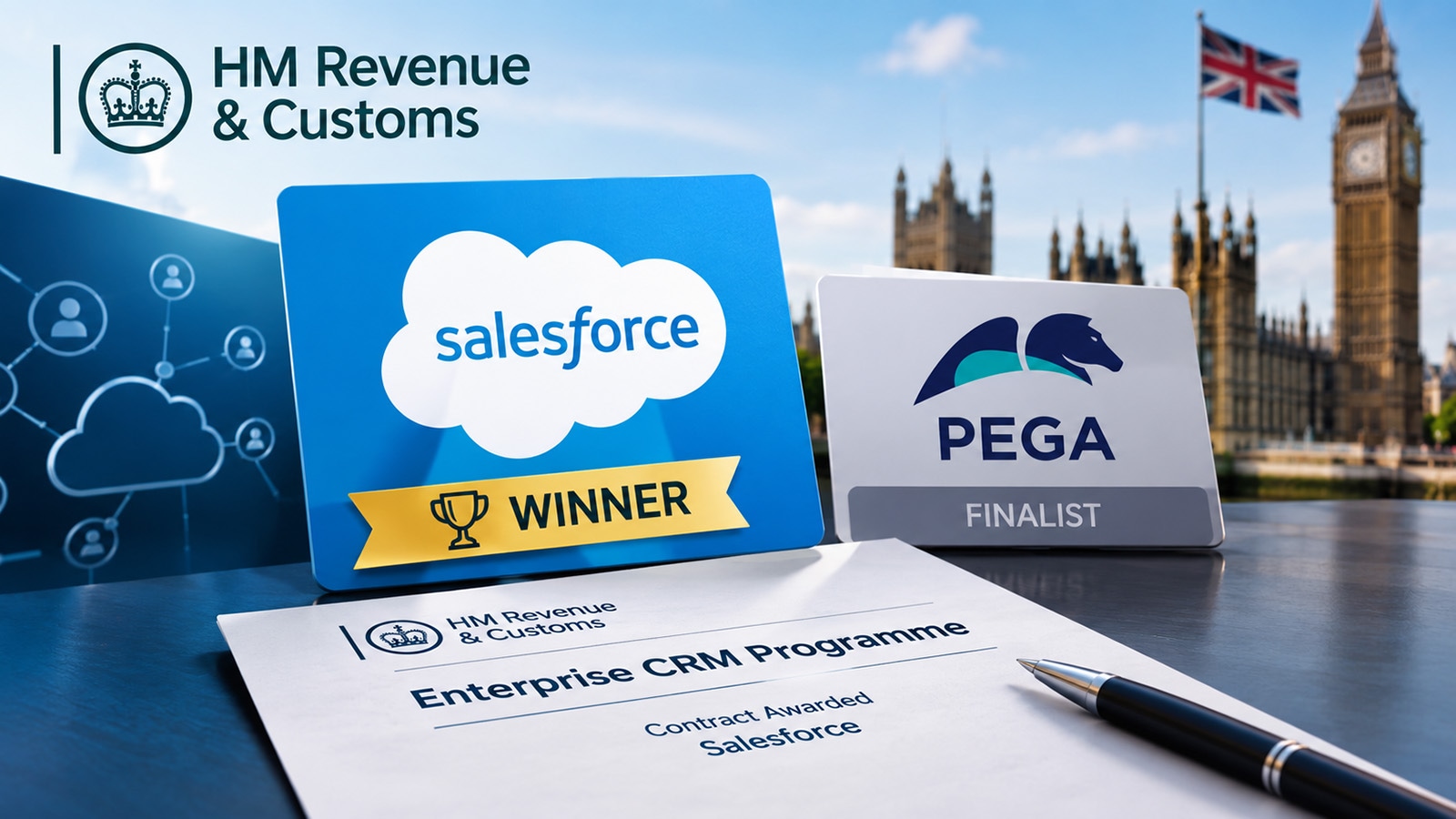
The U.K. tax authority HMRC has awarded Salesforce a contract with a maximum value of £2.4BN including VAT to provide its new Enterprise Customer Relationship Management (CRM) capability.
The 10-year agreement, published through the U.K. government's Find a Tender service, covers a software-as-a-service (SaaS) CRM platform and associated professional services. The contract can be extended by up to five additional years to 2041.
HMRC selected Salesforce after two final-stage bids, with Pegasystems filing the other bid. The evaluation weighted quality at 70 percent, social value at 10 percent and price at 20 percent, according to the tender document.
The deal is significant in its own right, but it also completes an important part of a broader HMRC customer-service transformation that already includes a £600MN Contact Center as a Service (CCaaS) contract awarded to Capgemini.
While the agency stuck to its £600MN budget for the CCaaS contract, it has blown through its initial £1.2BN budget for the CRM part.
HMRC's Salesforce procurement covers customer management, case management, interaction, channel and messaging management, AI, insights, reporting and intelligence, and customer experience through a customer portal and app.
Additional capabilities include identity, verification and authentication, secure digital communications, fraud, data and integration management, operational management, knowledge management and non-compliance management. The supplier is also expected to provide professional services to support implementation.
The breadth of the specification is notable because HMRC is dealing with a large and complex customer base across multiple taxes, benefits and duties.
The department's existing data work provides another part of the picture. HMRC has said its Unique Customer Record program has brought together previously separate data sources into 97 million unique records in a Central Customer Registry. The new CRM will need to connect with an extensive existing data environment while supporting the systems and employees responsible for customer contact.
Salesforce CRM Joins Capgemini's Contact Center Overhaul
In June, Capgemini announced that it had signed a multi-year contract with HMRC, working with NiCE and Route 101, to transform the department's customer experience operations.
The arrangement centers on NiCE CXone, deployed on a U.K. sovereign cloud, with Capgemini providing implementation, system design, workflow integration and ongoing support. Route 101 is providing professional services around CXone and NiCE Cognigy's AI capabilities, alongside telephony infrastructure through Gamma.
Capgemini said the program would consolidate HMRC's legacy infrastructure and existing products into a unified cloud-native platform.
The CCaaS award provides the customer contact layer of HMRC's transformation, while the Salesforce contract provides the enterprise CRM capability intended to support customer and case management, interactions, data and digital experiences.
HMRC Wants CRM and CCaaS to Work Together
The two programs are explicitly linked in HMRC's own transformation plans. HMRC's 2026 Transformation Roadmap states:
“We will continue to build momentum by investing in new customer technology: a modern Contact Centre as a Service (CCaaS) platform and an Enterprise Customer Relationship Management (CRM) system. Together, these will help us to join up customer contact across channels and give colleagues the tools they need to provide a faster, more consistent service.”
The CRM system is intended to provide more personalized support for customers and their advisers, while the wider program includes work on digital self-service and HMRC's digital assistant. That gives the Salesforce contract a role beyond traditional contact and account management, as is intended to become part of the infrastructure connecting customer information with interactions across HMRC's service channels.
AI is Appearing Across the Transformation
AI is a component of both major technology programs. The Salesforce procurement explicitly includes AI among its core CRM capabilities, while the Capgemini program uses NiCE's AI-powered CXone platform and NiCE Cognigy capabilities to support self-service, real-time insights for contact center operations and AI assistance for advisers.
HMRC's roadmap also says work is underway on making its digital assistant more conversational and intuitive, allowing customers to ask questions in their own words.
This creates a technology stack in which AI is being introduced at several points in the customer journey: digital self-service, contact center interactions and the CRM platform used to manage customer information and cases.
The challenge will be ensuring those systems share the right information and context while maintaining appropriate controls over sensitive taxpayer data.
HMRC has been clear that the technology investments are part of a wider move towards more digital customer services.
Capgemini said HMRC is expanding self-service and using technologies such as AI to make it easier for customers to access information and support. Its June announcement also said the program would support customers who are digitally excluded, in vulnerable circumstances or dealing with more complex enquiries. HMRC is attempting to increase automation and self-service while retaining targeted support for customers who need additional assistance.
HMRC's £2BN Salesforce agreement should be viewed alongside its Capgemini-led contact center program, rather than as an isolated CRM replacement, covering much of the infrastructure through which HMRC manages customer relationships including the systems holding customer and case information, the channels through which people contact the department, the tools used by advisers and the AI capabilities supporting self-service and customer interactions.
HMRC's stated objective is to join those experiences together. The next test will be how effectively the department can connect the new platforms, legacy systems and underlying customer data without creating another layer of complexity for employees or customers.