In its CCaaS Magic Quadrant, Gartner evaluates the ability of nine prominent cloud contact center providers to meet the needs of global enterprises.
Until now, many of these larger organizations have stuck with their on-premise contact center infrastructure (CCI).
The underlying sticking point for many of these enterprises is that migrations from highly customized legacy environments are notoriously complex and cumbersome.
Recognizing this, Gartner notes that CCaaS vendors are acquiring adjacent technologies and striving to offer broader suites that will help them meet more specific requirements.
That’s critical as CCaaS becomes increasingly appealing, given the strategic emphasis on customer experience, the slowdown of on-premise innovation, and – of course - the rise of AI.
However, across different sectors and market segments, some vendors are better suited to deliver the full benefits of CCaaS than others.
Thankfully, in-depth market evaluations like the Gartner Magic Quadrant can offer an excellent resource to support customer service leaders in identifying the best-fit providers.
The Definition of Contact Center as a Service (CCaaS)
Contact Center as a Service (CCaaS) is an umbrella term for cloud applications that enable customer support teams to manage multichannel conversations.
The vendors included in the Gartner Magic Quadrant compile both native and third-party apps into CCaaS platforms, facilitating both human and virtual agent-led service experiences.
Yet, CCaaS platforms will also include apps that measure the quality of customer engagements, manage knowledge, and much more.
Some of these capabilities are evident in Gartner’s mandatory features list, which includes:
- Application and native communication connectivity that provides voice and data access
- Inbound call routing / automatic call distribution (ACD)
- Digital interaction routing (inc. email, live chat, SMS, and video)
- Pre-built and extendable reporting applications for agents and supervisors
- Workforce engagement management (WEM) apps (inc. workforce, quality, & knowledge management, agent-assist, call/desktop recording and analytics, and workflow routing)
There are many other standard CCaaS functionalities that Gartner doesn’t consider mandatory. These include outbound voice, self-service apps, CRM integrations, and real-time analytics.
Yet, the Magic Quadrant goes beyond capabilities alone. It also considers support services, customer feedback, sales execution, pricing, and more.
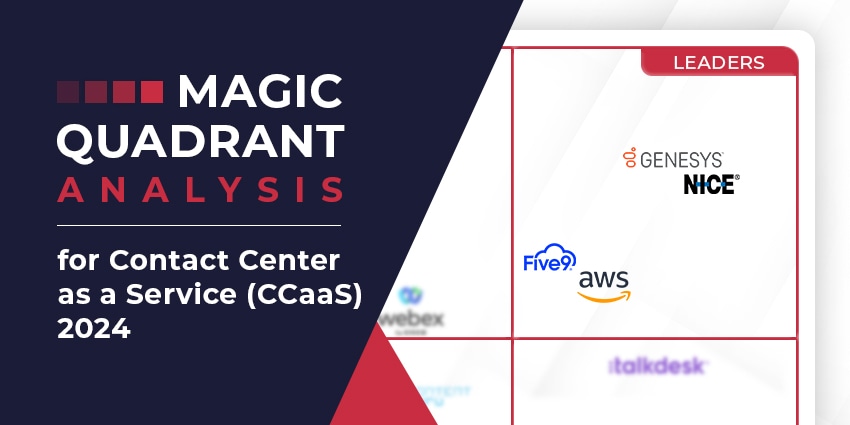
After mulling over all this, the analyst split its nine CCaaS providers into four quadrants: Leaders, Challengers, Visionaries, and Niche Players.
Here's a rundown of how each vendor performed, with commentary reflecting Gartner's findings.
Gartner Magic Quadrant Leaders
Leaders in the Magic Quadrant pair a broad CCaaS suite with a proven ability to serve and support multinational contact center operations. They can also demonstrate a large install base, above-average market growth, and the ability to flex across different levels of implementation complexities. This year’s Leaders are:
- NICE
- Genesys
- Amazon Web Services (AWS)
- Five9
NICE
In a recent Peer Insights study, Gartner named NICE its only "Customers’ Choice" CCaaS vendor, citing its extensive, worldwide customer support.
Again, the analyst highlights these support services for large-scale, global implementations as a core strength in its Magic Quadrant.
Additionally, NICE earns plaudits for its AI & analytics muscle, which flexes across CXone.
When clients pair this AI with the "vast amounts" of labeled customer intent, action, and WEM data on the platform, they can optimize the use cases across the contact center.
Finally, NICE has developed a "simple" UI and admin environment, product characteristics that customers often praise, according to Gartner.
Such customers include some of the world's biggest brands, with NICE recently securing its place as part of a $578MN megadeal to transform the Southern Hemisphere’s largest contact center.
Genesys
Like NICE, Genesys specializes in large-scale, complex CCaaS deployments, boasting extensive experience in supporting multinational implementations.
Its large on-premise install base has helped pull massive enterprises onto Genesys Cloud CX, and the vendor has made the most of this advantage.
How? By developing "strong" tools, processes, and playbooks for migrating on-premise customers from Genesys Engage and third-party systems.
Thanks in part to these migration and support services strengths, Genesys has become one of only two tech providers to announce that it has surpassed $1.5BN in annual recurring revenue (ARR) for CCaaS. NICE is the other.
Gartner also spotlighted Genesys’s customizable solutions as a core strength. However, it surprisingly excludes Genesys’s co-innovation efforts with Salesforce and ServiceNow to inspire closer CRM and CCaaS integrations. That’s a big differentiator.
Amazon Web Services
AWS first released Amazon Connect as a set of CCaaS building blocks, enabling businesses to devise their dream cloud contact center platform.
However, in recent years, it has recognized that enterprises typically want most of the CCaaS stack to come pre-packaged. As such, it has advanced its overall proposition and stormed into the leader quadrant.
Nevertheless, AWS hasn't forgotten its origins and still offers a highly customizable platform that businesses can tailor with in-house talent or developer partners.
Gartner recognizes this and the ability to scale that platform as continued strengths.
The analyst also notes how Amazon Connect is "agile for experimentation". In other words, brands can test new capabilities – including generative AI use cases, self-service, and voice automation – without long-term commitments.
Finally, as in 2023, the analyst lauds AWS’s consumption-based model, which Samsung notably cited as a primary driver for deploying Amazon Connect in July.
Five9
In May, Five9 signed its largest-ever CCaaS deal with a Fortune 50 bank, serving 70MN customers worldwide. That exemplifies its broad market appeal.
After all, some have historically marginalized Five9 as a vendor that specializes in midsize contact centers. Yet, it now serves many global enterprises with incredibly complex requirements.
In doing so, it has – according to Gartner - developed "strong programs and tools" for moving organizations from on-premise environments to the cloud.
Additionally, it surpassed the $1BN in ARR for CCaaS earlier this year.
Yet, Gartner cites one other critical strength driving that revenue growth: Five9’s post-sale services that focus on driving continuous value.
Verified customers often note this in reviews left on the Gartner Peer Insights platform.
Gartner Magic Quadrant Challengers
Challengers in the Magic Quadrant typically have a large install base, broadly recognized strengths, and a referenceable ability to serve specific sectors or market segments. Yet, they may trail Leaders in their maturity of product capabilities, "multi-regional market approach", or overall marketplace representation. This year’s Challengers are:
- Cisco
Cisco
Cisco offers CPaaS and UCaaS solutions alongside its CCaaS offering within its Webex portfolio.