Customer communities once had a narrow purpose: give users a place to ask questions and help one another. That role still matters. But for B2B SaaS companies, community now sits much closer to product adoption, customer education, feedback, and retention.
Gainsight community platform strategy reflects that shift. Its May 2026 launch of Developer Studio and a new Skilljar integration places Gainsight Customer Communities at the center of a larger digital customer experience. Gainsight is not simply pitching a more polished support forum. It is making a case for a connected customer hub where learning, peer expertise, and product engagement reinforce one another.
That is an appealing vision for CX leaders managing fragmented support, education, and customer success operations. It also raises practical questions. Can a connected community and learning experience reduce effort for customers? Can community managers create useful experiences without creating governance issues? And can vendors prove that engagement contributes to retention?
TL;DR
- Gainsight Customer Communities is expanding from peer support into a digital hub for customer learning, feedback, and engagement.
- Developer Studio promises to give developers and community teams more control over custom experiences.
- The Skilljar integration connects community and customer education through shared navigation, login, learning widgets, and search.
- The real test is whether buyers can connect community activity to measurable gains in adoption, self-service, and retention.
How Are B2B Customer Communities Moving Beyond Peer Support?
B2B customer communities are moving beyond peer support because customers expect answers, training, and practical expertise in the same moments they use a product. A discussion forum can help users solve problems, but it cannot alone create a connected journey across onboarding, learning, support, and feedback.
For customer experience teams, the opportunity is clear. A useful community can make expertise easier to find, help customers learn from peers, and expose recurring product issues before they become wider customer experience problems. It can also provide a direct view of the questions and friction points users discuss outside formal support tickets.
However, launching a branded destination does not automatically create those outcomes. A poorly moderated space, a thin knowledge base, or a disconnected learning portal creates another destination for customers to navigate. The value comes from making the community useful at the point of need, then connecting its signals to the teams responsible for support, customer success, product, and education.
Gainsight acquired inSided in 2022 and later rebranded the offering as Gainsight Customer Communities. The acquisition added a community product to Gainsight’s customer success portfolio. Its latest launches show the company now sees community as a more central layer in a wider retention strategy.
What Is Gainsight Building With Its Customer Communities Platform?
Gainsight is building a customer engagement layer that brings peer-to-peer discussion, self-service support, product feedback, and customer education into a more connected experience. The company calls this a Digital Customer Hub, with its Customer Communities product acting as a place where users can find answers, access learning, and connect with peers.
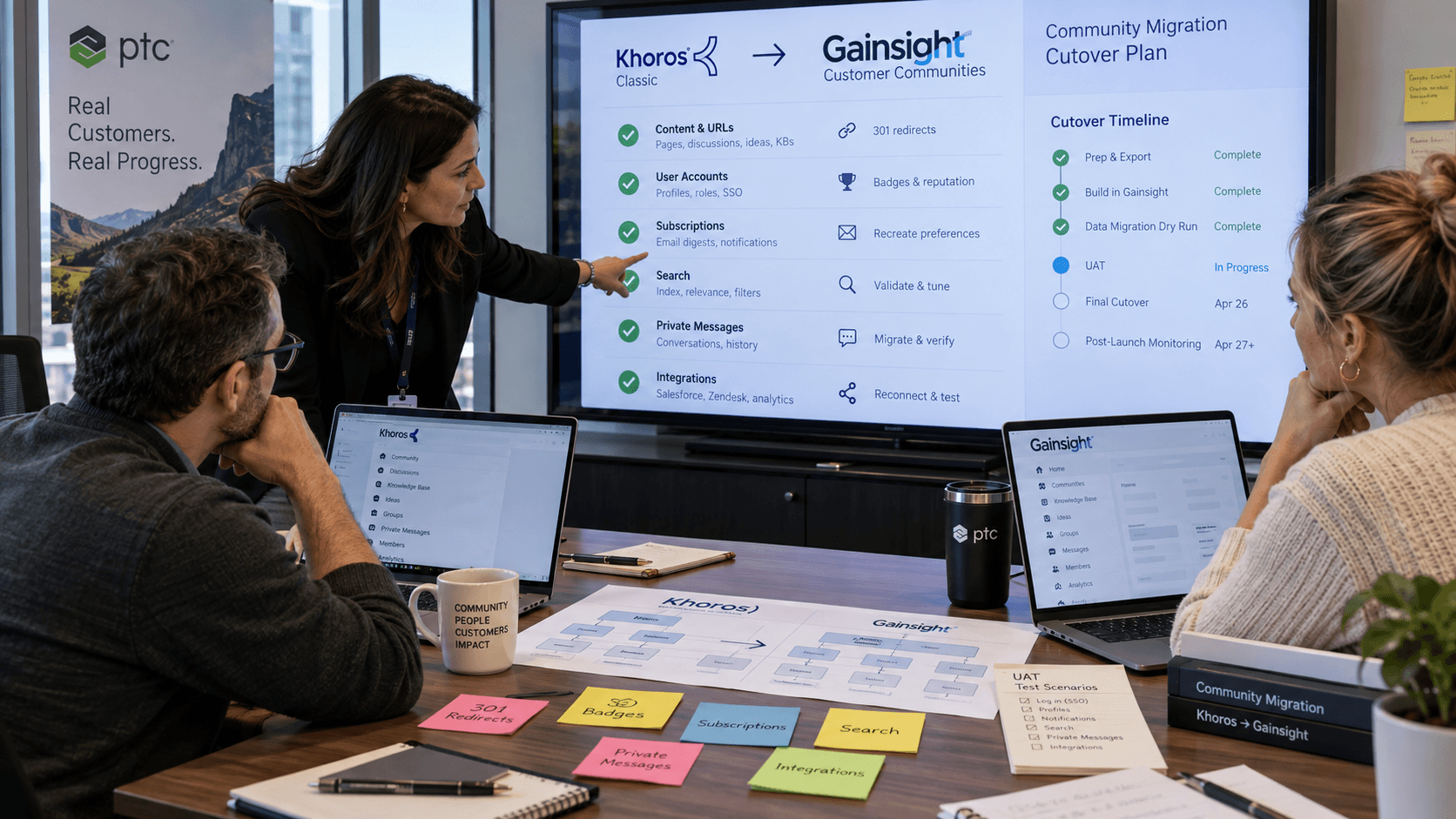
Gainsight says organizations including Zoom, Zendesk, ShipStation, Kaseya, PTC, Greenhouse, and Cognite use Gainsight Customer Communities. Those customer references show that the platform targets enterprises that need more than a lightweight discussion board. They also show how communities can support several different goals, including customer support, product feedback, advocacy, and industry knowledge-sharing.
The strategic value depends on how deeply the community sits in the wider enterprise stack. Community activity needs to inform customer success, support, product, and learning teams. If it remains isolated, a company may gain another engagement channel without gaining a clearer picture of customer health.
That is where Gainsight’s wider CustomerOS strategy becomes relevant. The company positions its portfolio around the journey from onboarding through outcomes. Community, in that model, becomes both a customer-facing destination and a source of behavioral insight.
Can Developer Studio Give Community Teams More Control Without Creating Governance Risk?
Developer Studio could give community teams more control over customer experiences by supporting custom widgets, integrations, and personalization. However, organizations need clear permissions, testing processes, and security controls if they want faster customization without creating governance risks.
Gainsight announced Developer Studio in May 2026 as an AI-native customization toolkit for Gainsight Customer Communities. The company says developers can build and version custom widgets in GitHub. It also says community managers can create reusable widgets with AI-assisted workflows without writing code.
That distinction matters. Community teams often understand which resources, journeys, and workflows need improvement, but they may rely on product or engineering teams to make even small changes. A more accessible customization model could shorten that cycle and make it easier to test new support journeys, onboarding paths, or feedback modules.
Erica Kuhl, GM and EVP at Gainsight, said:
“The companies winning in customer retention today aren’t treating community like a side project anymore. They’re treating it as a strategic differentiator and a core driver of customer ROI.”
Kuhl said Developer Studio will allow people closest to customers to shape the community experience in real time. That is a logical ambition. However, “vibe coding” should not become shorthand for bypassing enterprise controls. Customer communities can involve identity data, private support context, brand-sensitive public conversations, and integrations with critical systems.
What Should Teams Check Before Customizing a Customer Community?
Teams should confirm who can publish changes, how they test experiences before launch, how they secure integrations, and who maintains custom components over time.
Gainsight says Developer Studio includes staging and production environments, edit history, and secure credential management. These are useful enterprise capabilities. Buyers should still assess how they work in practice, including how easily teams can audit changes, manage exceptions, and roll back a faulty customer-facing experience.
How Does the Skilljar Integration Change the Customer Learning Journey?
The Gainsight and Skilljar integration aims to reduce the separation between customer education and community engagement. It brings learning content into a shared experience so customers can move between training, product questions, and peer conversations without treating each activity as a separate destination.
Gainsight identifies four capabilities within the integration: unified login and profile, unified navigation, education widgets inside the community, and federated search across academy and community content. The common objective is to reduce context switching for customers.
This addresses a familiar customer experience problem. A customer may search a community for help, realize they need training, and then face a separate login, different navigation, and unrelated content experience. That break in the journey can discourage completion. It can also make it harder for CX teams to understand how learning and community engagement interact.