

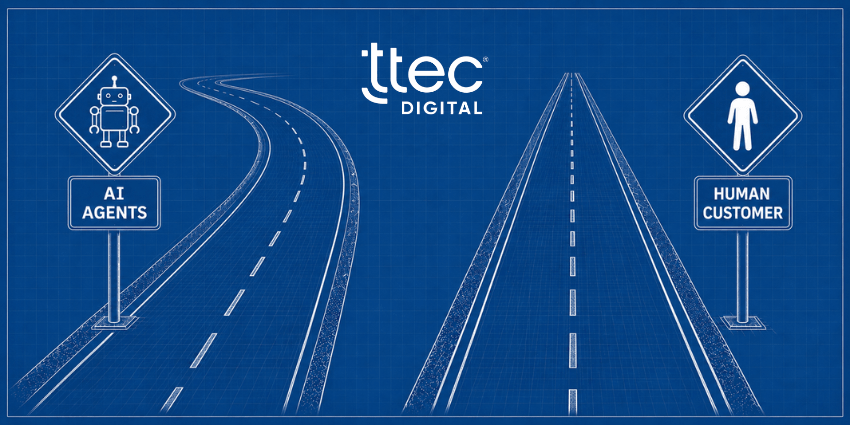
The CX industry has spent the better part of the last decade building smarter front doors. IVRs that understand intent, chatbots that handle volume, and virtual agents that guide customers through journeys without a human in sight.
Now there’s a new challenge. The focus is shifting from how to automate outbound service delivery to how to manage what comes through the door when the customer on the other end isn’t human either.
How do you reliably detect what kind of interaction you're receiving, make the right decision about how to handle it, and route it to the right place, at speed, securely, without creating chaos?
Calling this “detect, decide, and route,” Carrie Brough, Director of Strategy & Operations EMEA at TTEC Digital, has a straightforward answer: you need a traffic controller.
Related articles:
- Empathy for Humans. APIs for AI: Why One CX Model No Longer Works
- Who’s Really Calling? The Rise of AI Customers
- AI Customers Are Here. Is Your Contact Center Ready to Serve Them?
- The Inversion: When AI Calls the Contact Center – And Why CX Leaders Keep Gasping
Building a Dual-Lane CX Framework from Concept to Action
That idea sets the direction, but it also introduces a practical challenge. A traffic controller only works if he/she can interpret what’s arriving and respond with consistency. It's the same for the AI Agent.
Below are several steps you can follow to handle dual-lane CX effectively.
Step 1: Classify AI-Driven Demand
The first step is not redesigning the CX experience. It is honestly reviewing and understanding the demand. Enterprises need to know which customer needs are entering the contact center, how they are being routed, and where human or AI support is best suited. That makes demand classification a critical foundation, and one many contact centers were still refining long before AI arrived.
Brough explained to CX Today that the key is "understanding what your demand is, what is likely to come through from a customer's AI, and what is the expectation in terms of handling.”
“Insight is difficult in contact centers. People have struggled with it for years. [But] having an understanding of intent and being able to classify that demand is something that you need to have in place."
This is not just about labeling contacts differently. It is about developing genuine visibility into who, or what, is initiating the interaction, and what they are actually trying to achieve. Only then can the routing decision be made with any confidence.
Step 2: Design Separate Human and AI CX Paths
Once demand can be classified, the design work begins. The design for an AI-facing lane is fundamentally different from the one built for human agents.
AI agents do not navigate service interactions like people. They do not show confusion through the tone of voice or frustration. They repeat, reframe, and keep asking until they receive something usable.
When that happens, the impact is felt by the human that sends them, often when the issue is harder to resolve.
The triggers for human escalation in a dual-lane model look nothing like traditional escalation signals, Brough pointed out, "It's not like today, where you'd move out of an AI service because you heard a customer getting frustrated and emotional… It's actually the reverse now. You're not going to get that.”
“So you're looking at the AI asking the same question again. You're looking for the 'I didn't understand' language from an AI agent. That would indicate something's not happening in that interaction."
The signals are subtler, more structural, and require a different kind of monitoring. Which means the decision logic must be built deliberately, not retrofitted from the human model.
Step 3: Assess Risk Before Every Routing Decision
Brough believes before any technical trigger is fired, there’s a fundamental question every organization needs to answer first: what are you prepared to let an AI handle autonomously?
"The first place I'd start with is: what is the risk factor of keeping it within the AI lane? If it's financial, legal, reputational, anything that's potentially going to cause a big problem further down the line, and you want to be risk averse… they're the sorts of queries that I would want to get a human involved in."
Organizations that clearly define their risk appetite can set intentional rules for when AI should continue and when a human agent should step in. Without that clarity, handoffs are likely to be driven by failures, escalations, or customer frustration rather than by design.
Step 4: Route with Continuity
The routing decision is only valuable if what follows it is seamless. A handoff that loses context is not a handoff, and restarts are damaging regardless of whether the customer waiting for the outcome is a person or an AI.
Brough is precise about what good looks like: