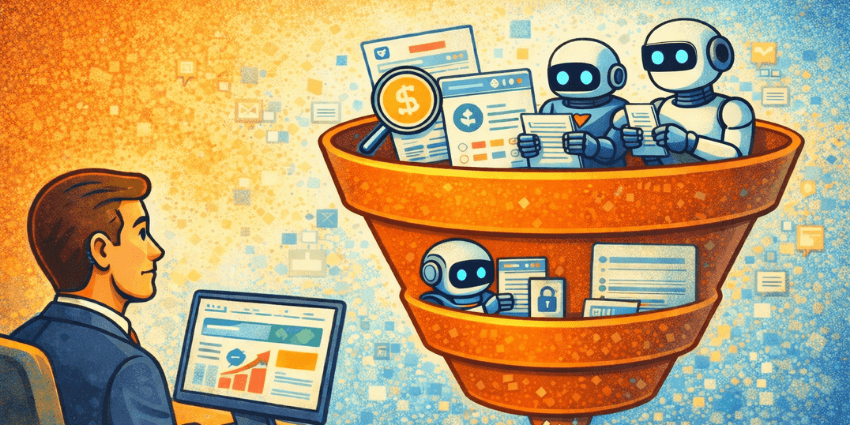
Today’s sales funnels are tricking teams. These days, they’re full of activity that looks like red-hot demand, but actually turns out to be noise.
Think of all the form fills you see happening at midnight, and pricing pages getting hammered in continuous mechanical loops. Reps chase these mirages. Forecasts count them. Executives see the volume and get excited, until they see conversion rates sitting still.
That’s what happens when you’re not building bot-aware journeys for sales teams.
Machine customers are here, like it or not, and they don’t research, connect or buy like humans.
"Journey mapping, for the sales and marketing team, needs an update, and fast."
If you’re missing bot buyers out of your strategy, you’re missing out on a $30 trillion opportunity.
Further Reading:
- Why CX Teams Still Aren't Ready for Machine Customers
- Machine Customers and Sales: Strategies for Success
- Sales Automation without Sales Alienation
What Are Bot-Aware Customer Journeys?
Most sales funnels still run on an outdated assumption: if there’s intent, there must be a person behind it. That belief is getting expensive. A massive share of inbound activity now comes from systems acting on someone else’s behalf. We’ve got:
- Buyer-side assistants: Procurement copilots and research agents comparing vendors across pricing, integrations, SLAs, and policy language. High signal, but not human-ready.
- Crawlers and scrapers: Indexing bots, competitive tools, and AI training crawlers that hammer feature matrices and pricing tables. They never convert, but they absolutely inflate activity.
- API-based and autonomous agents: Running integration checks, vendor validation, replenishment logic decisions.
Tools like Amazon’s “Buy for Me” agent aren’t browsing aimlessly, or gradually warming up to your brand. They’re executing tasks quickly, and logically, right at the points where funnels are most fragile: pricing pages, demo requests, security docs, and procurement flows.
That’s why bot-aware journeys have to exist before routing logic even kicks in. Without them, you’re orchestrating journeys for humans that never show up.
How Can Organizations Design Journeys For AI Agents and Humans?
The purchase stage is where a lot of funnels are starting to sweat today, just because its where machine customers put on their best human disguise. They’re running price checks, requesting demos, and even filling out security questionnaires. To sales teams, it all looks like “serious buyer” signals.
Then routing logic confuses a bot with a human, and problems start piling up. Reps waste time on sequences and calling “prospects” that never reply. Pipelines start making it seem like lead volume is going up, even when conversion rates are dropping. Plus, your attribution team loses the plot because machine-led research doesn’t fit with first-touch or last-touch models.
"That’s why it’s becoming more and more crucial to design journeys that actually accommodate the new brand of shopper."
If you wait until post-conversion to sort out signal from noise, the damage is already done.
Step One: Detecting Machine-Originated Inquiries
The first (and most obvious) step in designing bot-aware journeys is figuring out how you’re going to tell the difference between people and machines. It sounds simpler than it is.
Detection doesn’t mean you need to perfectly label every interaction; you probably couldn’t do that if you tried. But you can use the intelligent tools you’re already relying on for sales automation to start detecting patterns. The easiest place to start is with metadata signals.
Look for user agents that don’t quite line up, headless browsers, or traffic coming from cloud infrastructure instead of consumer ISPs. Watch weird changes in geographic trends. Those things won’t prove you’re dealing with a bot on their own, but they help.
Then there’s behavior. Track forms completed in seconds, perfect regularity at all hours, or the same path repeated again and again with zero deviation. Those are pretty significant signs of machine browsing. After that, consider journey patterning.
Bots run repeated pricing checks, or obsessively revisit specific documents to “scrape” data for human buyers. Then give all of your “leads” a machine confidence score. Basically, give them a number that defines how likely they are to be human. That alone gives a starting point for figuring out the next stage in the journey.
Discover:
- Evaluating AI Transparency in Marketing Tools: The New Dealbreaker Hiding in Your MarTech Stack
- How AI Helps CMOs Hit Key Marketing KPIs Faster
- Using Data Analytics to Stop Customer Churn
Step Two: Route Humans and Machines Into the Right Lanes
Once you can see machine behavior, you need an idea of how you’re going to direct it. Bot-aware journeys work because they’re opinionated. They assume different initiators need different paths, and they enforce that assumption early.
Four lanes should cover most of the next steps in the purchase stage:
- Bot → Bot: This is where you send routine questions and tasks. Compatibility checks. Policy lookups. Basic pricing logic. Let machines talk to machines and stop dragging reps into conversations that don’t need people.
- Bot → Knowledge base/docs: Research and shortlisting agents want structure, not persuasion. Clean tables. Consistent language. Stable answers.
- Bot → Limited pre-qualification: This lane handles ambiguity. When there might be a human behind the agent, use progressive disclosure, identity checks, and throttles. No full CRM record yet. No opportunity creation. Just verification.
- Human → Sales: Reserved for verified people with real stakeholder signals. This is where reps should spend their time.
Routing rules stay simple if confidence drives them. High machine confidence plus pricing intent? Docs. Security or integration probing? Controlled pre-qualification. Mid-range confidence? Verify first. Low confidence? Let sales engage.
The only override that matters: escalate when machines start to negotiate, test thresholds, expand scope, or show enterprise signals. That’s when machines become valuable evaluators, not just noise.
Step Three: Prevent Bot-Created Fake Pipeline Volume
Detection and routing don’t matter if machine activity still creates leads, opportunities, and forecasts. That’s how teams end up celebrating a pipeline that isn’t real. If you want your bot-aware journeys to work, and you want to make the most of both human and machine customers, you need a plan.
Start with suppression rules that live in RevOps, not just marketing. If the same machine identity hits three forms, a chatbot, and an API endpoint in an afternoon, that shouldn’t produce three leads and an opportunity.
Next, slow down with opportunity creation. If an inquiry hasn’t passed verification, it doesn’t belong in the pipeline. Park it in a non-pipeline object where it can be analyzed without inflating deal stages.
Also, remember suppression has to cover APIs, not just forms and chat.
"Automated agents increasingly enter through technical endpoints that still trigger downstream CRM logic."
This might sound strict, but it has to be. Pipeline is a decision system. Forecasting, hiring, quotas, and investment all depend on these numbers. Letting machine benchmarking masquerade as demand throws off your entire strategy.
Step Four: Update Systems So Bot-Aware Journeys Can Operate at Scale
Most revenue systems were built on an unspoken rule: every inbound actor is a person. Once machines enter the picture, that assumption leaks everywhere: CRM, attribution, scoring, even content ops.
"Your systems need to adapt to support bot-aware journeys too."
Start with the data model. If your CRM can’t distinguish a human from an automated agent, nothing in the funnel works. You need explicit fields for customer type, machine type, autonomy level, confidence score, verification status, and routing outcome. You also need to make sure those insights flow across teams (marketing, sales, and customer service).