

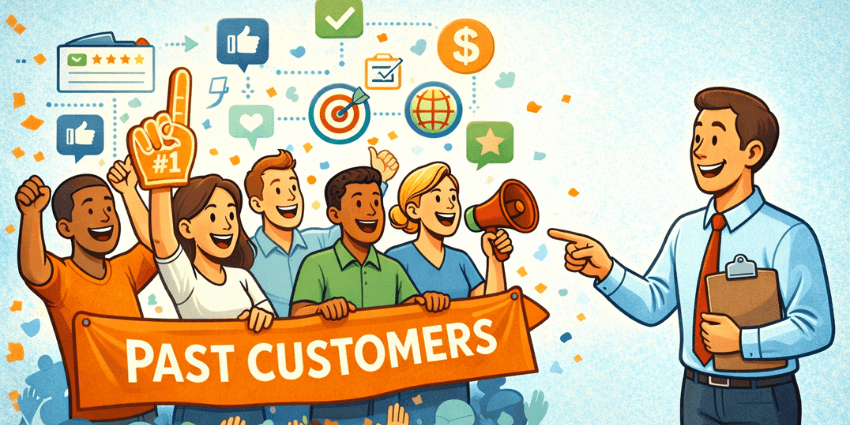
Customer communities are moving from “nice-to-have” forums to core growth engines.
Community-led growth is defined as a strategy where a brand’s community becomes a driving force behind acquisition, expansion, and retention, not just engagement or support. When you treat community as a revenue channel, those interactions start to influence pipeline, deal cycles, and renewals directly.
Instead of sitting at the end of a funnel, customers and users now sit somewhere more valuable. Right at the center of a flywheel of advocacy, self-education, and peer support.
That makes customer communities a natural lever for new pipeline, faster deal cycles, and higher renewal and expansion rates – a true community-led growth strategy rather than a side project.
"This acts as a powerful counterpart to traditional sales-led and product-led approaches."
For sales and marketing leaders, the question is no longer “Should we invest in community?” but “How do we wire community signals and programs into the way we create, qualify, and close revenue?”
Related Articles:
- How Sales Enablement Technology Will Transform the Revenue Team by 2030
- Marketers Face Higher Expectations Across Search and AI Tools, Gartner Finds
- Designing Bot-Aware Journeys for Sales Funnels: Preparing for the New Age of Machine Customers
Why Community-Led Go-To-Market Is Rising Now
Several forces are pushing community-led go-to-market and community-led growth into the spotlight.
First, trust in traditional advertising has fallen behind peer recommendations.
- Research into consumer trust show that recommendations from friends and family remain the most trusted source, while many paid formats lag far behind. Customer communities naturally amplify this kind of word-of-mouth and peer proof.
Second, buyers now complete much more of their journey without speaking to a seller.
- Business technology buyers spend long periods in “rep-free” research, using peer networks, user groups, and independent communities to compare options and validate decisions. Sellers often only arrive further down the buying journey.
Third, there is a fast-growing technology ecosystem behind community-led growth.
- The global market for community-led growth platforms is expected to increase from about $1.5 billion in 2024 to over $12 billion by 2033. That level of investment suggests community is moving from experiment to operational discipline.
Strategically, communities now act as forces for customer acquisition and loyalty, not just simply a channel for in-your-face advertisements.
From “Nice Community” to Community as a Revenue Channel
For sales and marketing teams, the key shift is to treat community as a revenue channel rich in buying signals, not a side project. That means connecting customer communities and their activity to customer relationship management (CRM) data and to the wider revenue operations stack.
Community-led growth platforms such as Common Room and others ingest signals from places like Slack, Discord, social media, and other ‘dark funnel’ sources. They then map them to companies and contacts in your CRM.
This allows commercial teams to: