
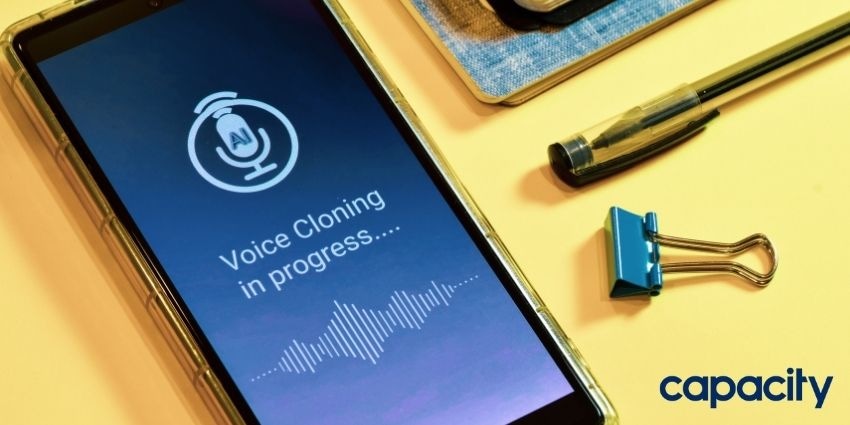
Capacity has showcased how it's supporting contact centers amid emerging AI threats.
Specifically, it's looking to protect contact centers from spoofing attacks, which are evolving thanks to the evolution of voice cloning tech.
Now, they pose a very real threat to conventional voice biometrics systems.
Voice biometrics systems analyze an individual’s unique vocal characteristics to instantly verify their identity.
In doing so, they have helped remove clunky, cumbersome contact center processes, such as running through security questions.
However, whilst efficient, this technology has suddenly become vulnerable.
Indeed, new AI models can clone a user's voice in as few as five seconds.
Harnessing these, attackers can target contact centers, bypass security measures, and gain unauthorized access to sensitive data.
How Significant Is This Threat?
Early last year, OpenAI warned businesses against using voice-based authentication as the threat of spoofing escalates alongside the advancement of technology.
The AI giant did so while stalling the release of its Voice Engine solution, which enables voice cloning.
Indeed, the company published a blog post stating:
We encourage steps like phasing out voice-based authentication as a security measure for accessing bank accounts and other sensitive information.
More than a year later, OpenAI has yet to release the solution.
That may be a smart move. After all, in November last year, a BBC journalist demonstrated the true extent of the issue.
With the help of GenAI, she replicated her own voice and successfully bypassed the voice identification systems of two major UK banks.