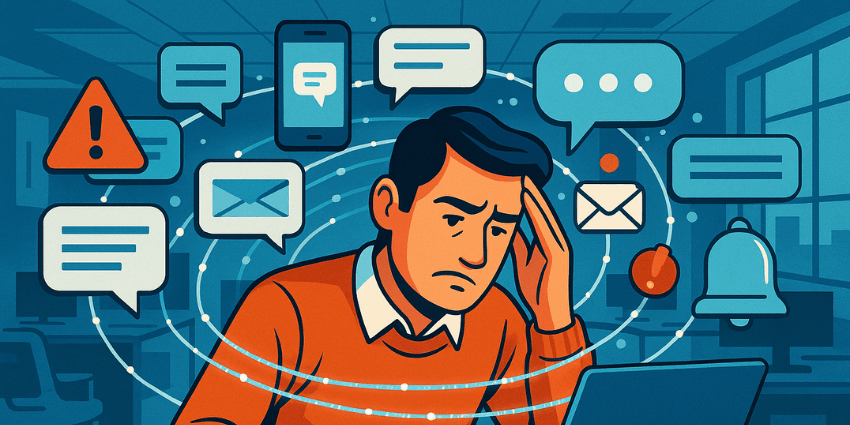
Have you ever suddenly realized after staring at a screen for a few hours, that you haven’t really been taking anything in? You probably skimmed dozens of emails, messages, and sites, but nothing’s stuck, or convinced you to actually “do” anything. It’s not just you. Buyer attention has all but flatlined lately, and it’s easy to see why.
Because the average buyer isn’t dealing with a tidy inbox or a couple of brand notifications. They’re wading through a digital swamp: promo emails stacked like old receipts, push alerts firing off for no good reason, chat apps nudging them about “updates” that aren’t remotely urgent. Then AI came along and multiplied all of it. Overnight.
So now we have this weird tension: brands shouting louder, and buyers hearing less. Statistically, around 70% of customers say they’re “tuning” brand messages out. Not just marketing messages, but service updates and account alerts too.
You can call it marketing fatigue, or message overload, or whatever label feels polite, but the bottom line is simple: people are tired. We need a way to wake them back up.
Further Reading:
- How Brands Can Build Trust in an AI-Driven World
- How AI Helps CMOs Hit KPIs
- 5 Things to Do Before Buying Marketing Tech
What is Marketing Fatigue?
Marketing fatigue is the sense of exhaustion customers feel when they’re constantly bombarded by excessive, or irrelevant brand messages. For a lot of companies, it goes beyond customers just getting “tired” of them. Consumers start disengaging, or even blocking messages.
One study found about 81% of customers are happy to cut ties with brands that constantly overwhelm them. Others don’t “unsubscribe” they just start tuning you out.
What causes marketing fatigue isn’t just the sheer volume of messages customers see today. It’s a combination of things. The same ads repeated across platform, a lack of any relevance or any personalization in suggestions, and even bad timing (sending a marketing message when customers are already dealing with a problem, for instance), all make the problem worse.
Why are Buyers Paying Less Attention to Marketing Messages?
As our guide on how AI helps CMOs boost their marketing metrics shows, companies definitely have more tools fueling better marketing strategies these days. But there are more challenges, too.
Channel Proliferation + AI Content Overproduction
It’s hard to keep track of how many touchpoints brands use now. Email was manageable. SMS was fine. Then push alerts, WhatsApp, in-app nudges, browser notifications, social DMs, RCS, and chatbot prompts all barged in. Customers went from “reachable” to “constantly interrupted”.
GenAI poured rocket fuel on everything. When content that once took a week can be spun up in fifteen minutes, brands inevitably overdo it.
Repetition makes it far worse. Show someone the same ad too many times, and purchase intent drops around 16%. Roughly 59% of people flat-out say repetitive messaging damages the experience. It’s telling that The Times in the UK capped their mobile alerts at four per day because readers were turning them off in frustration. When even high-value news has to ration itself, the rest of us should probably take the hint.
Buyer Journeys Have Shifted Upstream
Meanwhile, buyers changed where (and how) they start looking for answers. Today, about 51% of service journeys start somewhere that isn’t your website, usually Google, YouTube, Reddit, TikTok, or increasingly, AI assistants like ChatGPT.
Buyers show up later, more self-informed, and significantly less patient. They expect your content to match what they learned upstream, and they don’t want to scroll through a 7-email nurture sequence to get there.
Berlin Airport is a good example of how this can work. Their data-driven approach to structured, AI-friendly content helped them improve self-service performance because their information became easier for both humans and AI systems to parse. Their “discoverable upstream” strategy is one more brands will need to copy.
AI-Accelerated Buyers = Higher Standards, Lower Tolerance
Buyers aren’t wandering aimlessly through the funnel anymore. They arrive knowing more, expecting more, and giving less time to anything that doesn’t nail relevance right away.
The tolerance for generic messaging is almost non-existent now. “Hi [First Name], here’s our latest update…” is basically invisible to a customer.
But when personalization is done properly, the upside is huge. Coca-Cola’s journey orchestration program delivered a 36% revenue lift and 89% conversion on re-engagement journeys, not because they sent more, but because the messages actually mattered to the person receiving them.
Frequency Overload Has Crossed Tolerance Limits
If you want a slightly depressing statistic: 55% of customers actively want fewer messages. Their tolerance seems to hover somewhere around five emails per week per brand, and going past that line pushes engagement off a cliff.
41% say they’re simply receiving too many emails. 49% have avoided buying from a brand that contacts them too often.
Cross-channel inconsistency only accelerates fatigue. Disconnect and lack of orchestration between sales, marketing, and customer service teams leads to serious message overload. It’s the promo text that arrives during an outage. The support email that contradicts the marketing email. The push notification that pings while a customer is already mid-conversation with your service team. Everything blends into meaningless noise.
How Does Marketing Fatigue Affect Business Outcomes?
There’s a temptation to see dwindling buyer attention as one of those issues no-one can do anything about. We’re all sort of starting to accept that there’s just too much noise to stand out these days. But that’s the wrong attitude for any company to have.
Let message overload and communication inconsistencies get in the way and you end up with a situation where:
- Critical Messages Are Missed: About 59% of customers say they’ve trashed an important message because it looked like marketing clutter, a fraud alert, a bill, a service notification. When every message looks like a promo, customers treat it like one. That leads to higher support calls, more churn, and financial losses.
- Engagement and Revenue Decline: We tend to look at unsubscribes like they’re a cost of doing business, but they’re not. They’re a shrinking of your reachable universe and future revenue base. People aren’t just unsubscribing anymore. They’re walking away entirely. more people have paid for ad-free experiences this year. When customers are literally spending money to avoid brands, it’s a sign things have gone off the rails.
- Internal Attention Collapse: The irony in all of this is that the people building customer journeys are overwhelmed by alerts and updates themselves. It’s attention collapse on both sides of the glass. Sellers now spend less than one-third of their time actually selling. The rest is swallowed by internal noise: notifications, meeting pings, automatic CRM updates, “urgent” Slack messages, dashboards that refresh every 15 minutes. The whole thing creates a low-grade cognitive buzz that drains focus.
Wondering how AI will continue to change marketing? Read our guide to the future of AI in marketing strategies.
How Can Companies Regain Buyer Attention?
What’s strange is that the solution isn’t “better marketing.” It’s better control. Customers aren’t asking brands to be louder or more clever, they’re asking them to calm down. To stop treating every notification like a life-or-death situation. The upside is that the tech already exists to fix this; most companies just aren’t using it in the right places.
Real-Time Orchestration as the New Growth Engine
If there’s one piece of technology that actually makes a real difference to buyer attention, it’s orchestration. We covered this in our Techtelligence report, so check it out for more insights.
The idea is this: instead of twenty systems deciding independently when to “engage,” orchestration creates one brain that prioritizes, delays, or cancels messages based on what the customer’s actually doing.
Brands that use this right see huge lifts. Saïd Business School, for example, saw 10–20% higher engagement once they harmonized timing and tone across channels. Not new creative. Not more content. Just coherence.
Suppression Rules + Fatigue Scoring
Overcommunication kills customer experiences, across sales, marketing, and service. Good cross-channel suppression rules prevent the worst outcomes, you set rules, so you don’t:
- Send promos to someone with an open ticket.
- Message during a known outage.
- Push reminders when sentiment is negative.
- Double-message across channels within the same hour.
Then there’s customer fatigue scoring, which is basically a way of teaching your system to read “stop” signals. Deletes, quick swipes, zero engagement, and unsubscribes in related campaigns are all early warnings that you’re becoming noise.