

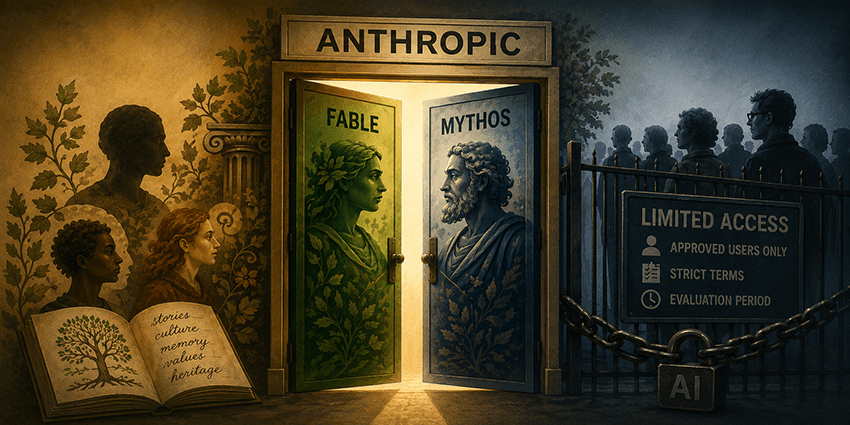
Anthropic is restoring access to its Claude Fable 5 and Claude Mythos 5 frontier AI models after U.S. government export controls were lifted on June 30 but the redeployment is limited, particularly for Mythos 5, and the company has stressed that this is not a full return to business as usual.
The models were suspended on June 12, quickly following their release on June 9. The U.S. Department of Commerce’s export control order required Anthropic to restrict access to foreign nationals, whether located inside or outside the U.S.
“Because the order took effect immediately and we had no reliable way to verify nationality in real-time, we suspended access to both models for all users,” the company stated.
Access to Fable 5 has been restored from July 1, to users globally across the Claude Platform, Claude.ai, Claude Code and Claude Cowork. However, Anthropic is still limiting how the model can be used. For Pro, Max, Team, and select Enterprise plans, Fable 5 will be included for up to 50 percent of weekly usage limits until July 7. After that, it will be available through usage credits.
Access through AWS, Google Cloud, and Microsoft Foundry has not yet been restored, with Anthropic stating that it will re-enable those channels “as quickly as possible.”
The restoration of Mythos 5 is narrower. Anthropic said it has restored access only for “a set of U.S. organizations,” following US government approval on June 26. It is continuing to work with the government to expand access to the broader set of domestic and international partners in its Project Glasswing cybersecurity program.
That distinction is important. While Fable 5 is returning globally in a limited usage capacity, Mythos 5 is not being redeployed broadly.
Why the Models Were Pulled
Anthropic said the original export control directive followed a report in which Amazon researchers identified a method of bypassing Fable 5’s safeguards.
According to Anthropic, the technique prompted the model to identify a number of software vulnerabilities. In one case, the model produced code demonstrating how a vulnerability could be exploited.
“Over the past two weeks, we have worked closely with the government and other partners, including Amazon, to review the report and evidence.”
Anthropic's own testing found that several less capable models, including including Claude Opus 4.8, OpenAI’s ChatGPT-5.5 and Kimi K2.7, could identify the same vulnerabilities and that multiple models could produce the same exploit demonstration, including Claude Haiku 4.5, Sonnet 4.6, Opus 4.6, Opus 4.7, Opus 4.8, GPT-5.4, GPT-5.5, and Kimi K2.7.
The company argued that “the reported technique did not reveal unique Mythos-level cyber capabilities.” Instead, Anthropic characterized it as a borderline case for Fable 5’s safeguards, involving routine defensive cybersecurity work that would normally be blocked out of caution.
Anthropic has responded by introducing a new safety classifier designed to target and block the behavior described in the Amazon report. The company said the classifier blocks the specific technique in more than 99 percent of cases. Users will be notified if a request to Fable 5 is blocked and instead sent to Opus 4.8.
However, it also acknowledged that the stricter controls may create more false positives during routine coding and debugging tasks.
The CX Risk: Powerful AI Models Becoming Part of Critical Workflows
For customer experience leaders, the withdrawal and reintroduction of Fable and Mythos is significant.
First, it shows how quickly access to a frontier AI model can be withdrawn when governments, vendors or security researchers identify unacceptable risk. Second, it highlights the growing overlap between CX, cybersecurity, identity and operational resilience.
Many CX teams are rapidly embedding generative AI into customer-facing journeys, including voice agents, chatbots, knowledge assistants, agent co-pilots, quality assurance, and automated workflow orchestration. As those systems become more autonomous, the underlying model is no longer just another software component. It can become a critical dependency.
In a recent interview with CX Today, Ashish Nagar, Founder and CEO of LevelAI, warned that enterprises should not assume public LLMs will always be available when needed.
“Enterprises need to be in control of their own destiny. What do I mean by that? Don't be dependent on a public LLM provider for critical AI resources.”
That risk becomes more acute when AI systems are embedded into live customer service operations.
If a model powering a customer service bot, voice agent or internal agent-assist tool is suddenly restricted, throttled, or withdrawn, brands could face immediate service disruption. That could mean longer wait times, higher call volumes, frustrated agents, missed SLAs and customer churn.
“It can lead to critical operational gaps,” Nagar said. Enterprises should look beyond standard cloud-style uptime guarantees and scrutinize availability, throughput, latency, security, data use and dependency on third-party model providers.
“Availability, throughput, and latency, all three are really important,” Nagar noted.
For CX teams, latency is not an abstract infrastructure metric. In voice AI, for example, a delay of several seconds between turns can quickly damage the customer experience.
As Nagar pointed out: “If somebody's buying looking to buy flowers for their mother on Mother's Day, and if every response is three and a half seconds apart between when you're talking to an AI agent, the customer will find another brand to buy flowers from.”
Multi-Model Orchestration Could Become Critical
The partial redeployment also highlights the importance of intelligent AI orchestration. If access to one model is restricted, throttled or becomes too expensive for certain workloads, CX platforms may need to shift tasks dynamically across different models.