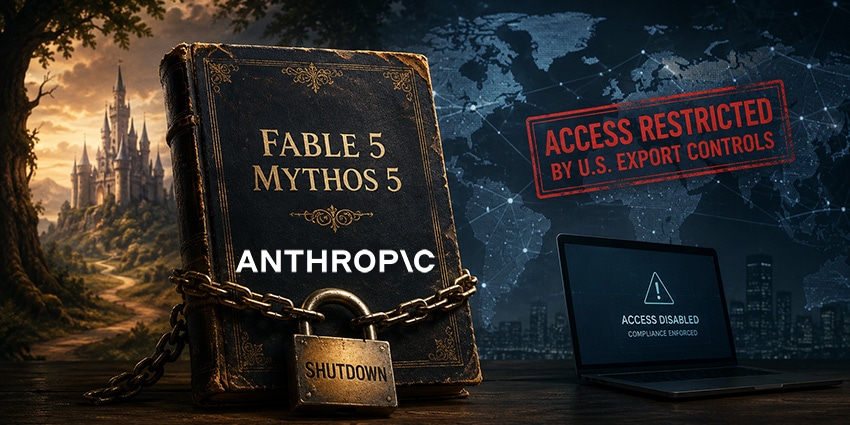
Anthropic’s sudden shutdown of its Fable 5 and Mythos 5 AI models is a warning for enterprise technology and customer experience leaders.
The company stated on the evening of June 12 that it had been forced to suspend access after receiving a U.S. government export-control directive targeting “all access to Fable 5 and Mythos 5 by any foreign national, whether inside or outside the United States, including foreign national Anthropic employees.”
Unable to control access in such a way, Anthropic stated:
“The net effect of this order is that we must abruptly disable Fable 5 and Mythos 5 for all our customers to ensure compliance.”
The move immediately disrupted access to Anthropic’s newest and most advanced commercial systems. Fable 5 had only launched publicly on June 9 as the first broadly available version of the company’s restricted Mythos-class models.
Anthropic had positioned the release as a carefully controlled deployment with additional safeguards for high-risk domains including cybersecurity, chemistry and biology. The company said at launch that Fable 5 would refuse or reroute sensitive requests and that “questions about some topics will instead be answered by Opus 4.8.”
The shutdown followed claims that external researchers had discovered methods capable of bypassing some of those protections.
“Our understanding is that the government believes it has become aware of a method of bypassing, or ‘jailbreaking’ Fable 5. We reviewed a demonstration of this specific technique being used to identify a small number of previously known, minor vulnerabilities,” Anthropic stated, adding:
“These vulnerabilities all appear relatively simple, and we have found that other publicly-available models are able to discover them as well without requiring a bypass.”
Tech founder and investor David Sacks, Co-Chair of the White House Council of Advisers on Science & Technology, wrote on X: “A highly credible trusted partner identified a jailbreak of Fable that raised serious national security concerns. The administration acted appropriately and responsibly.”
"Fable is Mythos with guardrails. But if those guardrails fail, then you’ve exposed Mythos and its advanced cyber capabilities to people who shouldn’t have them," Sacks wrote. "Keep in mind that Anthropic itself widely promoted the idea that Mythos was a cyberweapon and needed to be regulated as such. They asked for government regulation of Mythos and championed the guardrails on Fable. If there is a vulnerability — big or small — it is Anthropic’s responsibility to patch."
Anthropic disputed the characterisation of the issue, stating: “No universal jailbreak has been discovered.” The company added that the government had not presented “evidence of catastrophic or qualitatively novel capability uplift,” and argued that the threshold being applied could fundamentally reshape frontier AI deployment.
"If this standard was applied across the industry, we believe it would essentially halt all new model deployments for all frontier model providers."
For CX and enterprise technology leaders, the implications extend well beyond the U.S. government’s ongoing dispute with one AI provider.
The security concerns surrounding Mythos and Fable were already drawing scrutiny before the shutdown. Mythos-class systems are accelerating vulnerability discovery faster than enterprises can realistically patch and remediate issues. The issue has become especially relevant for Anthropic because Mythos and Fable were designed specifically for advanced cybersecurity research and vulnerability discovery, capabilities that some researchers and policymakers believe could create significant misuse risks if protections fail or access expands too broadly.
Customer Trust Risks Grow as AI Platforms Face Restrictions
“The recent Anthropic restriction on Fable and Mythos could have far reaching consequences for European and UK businesses and operators of critical infrastructure such as hospitals, energy providers or banks,” Nadia Kadhim, Executive Director at European AI research non-profit Aithos, told CX Today.
“The events have shown that we are dangerously reliant on U.S. systems and there is a real, not just theoretical, risk that necessary services could stop working at the whim of the American government without proper notice, the right to information or the right to appeal.”
Many organizations are now embedding advanced foundation models directly into customer service workflows, digital assistants, agent-support systems, search experiences and knowledge management platforms. The Fable shutdown demonstrates how quickly those customer-facing systems can become vulnerable to regulatory intervention or geopolitical tensions.
Unlike conventional SaaS outages, disruptions to AI models may emerge from export controls, national security directives or changing interpretations of acceptable model risk. That creates a new category of operational dependency for enterprises building experiences around a small number of AI providers.