

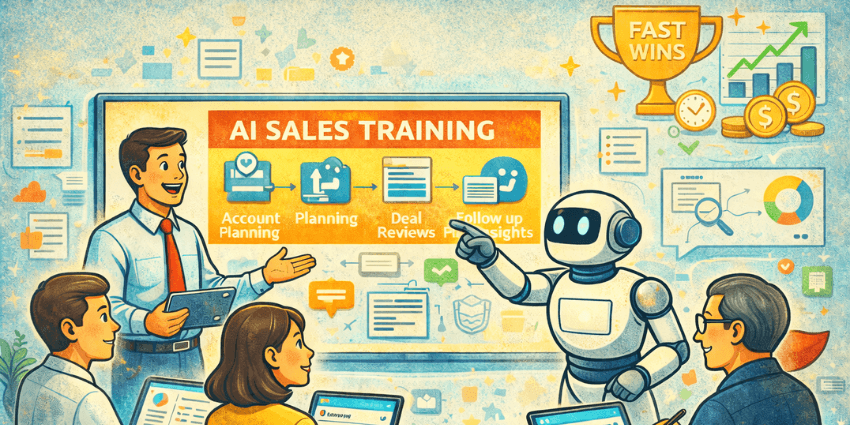
Once an AI sales solution has been chosen, most enterprises assume the hard work of sales team upskilling is done. In reality, the risk simply shifts: the technology may largely perform as promised, but sales behavior may not change enough to unlock value. That’s where structured sales training and AI sales training become the decisive factors in whether you see a return in the first 6–12 months.
From my vantage point, the quickest path to ROI is clear: treat AI sales training as an integral part of your go-live plan, not a parallel initiative. The aim is simple – help sellers sell more, faster, using the tools you have already paid for and truly supporting salespeople with tech instead of adding extra admin.
Make AI Part of the Sales Workflow, Not a Side Project in Your Sales Training
Generic sales training on “what AI is” has limited value. Reps need to see exactly how the new tools help them do their jobs today – not in theory, and how supporting salespeople with tech makes their daily work easier, not harder.
Anchor AI enablement in real sales motions:
- Account planning and territory coverage
- Opportunity management and deal reviews
- Prospecting, outreach, and follow-up
- Renewals and expansion motions
Every session should answer one question:
“How does this AI capability help me win this type of deal faster?”
Frontline managers are critical here. Equip them with simple coaching prompts (for example, “Show me where you used the AI assistant on this opportunity”) so AI usage becomes part of regular pipeline and 1:1 conversations.
Design Role-Specific Sales Team Upskilling and B2B Sales Team Skills
AI will be used very differently by SDRs, account executives and sales leaders, so B2B sales team skills need to be developed in different ways. A single, generic sales training path will slow adoption.
- SDRs: focus on prospecting efficiency, list building and AI-assisted outreach.
- AEs: emphasize stakeholder mapping, summarizing customer interactions and next-best actions in complex deals.
- Managers: train on pipeline insights, risk signals and coaching opportunities surfaced by AI.
Keep modules short, scenario-driven and immediately applicable. The most successful programs I see blend classic sales training principles with AI-specific workflows, rather than treating AI as a separate “tech” topic – they make sales team upskilling part of everyday selling.