

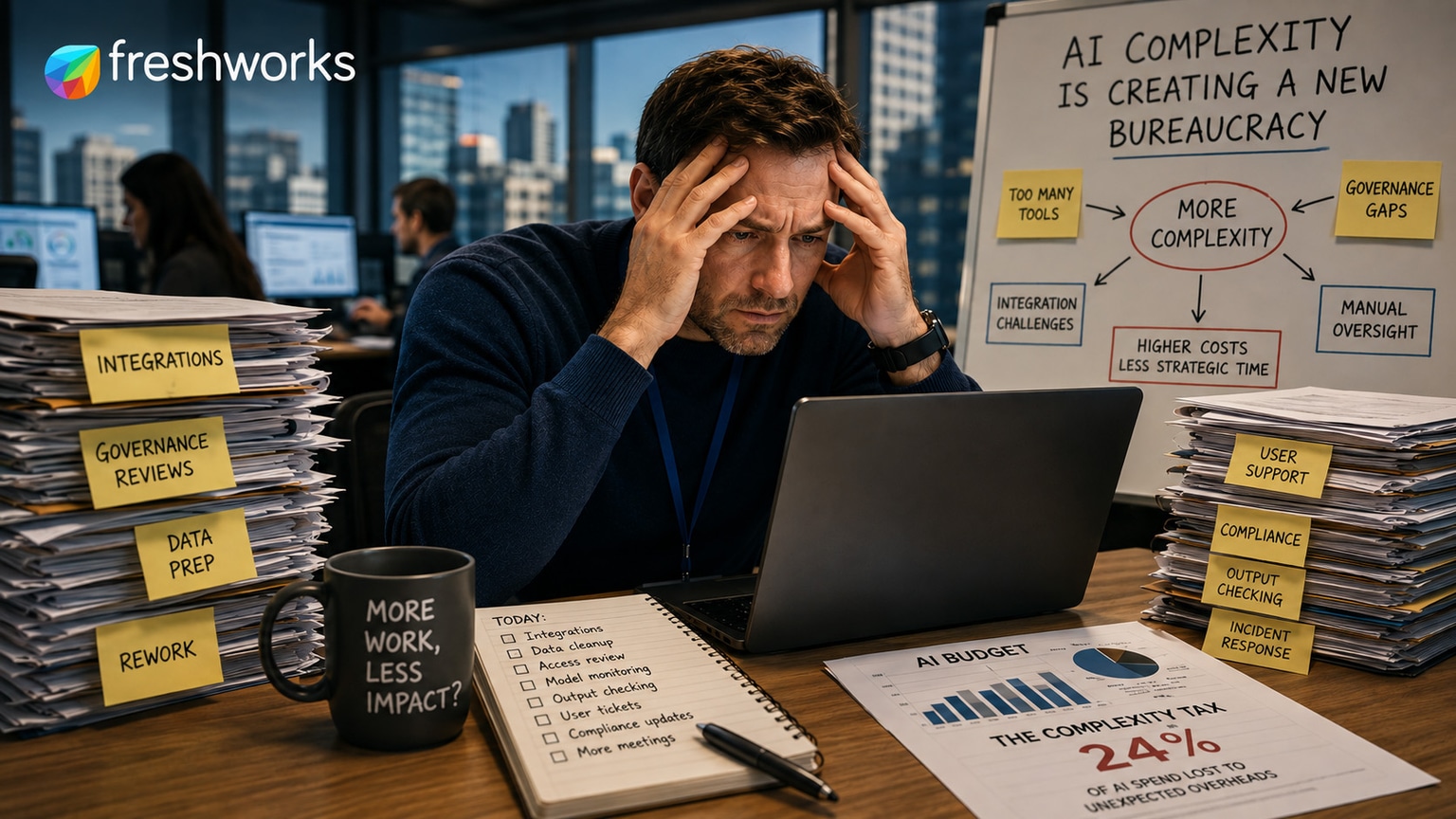
AI is increasing IT teams’ workloads, draining budgets and distracting them from strategic work, according to Freshworks research, a pattern that is reflected by wider 2026 research into “botsitting,” governance gaps and enterprise AI readiness.
AI is meant to reduce busywork, but many U.K. organizations are creating a new layer of internal bureaucracy as AI environments become more complex and difficult to govern.
The Freshworks Global Cost of Complexity Report found that 88 percent of IT decision-makers in the U.K. say managing AI complexity has increased their team’s workload, second only to the U.S.
A similar proportion, 87 percent, report that 10-39 percent of their team’s AI-related time is spent managing complexity rather than doing strategic work. On average, U.K. IT teams now spend around a quarter of their AI-related working time managing integrations, troubleshooting and complexity instead of focusing on strategic initiatives.
That burden is also hitting budgets. Organizations estimate that 24 percent of their AI spend is lost to unexpected overheads such as integration, governance, data preparation, rework and ongoing support. Freshworks describes this hidden expenditure as the “complexity tax.”
A third of U.K. IT decision makers describe that complexity as “a very significant issue” for their organization.
As Simon Hayward, Vice President of Sales, EMEA at Freshworks, pointed out, "UK businesses are under pressure to boost productivity and cut through bureaucracy, yet our research shows AI is often adding to the workload rather than easing it… If AI is going to move the needle on UK productivity, organizations need to plan for how it fits into their existing systems and teams, not just for the technology itself."
AI Is Saving Time But Also Creating New Work
The Freshworks findings come as wider research points to a growing divide between individual productivity gains and organizational value.
Glean’s Work AI Index 2026 found that 75 percent of digital workers say AI makes them more productive. However, only 13 percent say AI has significantly improved their organization’s performance and outcomes.
One reason is the amount of work now required to make AI usable. Glean found that workers spend an average of 6.4 hours per week “botsitting,” feeding AI tools context, checking outputs, debugging errors and cleaning up answers that are confident but wrong answers.
It also found that 77 percent of workers have corrected or redone AI-assisted work in the past month, while 36 percent of AI sessions “fail” outright and require a restart or substantial rework.
This reflects the core issue identified by Freshworks that AI often creates new operational work around the technology. As Hayward told CX Today:
"The extra workload is coming from everything that sits around the AI rather than the AI itself.”
“Every new AI deployment has to be connected into existing systems, monitored for accuracy and kept compliant, and that ongoing management is landing squarely on IT teams. Essentially, the productivity gain organizations expected from AI is being absorbed by the operational effort needed to keep it running."
The Hidden Cost of AI Overheads
Many organizations are finding that their AI budget is being consumed by the work needed to make systems function inside the enterprise, including connecting AI to existing applications, preparing data, managing governance, reviewing outputs, resolving errors and supporting users.
U.K. organizations estimate that almost a quarter of their AI budgets are being lost to this complexity tax, according to Freshworks, including on integration challenges, oversight, data preparation and the operational details that surround AI.
Hayward said:
"Businesses are budgeting for the AI capability itself and underestimating everything it takes to make that capability work inside their existing environment.”
“Our research puts the cost of this at close to a quarter of total AI budgets, lost to what we call the complexity tax… None of that shows up in a vendor proposal, so it gets treated as a hidden cost rather than something organizations plan for from the outset."
This is also where governance becomes a practical business problem.
Grant Thornton’s 2026 AI Impact Survey found that 46 percent of executives cite governance and compliance failures as a leading cause of AI underperformance. It also found that 78 percent of business executives lack strong confidence that they could pass an independent AI governance audit within 90 days.
Board-level readiness remains weak too. Grant Thornton found that 48 percent of boards have not set AI governance expectations, while 46 percent have not integrated AI risk into ongoing oversight. Only 20 percent of organizations have a practiced or tested AI incident response plan.