

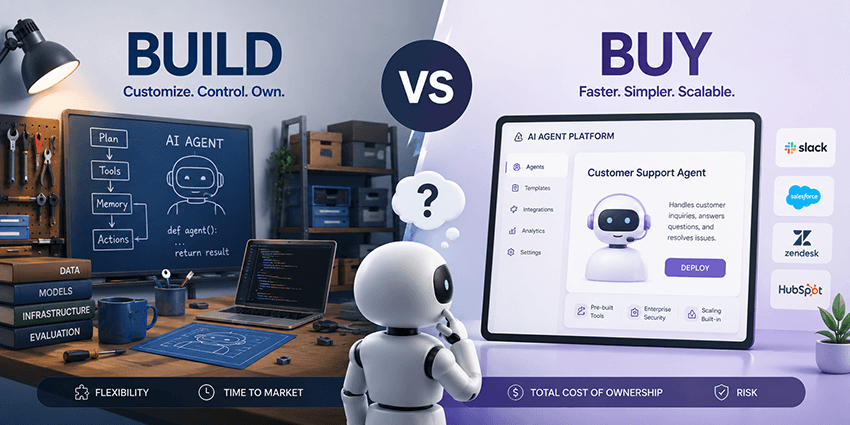
As customer experience (CX) teams race to deploy AI agents, leaders are faced with the question: Do we build our own custom AI agents from scratch, or do we purchase an off-the-shelf platform?
Recent industry research highlights a striking disconnect. While a significant majority of CX leaders express a desire to build their own AI agents to maintain control, market data tells a cautionary tale. According to widely-cited MIT research, 95 percent of in-house AI initiatives fail. The hidden costs of custom development are high, with organizations shelling out on model API calls, infrastructure, prompt engineering, testing and data management.
Gartner forecasting indicates why the build-versus-buy question is becoming more urgent. As enterprises increase their use of GenAI models already embedded in software, alongside new AI agents operating across multiple workflows, Gartner expects this shift toward multi-step, agentic automation to drive a sharp rise in short-term AI model usage. The analyst firm has increased its 2026 outlook for AI model growth to 110 percent, adding an estimated $6BN in spending this year.
That points to a market where buying AI capabilities through established platforms will become increasingly common, even as organizations continue to assess where custom-built agents can deliver genuine differentiation.
The Allure of Building: Trust and Specificity
If the costs and failure rates of building are so high, why do so many CX teams still want to take the DIY route? According to Dhwani Soni, Global VP of Product Management and Design at 8x8, it comes down to two factors: trust and domain specificity. As Soni told CX Today:
"Off-the-shelf agents are built for the average workflows. However, most companies don't have standard average workflows."
"They have very specific terminology. They've got escalation paths, regulatory constraints... They are not looking for off-the-shelf, but something that's curated for their need and something that they can trust with their infrastructure."
8×8 offers AI Studio, a tool that lets contact center teams build and deploy AI agents on the platform they already operate.
When businesses evaluate standard SaaS AI solutions, they often find them lacking the nuances they need to apply to their specific industry. But attempting to build a custom solution from the ground up to solve this problem introduces operational risk and delays.
From Off-the-Shelf Bots to Prebuilt Agents
There is a shift in the way vendors are packaging AI agents. Salesforce has launched Agentforce Help Agent, a pre-packaged autonomous service agent built on the Agentforce 360 Platform. Unlike earlier agent-building approaches, where companies had to connect their own knowledge sources, define actions and wire up channels themselves, Salesforce says the Help Agent comes with guided setup, Salesforce Knowledge grounding, pre-packaged actions and deployment across voice, web portal and messaging from a single screen.
The release indicates that the “buy” side of the market is heading away from one-size-fits-all bots toward configurable agents that come with the core plumbing already in place.
The Pragmatic Middle Ground: Buy the Commodity, Build the "Secret Sauce"
For enterprise leaders deploying these systems, the "build vs. buy" debate is rarely a binary choice. Instead, it’s about strategic allocation of resources.
Simon Ellis, Head of AI Transformation and Enterprise Architecture at Pets at Home, views the dilemma through the lens of a technology maturity curve: don't spend money building what someone else has already perfected.
"I'm going to buy the commodity if the platform's there and it's good, and you've got partners who have spent hundreds of millions, if not billions, investing in building something. You take that, and then you build your secret sauce—what makes you different."
At Pets at Home, this means relying on established platforms like Salesforce for standard customer service and veterinary B2B support. But when it came to the company’s highly specific consumer-facing digital pet care platform, the clear choice was to build.
"We built our own digital pet care platform, so that is where we have built differentiation, because that's unique to us. We can't go out and buy a pet care platform. It doesn't exist," Ellis told CX Today. "If we wanted to build all that [foundational infrastructure], you're talking hundreds of millions and years, so buy the best and bring them together."
The Hidden Risk of Building: The Compliance Trap
While building custom agents offers control over the "secret sauce," it also places the burden of legal compliance squarely on the enterprise's shoulders. And as recent research from Aithos shows, this is a burden most companies are not prepared to carry.