

Agentic AI vs AI Copilots, What Buyers Are Actually Comparing
AI copilots arrived with a simple promise: help people work faster. In practice, that help often looks like meeting summaries, suggested next steps, and search or writing assistance.
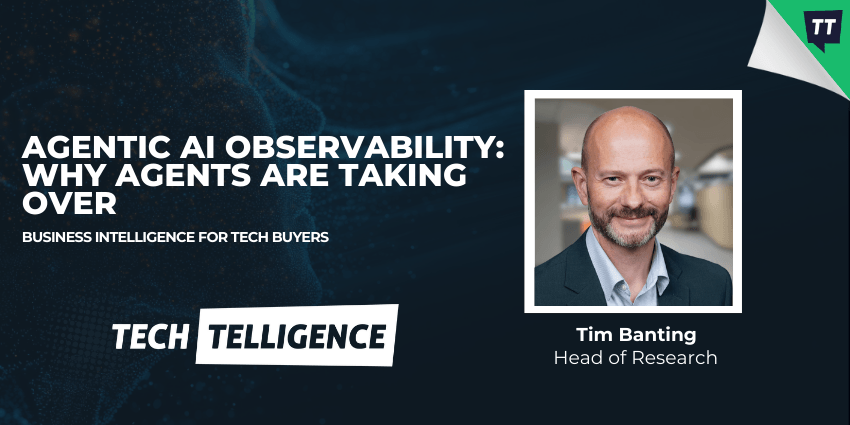
Tim Banting, Head of Research at Techtelligence, notes though:
“Those sorts of capabilities are just expected now.”
The market is already shifting to a different idea: agentic AI. While copilots typically assist a user inside a workflow, agentic systems aim to complete the workflow.
Banting sees copilots are like “Google Maps,” while agentic AI is “more like a self-driving car.” The distinction matters because enterprises are no longer judging AI by how polished its outputs look, but by whether it can take accountable action across real business systems.
That brings us to the keyword that will define the next buying cycle: Agentic AI Observability. If AI is going to act, buyers need to see what it did, why it did it, and what it used as evidence.
Copilot Compliance Hits a Trust Wall, Agentic AI Raises the Standard
For many organizations, the copilot story loses momentum at the point where legal, risk, and compliance teams get involved.
Just ask Air Canada. The company was found liable in a small claims court after its AI chatbot gave a customer inaccurate information. This precedent highlights that companies will be held responsible for any mistakes from its AI.
Banting explains that copilots are “falling short” because they still require people to verify results. That verification is not just quality control, it is liability management.
He points to the “trust wall” and the need for accountability.
“What people do is they end up checking whether AI has got the right answers. But they’d prefer to have observability to make sure that what AI is saying is rooted in some really good foundational insights and data.”
In other words, compliance is not only about policy, it is about provability.
This is where agentic AI becomes an upgrade, but also a bigger test. Agentic systems should be “auditable,” “enforceable,” and designed with observability so organizations can measure, review, and defend outcomes.
In practical terms, Agentic AI Observability becomes a core compliance feature, not a nice-to-have. It is what enables a risk officer to trace an AI decision to the underlying document, policy, or approved knowledge source.
Related Articles:
- How Data Layers and AI Are Rewriting the CCaaS Market
- A 2025 Review: The 5 Trends Every Head of CX Needs To Know
- Less Tech, More Flow: Why Orchestration Is the New CX Power Move
The Productivity Question: What Supports CX Staff
The productivity pitch for copilots is also facing scrutiny. If employees must constantly double-check, correct, and re-run outputs, time savings can evaporate. Banting cites Workday research that should make any CIO pause:
“Heavy users spend about one or two hours a week fixing AI's outputs.”
This need for review and reworking adds up to a significant amount of lost productivity over time.
The issue is not only wrong versus right, it is the dangerous middle. He calls out the operational pain of partial correctness: “almost right is really, really challenging.” Because it sounds credible, this information forces employees to spend extra effort figuring out why the system arrived at a conclusion, and whether it is safe to act on.