Zoom has expanded its contact center portfolio by introducing Zoom Workforce Management.
The platform provides solutions across the workforce management (WFM) cycle, which has four stages. These are: forecasting, scheduling, intraday management, and review.
At that final review stage, planners take learnings and apply those to their future plans, completing the cycle and ensuring continuous improvement.
Zoom has applied AI across the cycle to lighten the load on planners.
Moreover, as Ben Neo, Customer Experience Sales Leader at Zoom, tells CX Today:
Zoom’s WFM software is easy to use, intuitive, and reliable, and best of all is cloud-based to help customers scale up and down as their team evolves.
"This is another key element to further round out the Zoom Contact Center functionality and shows how we are reacting quickly to customer feedback."
Interestingly, Neo also suggests that the platform will soon expand further, with Zoom Workforce Management the first offering within a wider Workforce Management Engagement (WEM) suite.
Alongside WFM tools, such suites often include contact center Quality Assurance (QA), gamification, and learning management solutions.
These will bring many further native capabilities to Zoom Contact Center customers.
Yet, first things first, let’s delve deeper into the core competencies of Zoom’s WFM platform.
Forecasting
The WFM platform ingests historical contact volume data directly from the Zoom Contact Center.
With this, planners may utilize the forecasting tool to automatically predict demand - four weeks at a time.
Alongside this forecasted demand, the solution may predict average handling time (AHT) across the same period and account for various metric targets - i.e., service level, target occupancy, etc.
After combining this information, planners can complete staffing calculations in just a few clicks.
Yet, they may also take the process to a more granular level by segmenting historical and forecasted traffic across various scheduling groups.
Finally, users can create unique forecasts for peak seasons and "what if" scenarios while making manual tweaks based on their own experience.
Here’s a sneak peek of the UI Zoom provides with its forecasting solution.

As Zoom expands the solution, the vendor may consider adding more forecasting models. The WFM team could then test the most accurate model for their environment.
Zoom may also drop in more channels as its CCaaS platform expands. Indeed, the offering currently supports voice and chat alone.
Scheduling
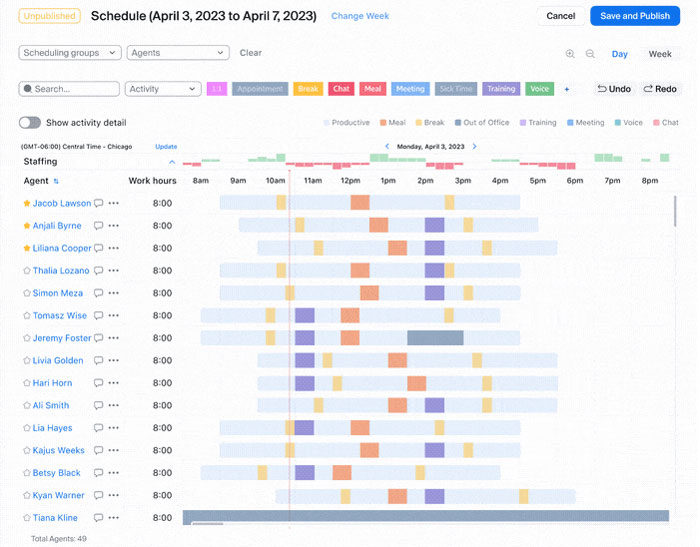
Taking data from the forecast, the Zoom Workforce Management solution generates recurring schedules, which account for agent contracts and preferences.
These are easily adjustable as contact center and agent' needs change.
Moreover, schedulers may use dedicated modules to plan agent activities, optimize their breaks, and schedule different groups.
Still, many contact centers leverage messy spreadsheets to meet such needs. Zoom aims to support these operations in building more flexible schedules from one application.
Here's a glimpse of the UI Zoom provides with its scheduling solution.