

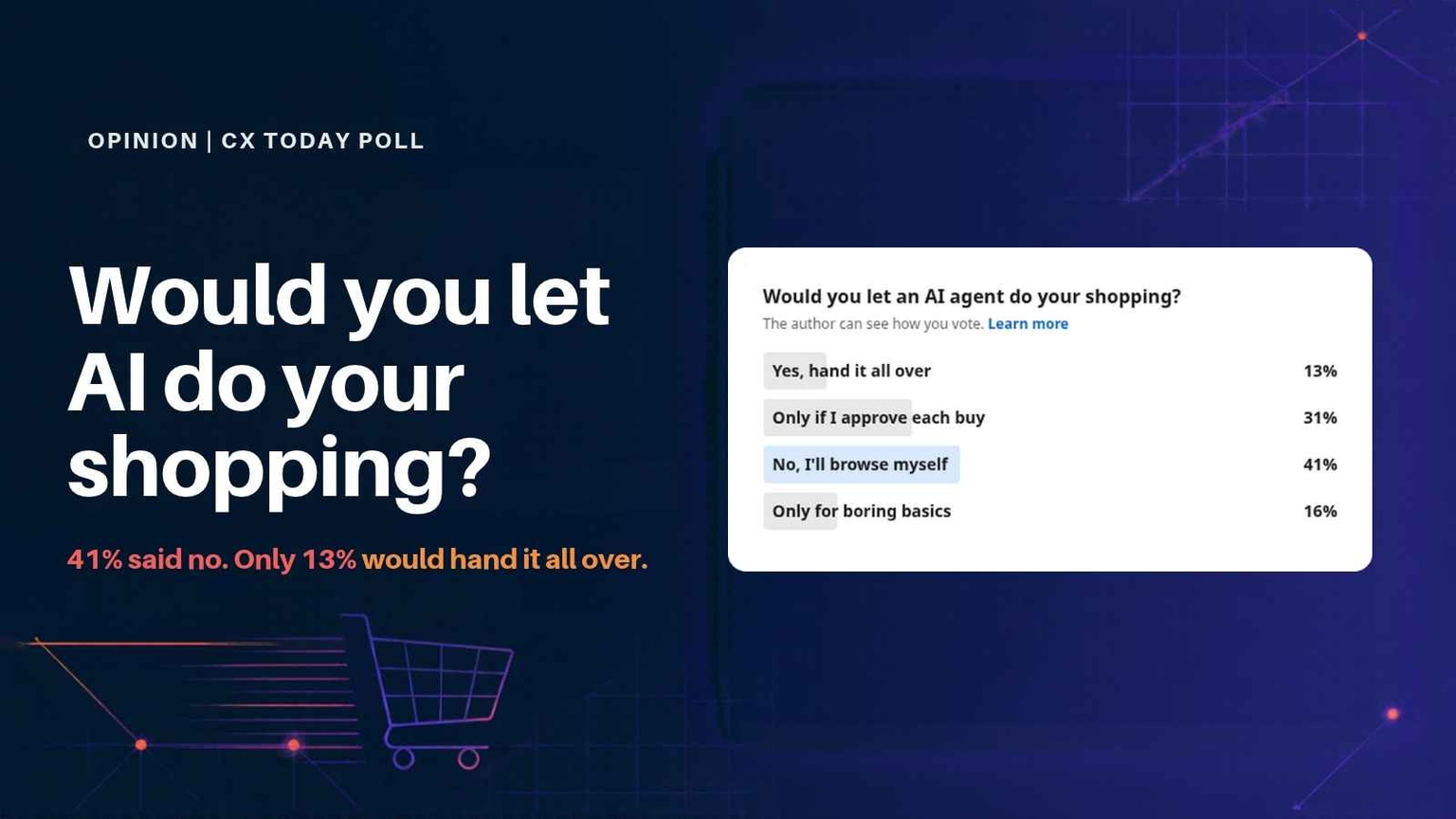
Last week, we asked a simple question on CX Today's LinkedIn page: would you let an AI agent do your shopping?
One thing to be clear about up front: this was just a LinkedIn poll, and not a huge sample. Thirty-two people voted over the week, mostly from our audience of CX professionals rather than a representative slice of shoppers. So read it as a temperature check, not a survey. We'd hoped for a bigger turnout, but it was a busy week for CX news and bigger stories dominated our LinkedIn channel, from Microsoft Ignite 2026: 7 Questions for CX Leaders to Salesforce Buys Cresta, and AI Stack Questions Grow.
But temperature checks are useful when the reading is this clear. And this one is.
The timing wasn't accidental. On 2 November, CX Today reported that Amazon wants Alexa to become your default shopping agent. According to Amazon, more than 400 million customers have used Alexa for Shopping in the past 12 months. Andy Jassy, Amazon's President and CEO, told the company's latest earnings call: "We believe Alexa for Shopping is going to be the primary shopping agent customers use to shop Amazon."
That's a big ambition, so we wanted a quick read on whether our audience is ready for it.
The poll closed today. Here's what came back.
- Yes, hand it all over: 13%
- Only if I approve each buy: 31%
- No, I'll browse myself: 41%
- Only for boring basics: 16%
Only 13% will let go of the wheel
Barely one in eight respondents would hand their shopping over to an agent entirely. That's the scenario the agentic commerce pitch is usually built around – the assistant that just knows what you need and gets on with it.
The single largest group, 41%, said they'd rather browse themselves. No agent, thanks.
The more interesting story sits in between. Put "only if I approve each buy" (31%) together with "only for boring basics" (16%) and you get 47% – nearly half – who are open to an agent, but only with guardrails.
I'm in that camp. I voted "Only if I approve each buy", and as I said in the comments, I'm not ready to let an agent spend my money without a final say.
That isn't a rejection of the technology. It's a statement about control.
The barrier is trust, not capability
The capability question is being answered fast. CX Today's report notes that Amazon says it has added more than 100 new capabilities to Alexa for Shopping, from building gift lists to adjusting Subscribe & Save deliveries and managing payments. Amazon also said customer interactions with the assistant grew 570% year over year.
Nobody in our poll was really asking, "Can an agent do this?" They were asking, "Do I trust it to do this on my behalf, with my card?"
Those are very different questions. The first is an engineering problem. The second is a customer experience problem – and it's the one that will decide how far, and how fast, agentic commerce goes.
Amazon also reported that US users of the feature spent 50% more per order than those who didn't use it. As my colleague Rhys Fisher pointed out in his piece, that alone doesn't prove the experience is better. Amazon didn't explain whether the assistant improved customer confidence, reduced returns or shortened decision time.