

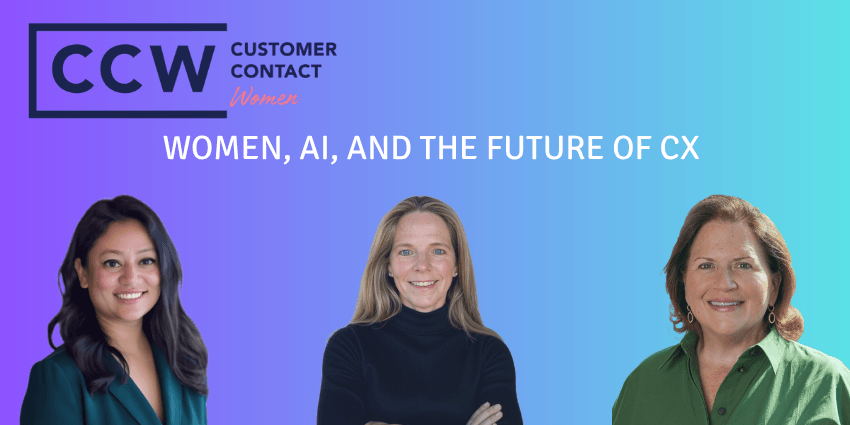
At CCW Vegas, CX Today's Sophie Wilson sat down with three CCWomen Summit speakers - Melissa Solis, CEO of Inbenta; Kamana Khadka, Founder of Inclusion Multipliers; and Courtney Shealy, SVP of Global Pre-Sales at Medallia - to unpack the forces reshaping customer experience leadership. Their conversations surface an urgent message: AI is widening the gap for women in CX, and closing it demands action now.
The Crisis No One Is Talking About Loudly Enough
The numbers are stark. According to Melissa Solis, CEO of Inbenta and a 30-year veteran of the tech industry, approximately 13 to 14 million women currently work in the call centre and customer experience space - and analysts project that up to 50% of those roles could be displaced by AI within the next three to four years.
Solis said
"That is staggering. We're going to have half these women missing in three years - not even here at this forum."
Solis, who founded a company with $300 and sold it for $610 million before coming out of retirement to tackle the gender gap head-on, pulls no punches about the systemic failures at play. Policy changes haven't worked. Representation in AI is dismal - less than 30% of the AI workforce is female, fewer than 15% hold leadership roles, and female CEOs are rarer still.
Her message is direct: women cannot wait for the system to fix itself. "Quit waiting on a man to solve your problem," she said. "AI is an equaliser - anything you need to know, you can learn without stepping into a college, without spending money. Shut the TV off, start investing in yourself."
Rethinking DEI: From Department to Distributed Leadership
While Solis zeroes in on individual empowerment, Kamana Khadka, Founder of Inclusion Multipliers, is focused on transforming the organisational structures that shape opportunity.
As DEI departments face widespread cuts across US enterprises - a trend accelerated by political backlash - Khadka is not sounding the alarm. She's sounding a different note entirely.
"The future of DEI is actually pretty bright, companies that were truly committed from early on - like Costco, like IKEA - are doubling down. They may have rebranded, but the work continues."
Khadka's concern is less with the acronym and more with the architecture. Her framework, Inclusion Multipliers, advocates for taking DEI out of siloed HR departments and distributing inclusion responsibility across all leaders.
"When it's distributed leadership, even if your budget goes away, the work still continues - and that's how it should be."
On the AI knowledge gap specifically, Khadka is clear-eyed. Women are disproportionately underrepresented in the rooms where AI decisions are made - not just in training, but in design. "Women need to be in the boardrooms and meeting halls where the decisions are being made about how to use AI, what's the design," she said. Her call to action for CX leaders: bring non-technical women into AI training conversations, not just the tech-savvy ones.
"That's the way to shorten the equity gap."
Humanising AI: The Case for Keeping Humans in the Loop
Courtney Shealy, SVP of Global Pre-Sales at Medallia, approaches the conversation from a different angle - the technology itself, and what it should and shouldn't replace.
Her CCWomen talk focused on humanising AI in contact centres, and the core thesis is deceptively simple: leaders are asking the wrong question. Instead of what can we automate?, the better question is what should remain human?
"AI is going to be there to help us research, prepare, and take certain tasks off our plate, but it doesn't replace the desire and need for human connection."
The opportunity, as she sees it, is to use AI to eliminate redundant tasks so that human agents can do what they do best - coach, empathise, and build lasting customer relationships.
Medallia's work centres on reading not just what customers say, but the intent and emotion behind their words.
"Can I not only understand the words they said, but their intent - hidden in the words they use, the emotions they speak about?"
That depth of intelligence, she argues, is what connects CX teams to real business outcomes: growth, customer retention, and risk reduction.
On women in leadership, Shealy is optimistic about AI's potential as a leveller.