

Despite the recent advancements in AI technology, customers appear to be turning their back on chatbots for their customer service needs.
Conducted by Gartner, a survey of almost 500 B2B and B2C customers has revealed that just 1 in 12 respondents used a chatbot during their latest customer service communication.
More worrying still, of the few customers who did use a chatbot, just 25% of them would use one again in the future. Indeed, amongst B2B customers, chatbots were ranked as the least utilised of all customer service channels (7%) – highlighting a clear lack of trust in the AI technology.
But why are customers avoiding chatbots in spite of them being more advanced than ever? And how can businesses address this rising issue?
Crossed wires
The chatbot market is developing rapidly, with 76% of organisations believing that virtual customer assistants/chatbots will be a high-value channel capability for their organisation in the next two years.
Yet, despite customer service and support leaders’ growing focus on chatbots, customer use of them remains low – highlighting a clear disconnect between how businesses and customers view their effectiveness.
The variations of chatbots are confusing customers, making them uncertain about when best to engage.
Part of the issue lies in the all-encompassing nature of the phrase ‘chatbot’, which covers everything from digital interactive voice response systems (IVRS) that can provide basic routing, to complex AIs that can recognise customer intents and connect them with the next best actions.
This variation can often confuse customers and create uncertainty as to when it is best to engage a chatbot to resolve their issue.
This divide and uncertainty is evidenced in the survey and is one of the major factors in the plummeting popularity of chatbots.
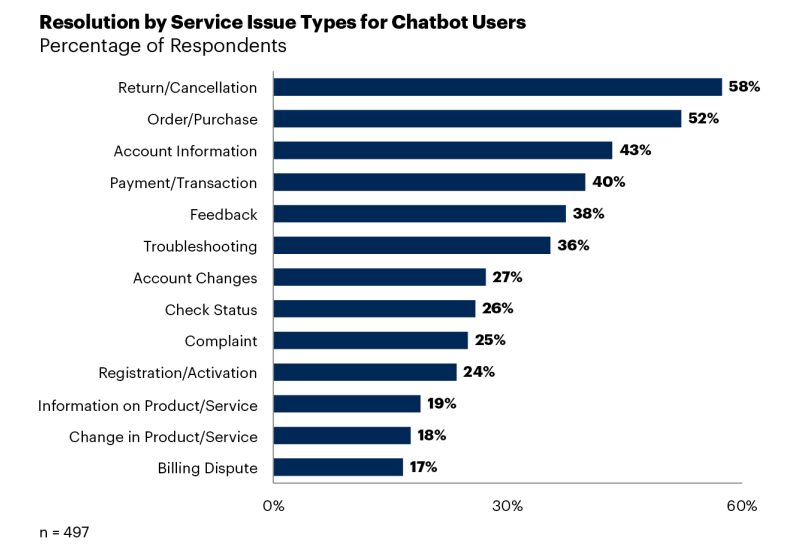
The data reveals that chatbots are highly varied in their capacity to resolve different customer intent types, facilitating resolution rates as high as 58% for returns/cancellations, and as low as 17% for billing disputes.
However, while businesses with a deep understanding of their chatbot capabilities and limitations know what issues are a good match, customers do not.
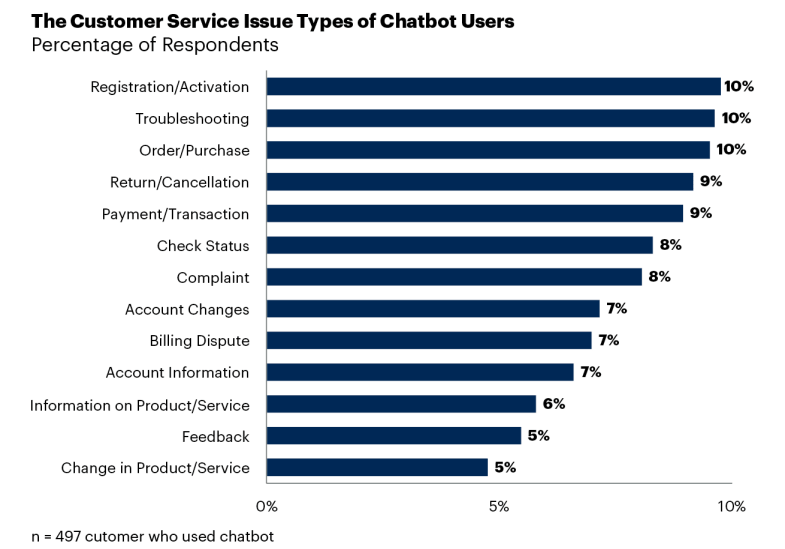
For example, customers are only 2% more likely to use a chatbot for a return/cancellation than use it for a billing dispute, despite the above graph showing that chatbots are far more successful in helping with returns.