
A survey of retail customer service agents has revealed that over half do not believe that their employers take their mental health seriously.
Conducted by DigitalGenius in support of Mental Health Awareness Week, the report explored how working at the frontline of customer service impacts agents’ mental health, and what measures and support employers are, or should be, implementing.
Of the 517 agents surveyed, only 48% believe that their organization takes their mental health seriously. Interestingly, the findings revealed that the larger the company, the less supported agents feel – as highlighted in the below graphs:
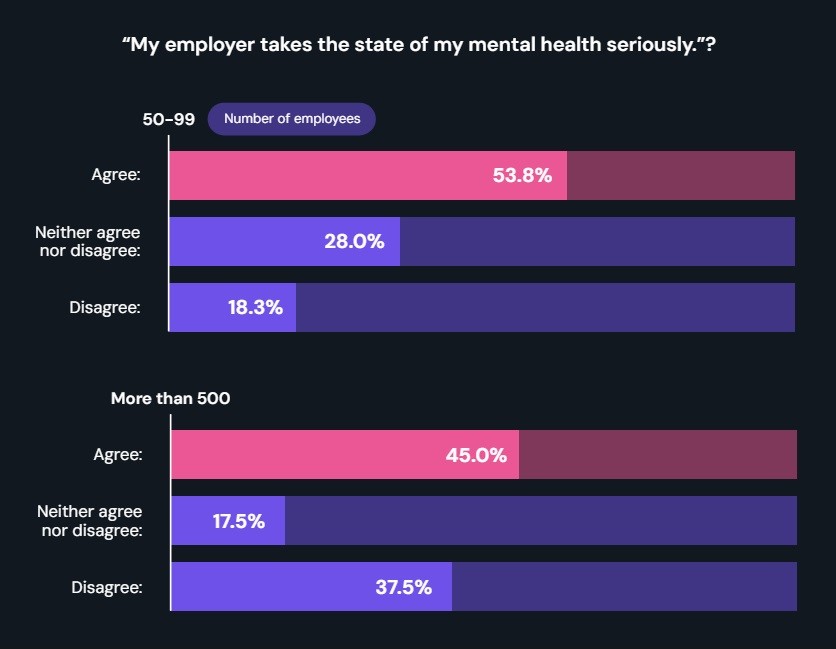
customer service agents
This is particularly troubling when coupled with the fact that 83% of call center agents have reported that work pressures have directly impacted their mental health, with 95% admitting that work-related mental wellbeing concerns have lowered their productivity.
The latter point here is especially important for employers, as while many may not consider it their responsibility to have a moral or ethical interest in their employees, the research shows that providing mental health support and fostering a happy environment is actually a savvy business decision.
Eleanor Galtie, Customer Service Manager at Boardriders, discusses her own teams’ experiences and how having happy agents is crucial to the success of the business:
It [employee wellbeing] is directly connected to employee satisfaction and engagement, increased productivity and a reduction in absenteeism. This is especially crucial for my team, given the potentially stressful nature of their role especially during peak periods.
Moreover, research conducted by digital job search and review platform Glassdoor, found a correlation between reported employee well-being and customer satisfaction – implying that happier employees equal happier customers.
So, let’s take a look at some of the causes of added stress that are negatively impacting agents’ wellbeing.
Stopping the Stressors
While any job can come with stresses, the report focuses its attention on issues and scenarios specific to the customer service sector, such as wait times, ticket numbers, and peak periods.
Unsurprisingly, it is the former of the above three areas that proved to be a significant factor in damaging an agent’s mental health.
Of those surveyed, 69% (17% strongly, 52% somewhat) agreed that dealing with customers who had experienced long wait times made their work more difficult, less enjoyable, and adversely affected their mental wellbeing.
Working during peak periods was another clearly defined stressor, which links to and enhances the issue of long wait times. Not only are periods such as Christmas a lot busier so likely to result in longer customer queues, but they can also be a highly stressful time for the customer – making it a perfect storm of unhappiness that agents must try to deal with.
Indeed, the report revealed that 73% of respondents felt more stressed and overwhelmed during peak trading periods.
Another key finding from the report was how tickets impacted agents’ mood and performance. While those surveyed did outline customer case handling targets as stress contributors, arguably the more interesting finding concerned the types of customer tickets that agents would prefer.
Although some agents admitted to wanting to get a few easier tickets under their belt early in the day to help with targets, the majority showed a preference for handling more complex cases.
As outlined in the graph below, almost three-quarters of respondents favored working on more complicated and challenging cases – providing the ticket target reflected this.
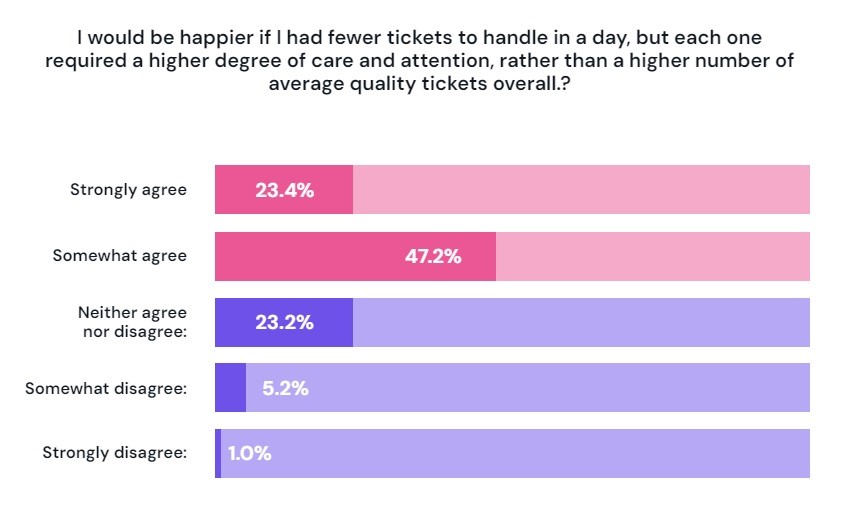
customer service agents
So, what exactly are companies doing to prevent these stressors and support their employees – and perhaps more importantly, what aren't they doing?
Supporting Your Employees
As is often the case, identifying the issues is the easy part, resolving the issues can be much more difficult.