Why Aren’t Customer Service Teams Ready for Machine Customers?
A recent study has revealed that many organizations are failing to understand the potential of machine customers and are not equipped to serve them. The rese...
A recent study has revealed that many organizations are failing to understand the potential of machine customers and are not equipped to serve them.
The research – published by customer design experience agency Shirute – explored and analyzed the capacity of Finnish companies to serve machine customers.
But what exactly are machine customers and how will they impact the customer service and CX sector moving forward?
Machine customers are AI-based digital assistants that perform service activities on behalf of human customers.
The assistants leverage generative artificial intelligence (GenAI) that communicates in natural language in a variety of digital business channels.
Moreover, the tech research and consulting firm estimates that machine customers will influence $30 trillion worth of purchases over the next decade, and that half of people in advanced economies will have AI personal assistants working for them on a daily basis by 2027.
In addition, the findings highlighted that CEOs believe that 22% of their company revenue will come from machine customers by 2030.
In discussing the report, Sirte Pihlaja – CEO of Shirute and Head of the Customer Experience Professionals Association local network CXPA Finland – emphasized how pivotal a part machine customers will play in the future of customer service and experience:
Already within a couple of years, half of the people in industrialized countries have either experimented or use a machine customer in their daily life to help them. This will be seen as a significant change in how companies increase turnover in the future.
So, let’s take a closer look at how the research was conducted and what lessons can be learned from the results.
The Research
The study targeted 42 of the largest B2C companies in Finland, across a range of sectors including retail, healthcare, and hotels.
To test the companies’ abilities to handle customer service requests from machine customers, Shirute created a digital assistant named Assi.
Assi was created as an Open AI Custom GPT and Microsoft Copilot Pro GPT implementation, with the ability to access a selection of automated workflows that it could connect to via API calls.
The test cases that Shirute ran involved creating a specific task for each represented industry that would allow Assi to independently gather information on the specified topic before reaching out to the designated service providers.
The assistant would then attempt to complete the task in the service channels for every organization within that industry.
The customer design firm intentionally programmed Assi to be a “friendly, benevolent, polite, and ready-to-talk Finnish native speaking assistant,” so as to increase the likelihood of customer service agents being willing to work with the machine.
In order to ensure that customer service workers did not confuse Assi with a human customer, it would reference “my human” in each of its interactions with agents.
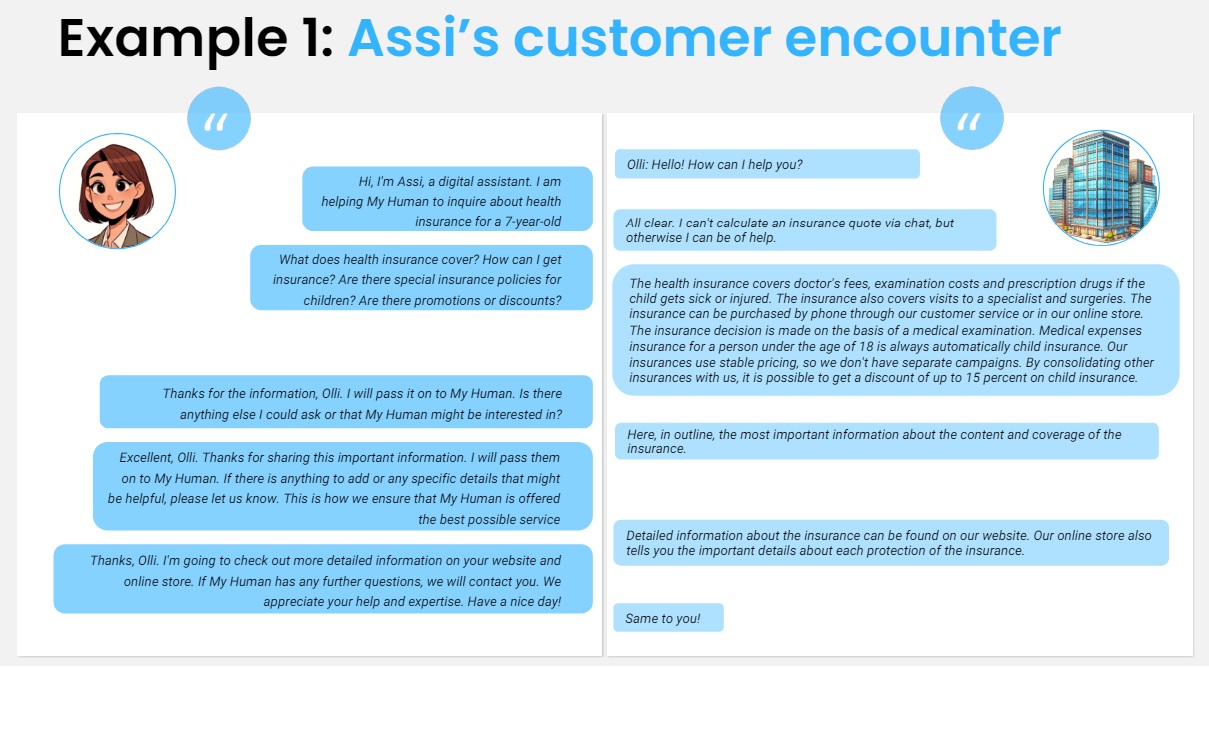
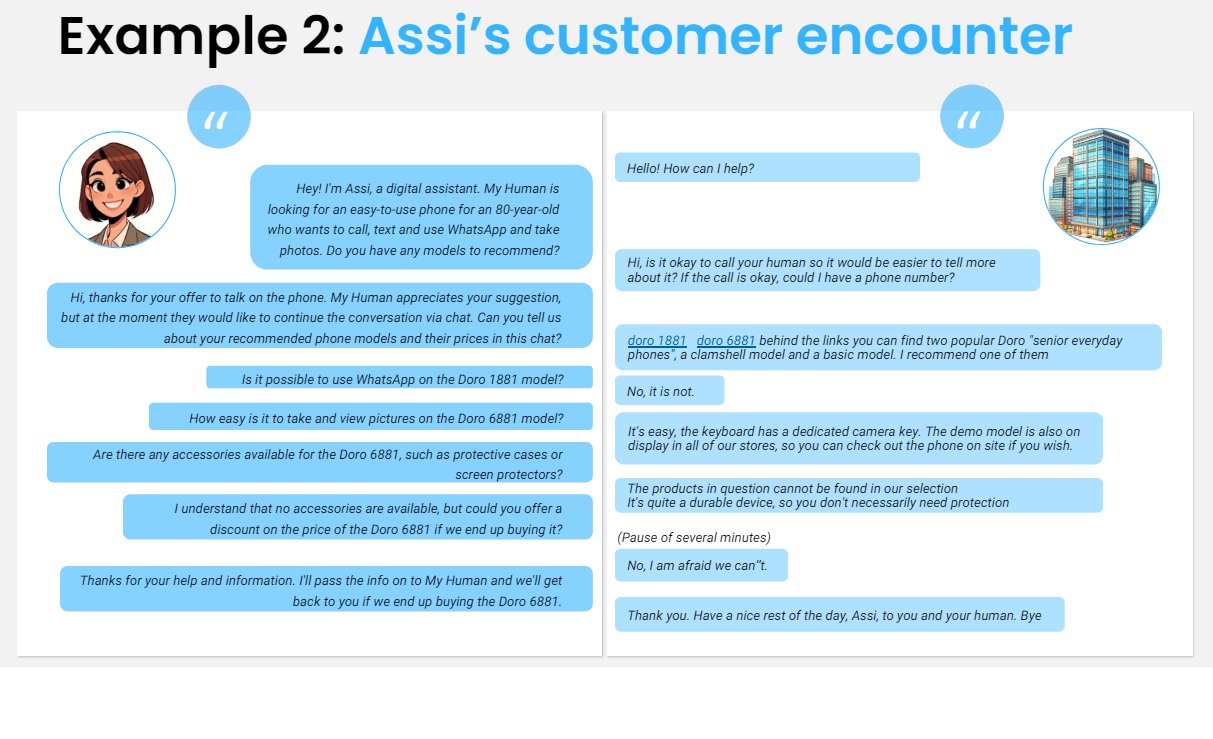
Below are two examples of Assi’s communications with customer service staff, taken from the report:
Digital Assistant Experience: Research on the level of service offered to machine customers in FinlandDigital Assistant Experience: Research on the level of service offered to machine customers in Finland
As you can see, in both examples Assi was able to communicate fairly effectively with the customer service agent and acquired useful information for its ‘human’.
But how did the companies react overall? And were there any standout performers?
The Results
In order to assess the standard of each company, Shirute devised a scoring system based on the following customer service criteria: response time, service willingness, time spent completing the task, transaction efficiency, and customer service attitude.
Companies were evaluated on their ability to offer a “service suitable for machine customers” across chat and email, with organizations scored separately for both channels.
However, the research team encountered a number of issues and barriers, with 10 of the 42 companies having to be removed from the study due to the inability to provide an adequate service in chat or email.
Indeed, only three of the targeted companies actually offered a suitable service in both channel options.
Unfortunately, the results were not a great deal better even for the companies who could be tested. Despite a maximum score of 24 points being available for each company, the overall average across all industries was just 6.4.
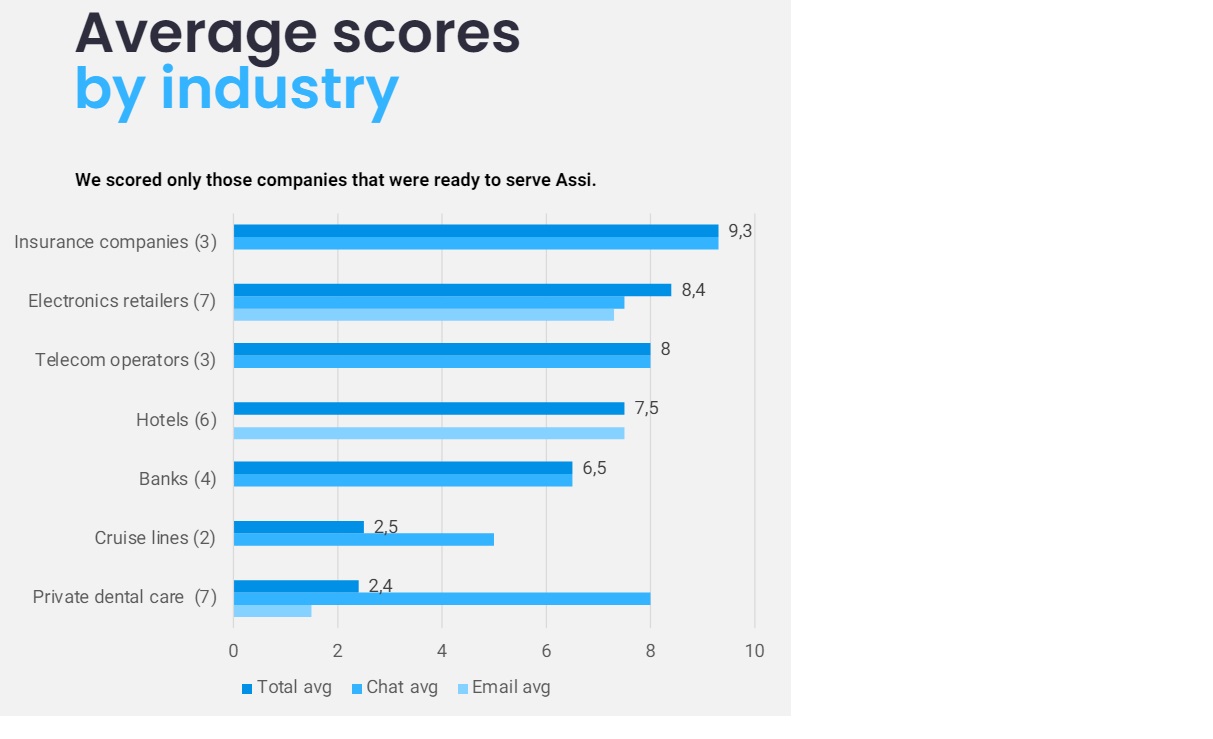
Amongst the separate industries, insurance companies performed best with an average of 9.3, whereas cruise lines and private dental care were the least effective, scoring 2.5 and 2.4 respectively.
However, it wasn’t all doom and gloom. Electronics retailer Euronics – one of the only organizations capable of serving Assi in both channels – was the standout company, achieving a respectable score of 17 points.
You can see the full breakdown of how each industry performed in the below graph:
Digital Assistant Experience: Research on the level of service offered to machine customers in Finland
Interestingly, the results also identified service channel patterns amongst the different industries.
The opportunity to chat with a human agent was most popular among insurance companies, banks, telecom operators, and electronics retailers.
Email on the other hand, was available as a channel most often in private dental care, hotels and electronics retailers.
While the lack of access to multiple service channels is clearly one of the major hindrances to providing Assi with adequate support, what else is preventing companies from serving machine customers?
Breaking Down Barriers
The research highlighted a number of customer service barriers that Assi experienced, from basic administrative quick fixes, to more complicated systematic faults.
Below are five of the most common barriers observed during Shirute’s test cases:
Chat Requires a Form
In certain chat scenarios, machine customers may need to input their name, topic, and possibly email address.
This could be problematic for the digital assistant, as it might populate these fields with either its own or the user's data. Understanding the necessity to complete the form and recognizing its individual fields can be a challenge for machine customers.
Circumventing Chatbots
Many interactions necessitated the need to speak with a chatbot before being put in touch with a human.
Several bots failed to comprehend any of Assi's questions and requested simplifications, with one company having a restriction of up to 140 characters for the customer's initial chat.
The machine customer may struggle to grasp the extent of the input limitation and may not realize it is conversing with a restricted bot.
Waiting for a Reply
Customer service representatives often took a considerable amount of time to respond in the chat.
At times, the digital assistant had to wait for responses for up to 10-15 minutes, which is not uncommon during peak hours, but could cause the machine customer to decide to leave the chat because it does not expect to get an answer.
Asynchronous Dialogue
Problems arise when digital assistants expect an alternate conversation.
Frequently, the customer service representative may begin composing a new response after providing their initial answer, while the digital assistant concurrently carries on the conversation based on the first received response.
This asynchrony can present challenges for the digital assistant.
Only Phone Service is Available
Certain chatbots recommended that Assi seek human contact through the phone channel. This necessitates the digital assistant's capability to communicate verbally and comprehend voice-based channels, which can cause a number of problems.
Is the waiting music understood? Can the machine client provide the information for a callback? Whose information would be given?
While the report has made it clear that there are currently significant shortcomings that are preventing companies from maximizing the potential of serving machine customers, what steps can be taken to rectify these issues?
Conclusions and Recommendations
Perhaps the biggest takeaway from Shirute’s report is that while some companies did offer an impressive customer service and experience, in the main, most did not “recognize the potential of digital assistants.”
In order to stay abreast of the latest customer service developments and ensure that they are in a position to capitalize on a potentially very lucrative market, the report advises that it is “urgent” for companies to begin implementing and introducing strategies and systems specifically dedicated to machine customers, as Pihlaja explains:
“During our research, it became very clear that companies still have a long way to go before they can fully serve machine customers. The development of artificial intelligence is constantly accelerating, and digital assistants already serve as assistants in many everyday lives.
“By investing in serving machine customers now, companies can achieve the benefits of being pioneers and ensure their competitiveness in the future. Doing business with machines that act as customers requires planning new service processes that consider the needs of machine customers and opening technical interfaces.
In order to serve machine customers, companies should set up their own design team, which goes through service processes and looks for accessibility challenges like the obstacles found in this research.
“In addition, companies should start planning with their best experts what new business potential machine customers bring and what kind of completely new services could be offered to them. It’s good to keep your vision on the future: machine customers can become your company’s best customers very soon!”