Seven years ago, when Opus Research first started to monitor the implementation of enterprise intelligent assistants (EIAs), the technology was relatively niche. Only companies with significant digital transformation budgets considered implementing the technology to gain a competitive edge.
Yet, thanks to technology advancements, reputation gains, and a clamor to reduce pressure on the contact center, the use of EIAs has soared in recent years.
Underpinning this new reality is a statistic within its 2022 Decision Makers’ Guide to Enterprise Intelligent Assistants report, which highlights that only 18% of the "bot-using" firms it surveyed in the "pilot" stage of deployment.
From this research, Opus uncovered many more fascinating findings, which include:
- Over half of EIAs (52%) now allow customers to update their personal information
- 68% of EIAs now offer personalization features to address users
- More than a third (33.7%) of EIA implementations come from within the banking and financial services sector
- 3% of EIA deployments take place on live chat, with 29.1% occurring on the voice channel
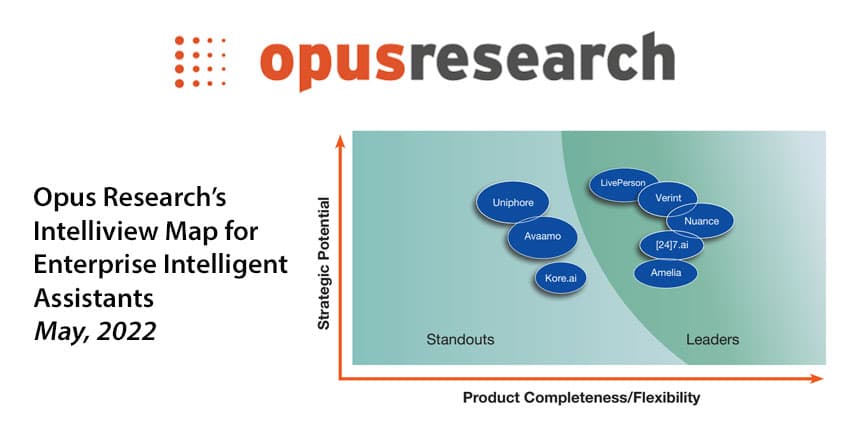
Yet, deeper within its report, the analyst also showcases its research into leading EIA vendors as part of its May 2022 Intelliview Map.
A Definition for Enterprise Intelligent Assistant
An EIA is a conversational AI application that communicates with the user to resolve queries and complete tasks. While these are most often customer-facing bots, some EIAs support customer service agents in fielding tricky contacts.
Many vendors now offer both within an enterprise EIA platform, alongside training and management capabilities, providing solutions that cover multiple modalities and channels. Typically, they will also supply a host of APIs and connectors to various enterprise systems to increase the functionality of each EIA.
According to Opus Research, best-in-class EIA platform vendors offer "comprehensive, scalable solutions that embrace the gamut of services and technologies necessary for successful Enterprise Intelligent Assistant deployments."
Sticking to this summarization and considering product completeness, track record, and strategic potential, the analyst isolated five market leaders and three standouts to create its 2022 Intelliview Map for EIAs.
[caption id="attachment_44774" align="alignnone" width="560"]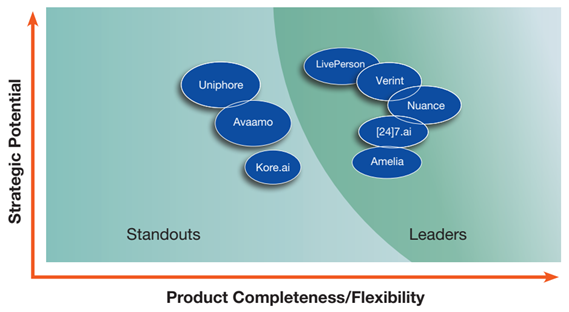 This graph comes from Opus Research Decision Makers’ Guide to Enterprise Intelligent Assistants (May, 2022)[/caption]
Leaders
Leaders in the Opus Research Intelliview Map provide a holistic approach to EIA implementation, recognize "tangible differences in high-value use cases," and offer omnichannel solutions. In addition, they demonstrate an excellent track record of delivering value for clients, offer robust orchestration and management capabilities, and showcase a diverse partner ecosystem.
- Nuance
- Verint
- [24]7.ai
- Amelia
- LivePerson
Nuance
Recently acquired by Microsoft, Nuance is a "perennial leader" in the EIA space, according to Opus. The analyst highlights its ability to leverage the incredible depth of the Microsoft portfolio as a significant strength, alongside its omnichannel customer engagement strategy. Nuance also sets itself apart in its conversational AI expertise, covering many verticals – including healthcare.
Verint
Verint receives praise from Opus for its capability to connect the enterprise with business-focused conversational intelligence data, in addition to its open platform. Such a platform enables many integrations to supercharge its EIAs and tackle many challenging use cases that go far beyond responses to frequently asked questions (FAQs).
[24]7.ai
[24]7.ai offers a low code solution, enabling fast, customizable bot implementations, alongside quick third-party integrations to maximize the potential of the AI and pave the way for omnichannel customer service. Also, the vendor provides an innovative intent discovery bot that listens to customer conversations to uncover intent and highlight possible automation opportunities.