

According to Aragon Research, the intelligent contact center (ICC) market is in flux.
There are several catalysts. One example is in how more virtual agents are coming online, not only assisting customers but agents, supervisors, and managers, too.
As such trends surge, more enterprises recognize the need to transform, understanding the risk of being left behind.
Unfortunately, those leveraging traditional platforms that prioritize telephony and routing may struggle to keep up with new customer expectations for consistent, digitized, personalized journeys.
Meanwhile, those harnessing cloud-native ICC offerings - which embed AI to automate more processes, accelerate conversations, and derive new insight - are much better placed.
Yet, it's not all about AI. ICCs also prioritize data management and developing unified customer profiles. Indeed, Aragon Research forecasts:
“By YE (year-end) 2024, 55 percent of contact center providers will enable the development of an enhanced customer profile that will enable a more personalized customer experience.”
While this underscores the overall advancement of contact center technology, some ICC providers are ahead in their product, AI, and data capabilities.
Thankfully, the Aragon Research Globe for the Intelligent Contact Center 2025 isolates those that are surging ahead, honoring them as “market leaders”.
Read on to discover how the analyst deciphers these leaders and its most striking findings.
Determining the 2025 “Intelligent Contact Center” Leaders
In its report, Aragon Research evaluated 15 of the “major” contact center vendors, deeming eight worthy of the “leader” tag.
As part of that evaluation, the analyst conducted a “rigorous” analysis that went beyond size and market share, factors that often dictate competitor reports.
Of course, global reach is critical when assessing a provider's support services, and Aragon Research recognizes this. However, its central focus leans into each vendor's core product features.
That’s evident in the three dimensions of Aragon Research’s assessment criteria:
-
Strategy
- Product
- Product strategy
- Market understanding and product roadmap
- Marketing
- Management team
-
Performance
- Market awareness
- Customer experience and feedback
- Financial viability
- Pricing and packaging
- Product feature mix and frequency/quality of releases
- Investment in R&D
-
Global Reach
- Worldwide sales and support offices
- Locations and time zones of support sentences
- Language support
- References across regions
- Data center locations
After dissecting the performance of analysts against this criteria, Aragon Research developed the matrix below, which features all 15 ICC providers.
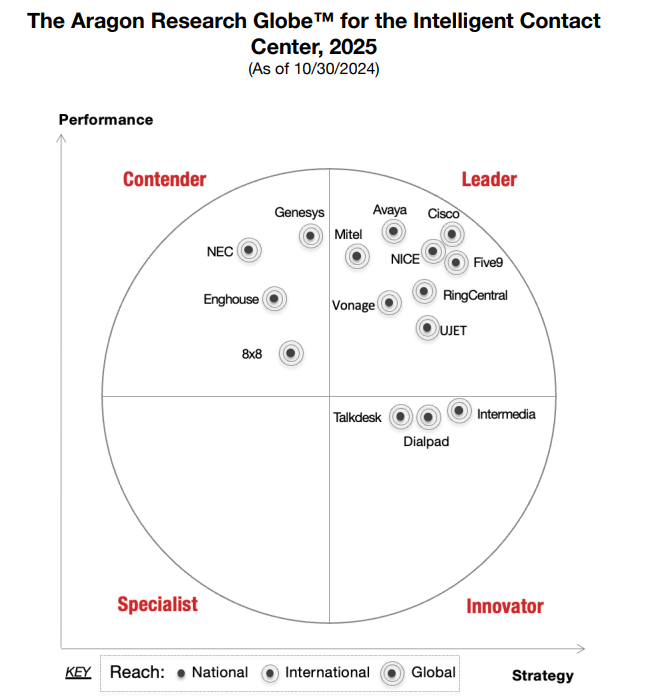
Unpacking the analysis, Jim Lundy, Founder, CEO, & Lead Analyst at Aragon Research, said: “The contact center market is undergoing rapid change, driven by new use cases and the increasing need to automate knowledge delivery with virtual agents.
"Enterprises are under pressure to deliver exceptional customer experiences, and AI-powered virtual agents are key to achieving this."
As such, it’s no surprise to see many of the familiar names – including Five9, NICE, and Vonage – in the leader group. After all, they aren’t shy of beating the AI drum.
Yet, another leader with a more differentiated AI strategy is UJET, which benefits from a special relationship with Google, empowering it with early access to leading AI models.
Leveraging those models, UJET empowers customers to orchestrate best-fit customer journeys by blending various forms of AI, humans, and channels. Here's a closer look.
UJET Reaffirms Its Place Amongst the Elite Contact Center Providers
Aragon Research spotlights UJET’s modern architecture as a differentiator, offering customers two considerable benefits.