
Along with customer satisfaction (CSAT), the net promoter score (NPS) is among the most widely used KPIs to gauge customer experiences.
First introduced in 2003 by business strategist Fred Reichheld, it was revered as: “The one number you need to grow.” But is NPS still relevant for contact centers in 2021 and beyond?
How does NPS Work?
NPS classifies customers into promoters, detractors, and neutral consumers. It then calculates how many more promoters the company acquires as compared to detractors, arriving at the final NPS.
The KPI helps to predict:
- The possibility of new business from referrals
- Customer loyalty and the possibility of retention
- Potential lifetime value to be accrued from customers
Calculating NPS
Businesses ask customers the following question to calculate NPS:
“On a scale between zero and ten, with zero being “not likely at all” and 10 being “very likely”, how likely are you to recommend our product/service to a friend?”
Depending on the customer’s response, they are classified into three groups. Companies consider those responding with a:
- One to six rating to be detractors,
- Seven or eight rating to be neutral,
- Nine or ten rating to be promoters
Once these groups are in place, count the number of customers in each group and enter the data into the following formula:
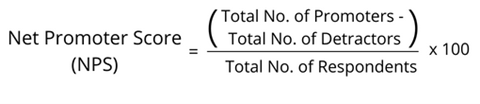
Consider this equation in practice. Perhaps 1,000 customers answer an NPS survey. 250 people give a rating between one and six, 500 people give a nine or a ten, and the rest share a score of seven or eight.
Below is the NPS calculation for this scenario: