
CX is customer experience. It encompasses all the interactions customers have with a business throughout their lifecycle, from initial discovery, through to post-purchase support and loyalty.
But how enterprises define CX has changed a lot over the years. It’s not just about making life easier for customers anymore. It’s about building a custom-made, intuitive journey for every buyer. CX defines how people feel about your brand after interacting with it. Not just once, but over time. It’s the sum of every digital click, phone call, chatbot exchange, service ticket, and delivery confirmation.
If those interactions are fast, helpful, and personal, CX becomes an edge. If they’re clunky, slow, or disconnected, CX becomes a problem.
Enterprise teams today think of Customer Experience as more than support, it’s a full-system strategy. One that spans marketing, sales, operations, IT, and product. The customer experience definition isn’t static either, it’s constantly shaped by changing preferences, tech shifts, and how well teams work together internally.
McKinsey says the most successful companies treat CX as a “value engine.” When it’s done right, the numbers back it up. CX leaders see up to 10% more revenue growth and far better retention than those still stuck in siloed service models.
CX isn’t just a metric. It’s the difference between being remembered and being replaced.
Why is CX Important?
For enterprise leaders, the question isn’t just “what is CX?”, it’s why it now belongs in the boardroom. 88% of customers say the experience a company provides is as important as its products or services. Experience is the product now, and it’s competing just as hard as features or pricing.
That’s why Customer Experience (CX) has evolved from a support function into a core business driver. CX matters because:
- Retention is Cheaper than Acquisition: Getting new customers is expensive. Losing them because of broken journeys, long wait times, or impersonal service is avoidable. A 5% improvement in customer retention can drive profit increases of 25–95%, according to Bain & Company.
- Loyalty Drives Advocacy: Great customer experience doesn’t just reduce churn, it creates promoters People don’t just stick with companies that deliver great service, they talk about them. That turns CX into a compound growth strategy.
- Experience Competes Where Price Can’t: In saturated markets, what is CX if not your best shot at standing out? Brands can’t always win on price or speed, but they can win on how they treat people. Enterprise buyers, especially, look for partnership-level experiences, not just transactions.
- CX Fuels Operational Efficiency: When journeys are mapped, data is unified, and support flows are optimized, everything works better. Contact center strain drops. Employee satisfaction goes up. Tools like WEM and AI-assisted service platforms reduce manual load and improve resolution time.
What is CX? The Three Pillars of Exceptional Customer Experience
Every strong Customer Experience (CX) program has three moving parts: people, process, and technology. Not as a framework on a whiteboard, but as the foundation of how modern businesses operate.
Most organizations get stuck because they over-invest in one of these areas and neglect the others. The tech stack gets all the budget. People get stretched thin. Processes grow around outdated tools. Customers feel that imbalance.
For enterprise teams, the goal isn’t to be perfect in all three, but to be intentional about each one. CX Customer Experience isn’t a slogan. It’s a system. And it’s only as strong as the least developed pillar.
It makes sense to start with people, because that’s where experience lives or dies.
Pillar One: People
There’s a difference between responding to customers and taking care of them. The difference usually comes down to who’s on the other side of the interaction, and whether they’ve got what they need to do their job right.
In contact centers, sales teams, field support, and even billing departments, people still shape the most critical moments of the customer experience journey. Tech can assist. Data can inform. But it’s humans who turn frustrated customers into loyal ones. That’s why companies leading in CX aren’t just focused on customers. They’re focused on employees too.
When Microsoft CEO Satya Nadella transformed the company’s approach to CX, he didn’t just talk about customer obsession, he tied executive compensation directly to customer success metrics. This ensured leadership remained focused on customer experience improvements that drove meaningful results.
If internal systems are clunky, if teams are burned out, if there’s no room for autonomy, then it shows. Customers pick up on that. It’s why employee experience and customer experience are so tightly connected, especially in high-scale environments.
This is where Workforce Engagement Management (WEM) enters the picture. It’s not just a back-office tool anymore. WEM platforms help teams:
- Plan smarter shifts
- Track performance without micromanaging
- Coach more effectively
- Keep frontline employees engaged and developing
Increasingly, companies are also experimenting with new ways to expand and scale their teams, working with BPO leaders focused on customer experience, journey optimization, and interactions.
Pillar Two: Processes: Systematizing Consistent Experiences
There’s a moment in most enterprise CX programs where the cracks show, not because of bad tools or unmotivated teams, but because process hasn’t kept up with scale.
That’s when CX becomes inconsistent. One channel works beautifully. Another frustrates customers instantly. Service feels reactive instead of intentional. People start to solve the same problems, in different ways, over and over again.
Strong Customer Experience isn’t just about people doing their best. It’s about systems that support the experience by design.
This is where process comes in, and it has to start with the customer journey.
Mapping the Customer Experience Journey
A well-built customer experience journey map highlights what customers need, what they expect, and where they run into friction. But a static map only gets teams so far. Enterprises need orchestration, real-time actions triggered across systems, not just a PowerPoint slide tracking emotions.
Tools that support customer journey orchestration are becoming essential, especially in large service environments with omnichannel complexity.
Voice of the Customer (VoC): Feedback that Fuels Change
A second piece of the puzzle: feedback. Not the kind that disappears into spreadsheets, but structured, programmatic insight that fuels decision-making.
Voice of the Customer (VoC) programs help teams collect, prioritize, and act on what matters—using surveys, sentiment analysis, live interactions, and behavioral data.
Done right, feedback becomes a loop, not a lagging report. It drives constant tuning of messaging, processes, even product roadmaps.
Closing the Loop with Loyalty
The final piece? Loyalty isn’t just about points programs, it’s about reliability, and how a customer feels after the issue is solved. When processes are clean, proactive, and personalized, customers are more likely to stay, and recommend.
- Discover the top loyalty management software solutions.
CX, at its core, is how repeatable those moments of trust become. Process is what makes them repeatable.
Pillar Three: Technology: Enabling Personalization at Scale
Technology doesn’t fix customer experience on its own. But it makes great experience possible at scale. That’s where most enterprise teams hit the wall. They’ve got the right people. Their processes mostly work. But when the tech is stitched together from too many places, or not designed around the customer experience journey, things fall apart.
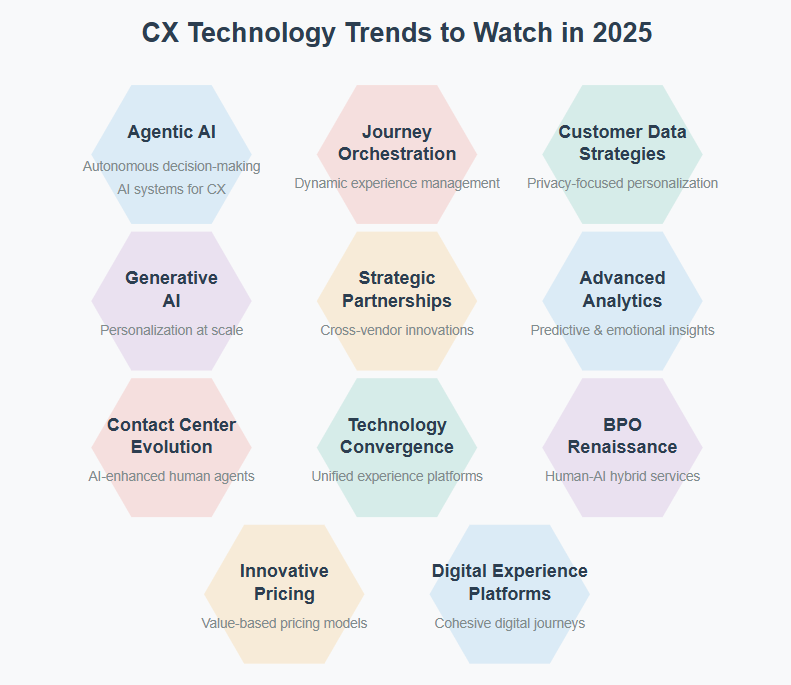
In 2025, enterprise buyers expect experiences to be seamless. Channels should talk to each other. Service should feel personalized. Answers should come fast. None of that happens without the right CX technology stack underneath.
Here’s how the best enterprise teams are building for modern CX:
Contact Center and CCaaS Platforms
The frontline of CX often starts in the contact center. CCaaS (Contact Center as a Service) platforms help manage calls, chat, social, and more in one place, with integrated routing, analytics, and agent tools.
CRM and ERP Systems
Customer data lives in CRM. Operational context lives in ERP. Great Customer Experience (CX) happens when these systems speak to each other, so agents and reps can act in real time, without switching tabs.
AI and Conversational Intelligence
Smart chatbots, generative responses, and agent assist tools are reshaping how support works. Conversational AI lets teams automate more without losing the human feel, while also improving consistency across channels.
Business Intelligence, CDPs & Analytics
A modern Customer Experience definition includes data. CDPs (Customer Data Platforms) unify profiles across tools. Business Intelligence (BI) platforms turn that data into insight, so teams can personalize, prioritize, and act.
Feedback & Loyalty Management
Listening matters. So does action. Modern CX stacks include built-in Voice of the Customer (VoC) tools, real-time surveys, and behavior tracking that feed back into journeys and loyalty workflows.
WEM & BPO Solutions
Behind the scenes, Workforce Engagement Management tools and BPO partners help manage scale, whether that’s during peak season or for 24/7 global coverage.
Devices & Endpoints
Customers don’t care about infrastructure, but they notice when call quality drops or a device fails mid-interaction. Modern contact center devices ensure every part of the experience just works.
CPaaS & UCaaS Integrations
APIs and real-time communications infrastructure let businesses build composable, channel-agnostic experiences. CPaaS platforms enable everything from SMS alerts to secure video calls, built into workflows. UCaaS ensures teams can collaborate on CX.
Need help building the ideal CX stack?
What is CX? Contact Center Excellence
The contact center isn’t just one part of the business; it’s often the clearest voice of the brand.
It’s where customers come for answers, resolution, and reassurance. And for most, it’s the most direct, memorable part of the customer experience journey. That makes it one of the most important levers in any CX Customer Experience strategy.
Excellence here doesn’t happen by accident. It comes from investing in both people and tools, then connecting the two in ways that actually make sense for agents and customers alike.
Empowering Agents Through Coaching That Works
Contact center agents with proper coaching deliver consistently better customer experiences. The most effective contact center coaching strategies focus on personalized development plans that balance technical knowledge with emotional intelligence. By implementing regular coaching sessions using real customer interactions, organizations can transform their agents into true CX ambassadors.
Quality Monitoring That Does More Than Score Calls
Understanding what happens during customer interactions is essential for improving your CX strategy. Strategic call monitoring programs help identify both exceptional service moments worth replicating and pain points requiring intervention.
The best programs balance quantitative scoring with qualitative assessment, ensuring you capture both efficiency metrics and emotional connection.
Faster Isn’t Always Better. Smarter Is.
Speed matters. But not if it comes at the cost of real resolution. One of the most challenging aspects of contact center management is balancing speed with quality.
Strategies to reduce average handling time (AHT) without compromising customer satisfaction include implementing intelligent routing, providing agents with comprehensive knowledge bases, and using AI-powered assistance tools. The goal isn’t simply faster interactions but more effective ones that resolve customer issues completely on the first contact.
Smarter Staffing with WEM Tech
Too many or too few agents, it hurts either way. That’s why modern workforce management platforms are leaning hard into AI and forecasting. They help teams align resources with real-world demand, reduce idle time, and even offer self-service scheduling to keep agents engaged.
What is CX? Measuring Customer Experience
It’s one thing to promise great experience. It’s another to prove it.
That’s why measurement matters. In modern enterprises, CX customer experience isn’t just about good vibes or anecdotal wins. It’s a performance metric. It’s a boardroom conversation. And increasingly, it’s tied directly to growth targets, retention goals, and operational KPIs.
So if someone asks, “what is CX measurement really about?” the answer is: alignment. Measuring CX means making sure what customers actually experience matches what your business intends to deliver. Here’s where most enterprise teams start:
- Net Promoter Score (NPS): Still a staple in enterprise CX. NPS tracks how likely customers are to recommend your brand. Simple, scalable, and a decent signal of long-term loyalty, if used with context.
- Customer Satisfaction (CSAT): Measures how satisfied someone is with a specific interaction or moment in their journey. Quick to collect, especially post-service.
- Customer Effort Score (CES): This one’s gaining ground. CES asks: how easy was it to get what you needed? It’s a strong predictor of future behavior, especially for support or service-heavy brands.
- Churn Rate / Retention Rate: You can’t define CX without talking about outcomes. Churn and retention are blunt but valuable indicators of how well experience is working over time.
Beyond the Score: What Leading Teams Are Doing Differently
Data is useful. But insights move the needle. The most advanced Customer Experience teams now go further:
- Journey Analytics: Mapping behavior across touchpoints, not just post-event surveys
- Real-Time Feedback Tools: Embedded surveys, in-app prompts, and emotion detection
- Voice of the Customer (VoC) Programs: Structured systems to capture, route, and act on feedback
Increasingly, that feedback isn’t just for CX teams, it’s looped into product decisions, marketing campaigns, and even sales strategy. McKinsey puts it clearly: companies that embed Customer Experience metrics across the org grow revenue faster, serve customers more efficiently, and keep them around longer.