

Customer turnover captures how many customers are dropping off from the business.
Also known as customer churn, attrition, and defection rates, this key performance indicator (KPI) is an excellent indicator of a company’s health.
Fortunately, customer turnover is easy to calculate within subscription-driven businesses where it is easy to quantify the percentage of active customers. However, for other business models, it is often tricky.
How to Calculate Customer Turnover
At its simplest, businesses may measure customer turnover with the following formula:
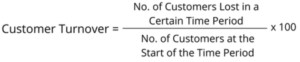
As an example of how this works, consider a business that wishes to measure customer turnover across the year. They start the year with 1,000 customers but lose 100 of these over the 365-day period.
Plugging these numbers into the formula, the business can calculate its annual customer turnover as 10%.
Customer Turnover = (100 ÷ 1000) x 100 = 10%
However, companies mostly measure customer turnover at shorter intervals to highlight how CX improvement initiatives impact turnover.
After all, spending an entire year optimizing CX only to realize that these efforts have not improved retention will likely prove a tough pill to swallow.
The Benefits of Calculating Customer Turnover
There are two significant benefits of calculating customer turnover:
- It enables businesses to manage retention actively
- It allows companies to calculate customer lifetime value
The first benefit highlights how companies can safeguard their revenues. As the Harvard Business Review reports: “Acquiring a new customer is anywhere from five to 25 times more expensive than retaining an existing one.”