

Customer satisfaction (CSAT) is a key performance indicator (KPI) that measures how happy customers are with a company's products and/or services.
Most often, CSAT scores are collected from individual customers and averaged. Benchmarking this average over time - as many companies do with a net promoter score (NPS) - enables companies to track how CX improvement initiatives impact customers.
Measuring CSAT regularly also allows companies to identify bottlenecks and various issues that may lead to customer churn. Brands can do this by engaging in either real-time or historical reporting.
Creating a CSAT Survey
To find out how satisfied or happy customers many companies choose to deploy surveys at various stages of the customer journey.
A customer is asked to rate their satisfaction with a service, product, transaction, or interaction by answering a simple question, such as: “On a scale of one to ten, how satisfied were you with your experience?”
While this scale is number drive - i.e. 1-3, 1-5, or 1-10 - companies can also track verbal responses and symbols - including star ratings and emojis - to gather a perception of customer satisfaction.
The difficulty is that satisfaction change throughout the customer journey. As such, it is also critical for CX teams to investigate how CSAT fluctuates across the experience.
To do so, many companies also create longer surveys - handed out to willing participants - which probe satisfaction across various journey touchpoints. However, CX teams must avoid spamming customers.
How to Calculate CSAT? Measurement and Formula
CSAT surveys often crop up in emails, apps, or after customer service interactions. Sometimes they also appear at particular customer journey touchpoints, such as post-purchase or onboarding.
Yet, no matter how companies source CSAT data, they will typically follow one of the following three calculation methods to unearth a CSAT score.
1. The Average Method
Traditionally, companies pose the following question to customer to measure CSAT: "On a scale of 1-10 (or 1-5), how satisfied were you with your experience?" Then, factoring in all the responses, they use the following formula to create a percentage score:
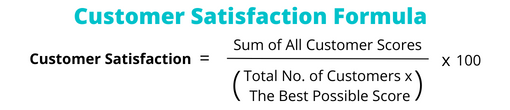
To highlight how this works, consider if five customers responded with a 10, 9, 8, 7, and 6. CSAT rates would equate to 80%, as evident by the calculation below.
[(10 + 9 + 8 + 7 + 6) / (5 x 10) x 100] = 80%
Alongside the overall percentage, companies may track of individual scores. Doing so may isolate customers at risk of churn. They may also identify high satisfaction customers who are likely to be more receptive to cross-selling or upselling opportunities.