All too often, customers encounter brand and customer experiences that are disjointed. For example, their bank might claim through its brand messaging that it values your time, but contacting its customer service team requires multiple steps and being on hold for an hour.
What brands must realise is that, while they might make the distinction between brand experience (BX) and customer experience (CX), customers do not.
Customer interactions – whether that’s a digital ad or a customer service call – all have the potential to impact customer satisfaction and ultimately loyalty.
While BX is focused on delivering a compelling image of the brand to customers with an ‘inside-out’ perspective, CX is focused on understanding how the customer wants the experience to be delivered, taking an ‘outside-in’ view in order to drive customer satisfaction. Many CX programmes remain focused on simply removing friction from the purchase funnel and miss the opportunity to partner with brand strategy teams to create more powerful experiences for the customer and the company.
Aligning CX and BX can seem like a challenge, mostly because many organisations treat them as separate. However, Gartner research shows that leaders who connect the two are more likely to exceed ROI expectations. There are three steps CX leaders can follow to better align their CX and BX.
Use CX insight to develop a brand promise focused on your customers’ personal benefits
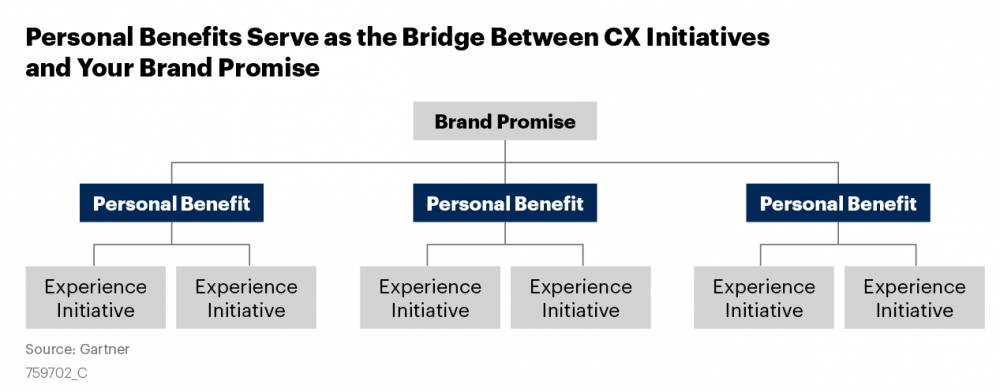
According to Gartner research, just 5% of consumers recall experiencing valuable digital interactions with a brand when considering a purchase. To cut through the noise, brands must provide experiences worth recalling by articulating how the brand can meet customers’ needs through clearly-defined ‘personal benefits.’
Personal benefits focus on what the customer gets out of a relationship with the brand and are a key driver of brand commitment, which is the degree to which audiences prefer the brand to alternatives, feel a personal connection to it and advocate on its behalf. According to Gartner research, customers reporting strong commitment to a given brand were more likely to complete a purchase, have purchase exclusivity and be willing to pay a premium. Personal benefits have three important characteristics:
- They focus on the customer, not the company
- They emphasise the outcome the customer with receive
- They fulfil a psychological need for the customer
Gartner research shows that personal benefits have the biggest impact on brand commitment, with societal and functional benefits trailing behind. To effectively capture a personal benefit, it is important to identify a psychological need that your brand is best positioned to support.
To effectively capture a personal benefit, it is important to identify a psychological need.
So where does CX come in? CX teams understand the needs that customers bring to a brand to resolve through voice of the customer (VoC) research and valuable CX assets like customer personas. Brands should use this insight to articulate the brand promise in terms of personal benefits, aligned to customers’ needs.