For years, predictions suggested that chatbots and digital channels would make the phone call obsolete.
Yet new data tells a different story: AI is not replacing voice, but fueling its resurgence as a strategic channel.
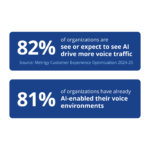
In fact, according to Metrigy, as noted in the 2025 State of International Voice for the Contact Center report, 82% of organizations expect AI to drive more voice traffic, reflecting the channel’s enduring power to handle urgent, high-value customer interactions.
The paradox is clear: the same technology that was once expected to eliminate live conversations is instead making them more affordable, intelligent, and valuable.
The Business Case for AI in Voice
The economics of voice have long been dominated by labor, with more than 80% of call costs being attributed to agent time.
AVOXI CEO Barbara Dondiego detailed how advancements in AI are helping companies to offset this cost:
“When you start offloading parts of the call process with AI, the economics make sense again.”
That shift is reshaping how contact centers think about their frontline operations.
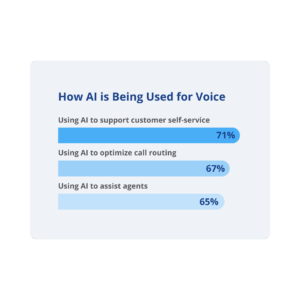
AI-driven assist tools are cutting training times and enabling less experienced agents to perform at a higher level.
Conversational bots are taking on routine queries, eliminating hold queues and freeing skilled staff for the interactions that matter most.
Moreover, AI is also converting raw conversations into structured data in the form of summaries, sentiment, and keyword analysis, which provides managers with new visibility into what customers are actually saying.
It’s a virtuous cycle: costs fall, agents become more productive, and customer satisfaction rises.
In fact, when implemented correctly, AI voice capabilities have the potential to significantly improve customer satisfaction, with 69% of organizations reporting that they expect the tech to deliver enhanced customer ratings.
Infrastructure: Preparing Voice for AI
It sounds like a win-win, doesn’t it?
Unfortunately, as ever, there is a catch.
Whether calls go to human agents assisted by AI or are fully handled via conversational AI, the calls need to traverse a voice network. So, to truly reap the rewards of AI, the existing voice infrastructure supporting and informing the technology needs to be up to the task.
AI cannot thrive on legacy telecom systems that were never designed for real-time intelligence.
Too often, enterprises are still dealing with fragmented carriers, inconsistent quality, and no clear visibility into where their calls are going or why they fail.
Modernizing voice infrastructure has become the first step toward AI.
This shift is happening against a backdrop of widespread modernization. Hybrid deployment remains the dominant model, with 84% of organizations using cloud for at least part of their contact center environment – yet 65% still rely on some on-premises systems.