

Self-service done well is a win-win-win.
It allows customers to solve their queries autonomously, lowers employee workloads, and cuts business costs.
Yet, it is not easy to develop high-performing self-service systems. After all, bots take time to build, self-service portals have a limited scope, and proactive problem-solving can cause confusion.
Of course, each use case has its merits, especially as conversational AI gathers momentum. Nevertheless, there is an easier way to self-serve many queries and deliver seamless experiences: a customer-facing knowledge base.
A Knowledge Base Is Not Just an Agent Support Tool
According to a Forrester study, customers prefer knowledge bases over all other self-service channels.
Yet, many only consider the knowledge base as an agent assistance tool, offering service teams an invaluable resource to fall back on when unsure how to answer customer queries.
Indeed, the agent use case has come increasingly into focus since the switch to hybrid work, with in-person support falling to the wayside.
However, presenting a knowledge base to customers offers an especially exciting opportunity.
Just consider the current contact centre climate. High contact volumes, stretched resources, and new digital-first customer preferences are wreaking havoc.
By flipping around a well-managed agent knowledge base and adding a customer view, businesses can maximise their investment, solve many queries online, and enhance digital experiences.
Simply upgrading the FAQ page will help secure these outcomes. Yet, businesses may also create eye-catching overlays – like in the example below.
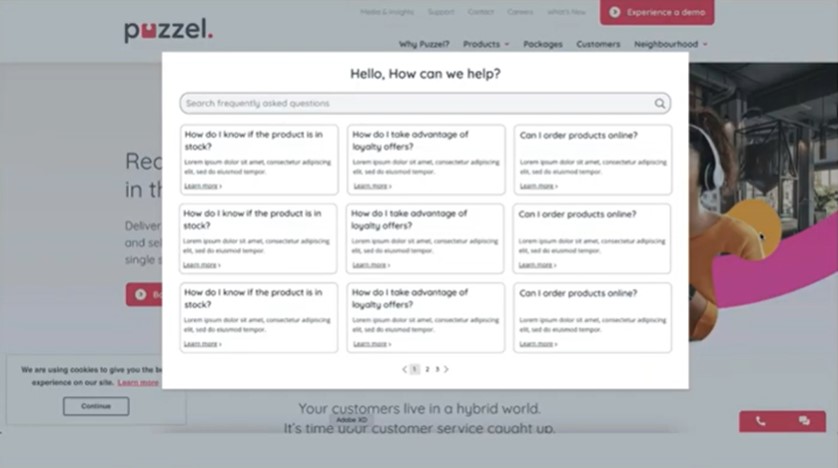
Here, the most frequently asked questions come at the top of the first page, although it is also possible to adjust the order, depending on the webpage.
Moreover, customers can also take advantage of NLU-powered search to ask something specific.
In the case of Puzzel’s knowledge base solution, the search also takes advantage of machine learning technology. As such, it begins to understand, over time, the most valuable knowledge article related to particular queries.
Meanwhile, users can zoom into specific articles, go back, and search again. When zoomed in, customers may access helpful images, videos, and attachments.
Other critical features include an article management portal to build knowledge templates, open categorisation, and embedded KPIs to track the value of individual articles.
The extent of most providers' core capabilities stops here. Yet, Puzzel pushes the boat out further.
A More Innovative Approach to Customer Knowledge Base
Within Puzzel’s extensive CCaaS portfolio lies its Digital Engagement solution. By aligning this with a customer knowledge base, businesses may enhance online customer experiences.
How? First, consider how the digital engagement solution works. It analyses onsite behaviour, gauges intent, and triggers help actions to improve customer journeys.