

Many believe chatbot experiences still feel far too rigid, robotic, and predefined.
Thankfully, generative AI (GenAI) embedded into conversational AI platforms may soon start to shift this tired yet largely prevalent narrative.
After all, GenAI is flexible, human-like, and acts on the fly – counteracting current conceptions of customer-facing AI.
All these qualities enable better chat experiences, as many of the following use cases exemplify.
They also highlight how GenAI is paving the way for faster, more efficient bot-building.
Lastly, they’re cutting-edge. Indeed, each use case is now available on the Cognigy and/or Kore.ai conversational AI platforms.
These are two of Gartner’s three "Customer’s Choice" enterprise conversational AI solutions.
1. Automating More Customer Queries
Example: Cognigy Knowledge AI
A customer support team will have many sources of knowledge to lean on. That includes a knowledge base, web links, and product manuals.
After understanding customer intent, a GenAI tool may parse all these materials to find the closest semantic match between a piece of knowledge and the query.
Once located, the tool sends the original query and the piece of knowledge back through an LLM, with a prompt, such as: "Answer the following customer question based on the found article."
As a result, contact centers can expand the scope of conversation automation beyond pre-trained chatbots – increasing containment rates.
Moreover, if the source information the bot used to solve the query is publicly available, it may also share that via a link – alongside the answer - so the customer can dig deeper.
Finally, some conversational AI platforms may strip insights from images within source materials – such as charts, tables, and diagrams – to inform their responses.
All this without the business creating a chatbot prototype.
2. Suggesting Intents to Automate
Example: Suggest Use Cases by Kore.ai
Once the developer specifies the purpose of their bot, Kore.ai’s conversational AI platform automatically suggests additional use cases.
For example, say the developer writes that the bot’s purpose is to offer customer support for a bank. The platform may then leverage LLMs to list potential intents to automate.
These could include checking a bank balance, transferring funds, and managing loans.
The developer can then enter a description to unlock more use cases, which they can add to the chatbot – as the screenshot below highlights.
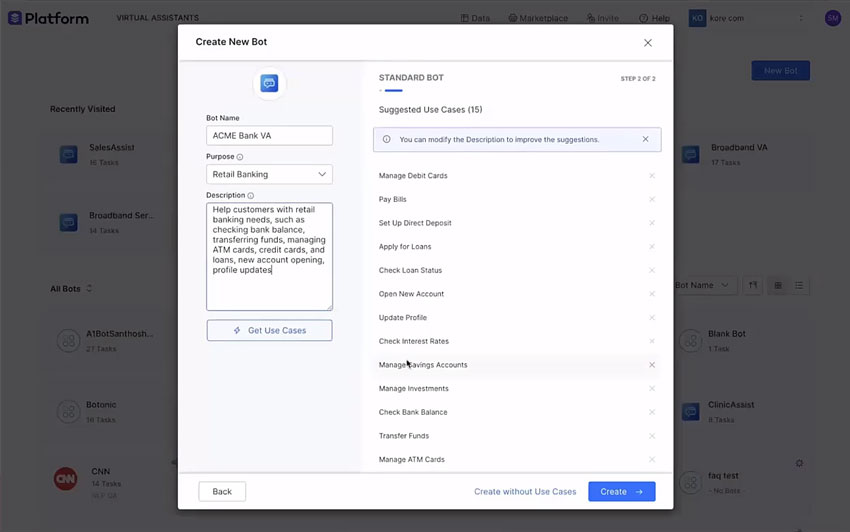
They may then select use cases for the bot from this list and – with the click of a button - generate prospective bot flows across each intent (more on this below!).
3. Generating New Bot Flows
Example: AI-powered Flow Generation by Cognigy
Conventionally, companies create chatbots from scratch on an empty canvas.
However, brands may now build bot flows from only natural language descriptions.
Cognigy’s offering places a panel next to these auto-generated bot flows for developers to test the simulated chat and voice experiences.
Based on their findings, the developer can adapt, expand, and finetune the flow as required. They may also connect it to various APIs to complete the experience.
Some models – including those offered by Cognigy and Kore.ai - may even define the necessary API integration to complete the flow.
4. Creating Lexicons
Example: AI-powered Lexicons by Cognigy
A lexicon is a vocabulary set that businesses drill into their bots so they understand the jargon that customers and employees often use.
Lexicons may cover everything from shorthand terms for pizza toppings to airport codes, such as "LAX" for Los Angeles International Airport.
A GenAI tool may auto-generate such a list of terms from a simple description. To use the airport example, the user may type a message like the following into a GenAI-powered solution:
A lexicon containing European Airport codes, like "AMS" and "CDG".
The tool may then create such a Lexicon, which the airline can review, finetune to their flight plan, and embed into their bots.
5. Producing New Training Data
Example: AI-powered Training Data by Cognigy
Previously, chatbot designers had to plug all the possible ways a customer could ask a question into their bot for each intent.
Advances in NLU have improved this process. Yet, generative AI has taken it further by training NLU models by auto-generating long lists of customer utterances that signal a specific intent.
Again, consider an airline example, where a developer wants to build out a set of queries a customer would ask when they’ve lost their luggage.
They simply have to write something into the GenAI tool, such as:
