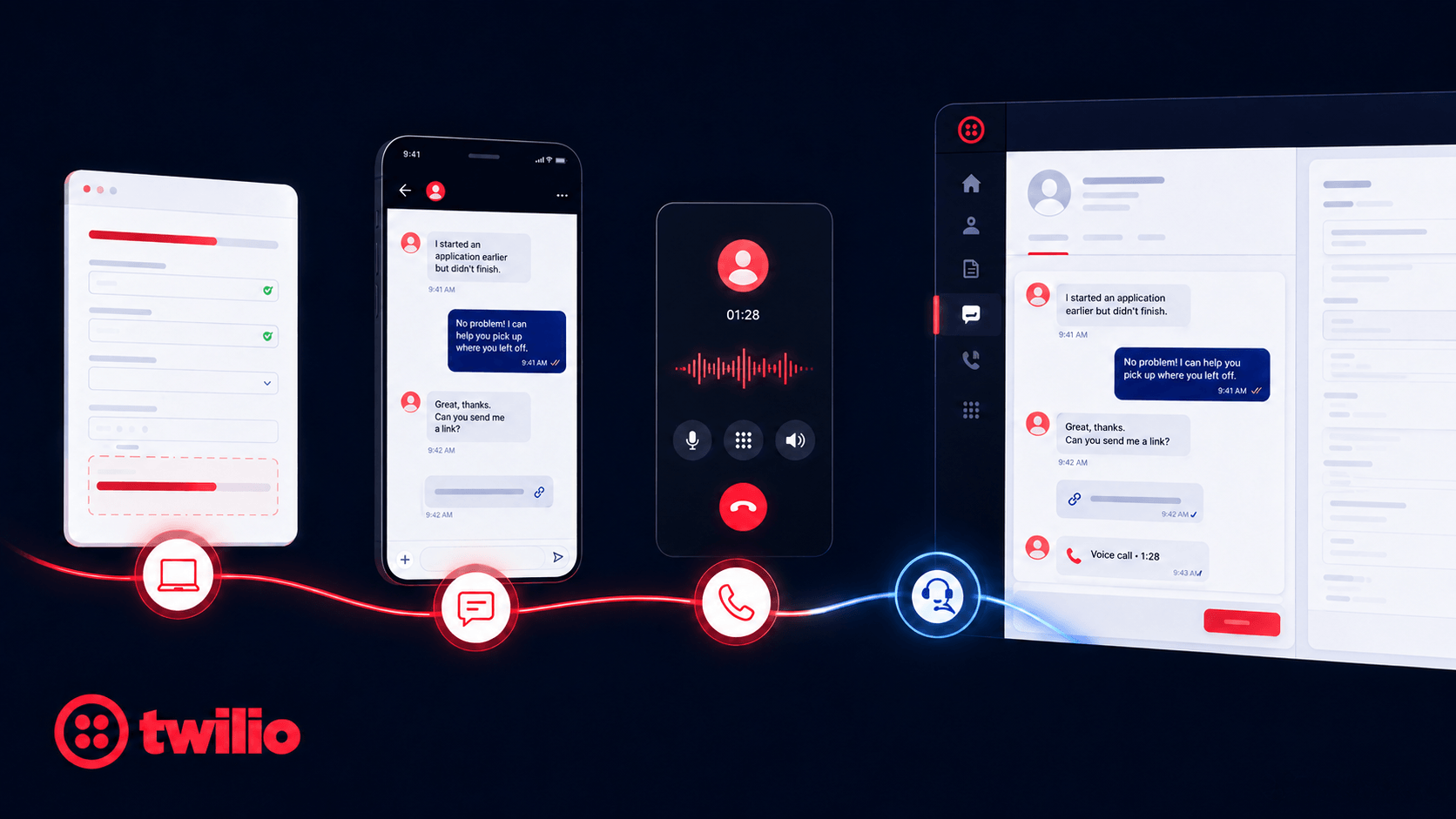
Twilio's 2026 releases give application recovery a connected operating stack. Studio can start or resume the outreach, while Conversation Orchestrator, Conversation Memory, real-time Conversation Intelligence, and Agent Connect now sit in a generally available Conversations layer. The Flex SDK then puts a human adviser beside the finance record when automation reaches its limit.
Picture the sales manager staring at a page of half-finished applications. One buyer missed a field. Another paused to find a document. Someone else left the form and called instead. The dashboard labels them all "abandoned," which is tidy, convenient and probably wrong.
Customers rarely follow the journey a company drew for them. They jump from web to messaging, ring an adviser, come back later, then wonder why nobody remembers what they already did. A digital drop-off may be a channel switch rather than a lost buyer.
The job, then, is to work out what stopped the customer and help them continue before their intent cools. Good cross-channel conversation orchestration keeps the unfinished action visible. Twilio Flex journey orchestration gives the employee somewhere useful to enter. Together, they create the customer journey continuity that most supposedly omnichannel businesses still haven't cracked.
The job in one line: get a customer who still wants to buy back to the one step they left unfinished, before that intent cools.
That's what omnichannel customer recovery should mean. Not another reminder campaign. A credible second chance to finish.
TL;DR: Can Twilio Flex and Studio Recover Stalled Applications?
In This Article
- How Does Omnichannel Orchestration Differ From Multichannel Outreach?
- How Do Twilio Studio and Flex Use AI to Reduce Customer Journey Abandonment?
- What Information Should Follow a Customer Into Flex During an AI-to-Human Handoff?
- Which Customer Journeys Are Best Suited to Orchestration?
- Which Teams Need to Own the Journey Recovery Workflow?
- How Does Conversation Orchestration Improve Sales Conversion?
- Twilio Has Built the Route Back for Customers
- FAQs
How Does Omnichannel Orchestration Differ From Multichannel Outreach?
Multichannel means more contact points; omnichannel orchestration keeps the customer’s open task attached as they move between them.
Multichannel means more contact points. Omnichannel orchestration keeps the customer's open task attached as they move between them.
A finance applicant may leave the web form, answer an RCS message, then call because one question feels risky. In a disconnected setup, those interactions can land in separate queues with separate histories. The adviser receives a call, but not the reason behind it.
Twilio's 2026 stack splits the work across its Conversations layer: Studio starts or resumes the flow, while Conversation Orchestrator can passively ingest existing voice and messaging traffic or accept conversations created through the API. It can group those interactions by customer profile, participant address, or channel, and Conversation Memory recalls relevant observations, summaries, and traits when the customer returns.
Real-time Conversation Intelligence can inspect the live exchange for sentiment, script adherence, a next-best response, or a custom business signal. Agent Connect links the AI agent to the same conversation, and Flex gives the employee a route in when the issue needs judgement.
In April 2026, Twilio CPO Inbal Shani put the April Flex launch like this:
"The era of the siloed contact center is over."
That claim falls apart if the next employee receives a name and nothing useful about the journey.
How Do Twilio Studio and Flex Use AI to Reduce Customer Journey Abandonment?
AI reduces journey abandonment when it works from the customer’s actual unfinished task, with Studio, Resume Conversation, and Conversation Memory keeping the flow connected instead of starting over.
AI reduces journey abandonment when it works from the customer's unfinished task, rather than firing off another reminder. The finance platform identifies the unfinished action, such as a missing field or unconfirmed term, then sends that event into a Studio flow. The business still decides whether to contact the applicant, when to do it and when to stop.
Twilio Studio controls the recovery path. Start Conversation opens a two-way exchange without a separate API build, while native RCS support adds branded messaging alongside SMS. The flow can request the missing information, offer a call or send the applicant to an adviser.
Resume Conversation prevents the outreach from becoming another disconnected message. It reconnects the flow to an existing Twilio Conversation, while Conversation Orchestrator groups the customer's voice and messaging activity around the same profile and channel history.
Conversation Memory gives the AI enough context to handle a limited correction without asking the customer to begin again. Agent Connect can retrieve approved knowledge and memory during the interaction, then hand the journey over when the request requires judgement, access to restricted data or a regulated decision.
That chain only matters if it gets the applicant back on track, which is what happens next: Studio creates the Flex SDK through Send to Flex. The Flex SDK can place that interaction inside the CRM or finance platform, giving the adviser the unfinished action and the relevant conversation beside the record they need to update.
Consent still applies across channels. Twilio's unified opt-outs carry a customer's STOP request across RCS, SMS and MMS from the same sender, so a fallback channel cannot be used to bypass a refusal.
Car Finance 247 used Twilio's Resume Conversation capability during its 2026 private beta: because the flow reconnected to the existing thread instead of opening a new one, applicants correcting a missed field, inaccurate detail or unconfirmed term didn't have to restart the exchange from scratch: that is the completion outcome, even without a published rate. In May 2026, CEO Reg Rix said customers could "pick up right where they stopped" across voice, SMS and RCS.
What Information Should Follow a Customer Into Flex During an AI-to-Human Handoff?
The adviser needs to know who the customer is, where the application stopped, why the AI stepped back, and what happens next, information Twilio splits across Orchestrator, Memory, and Agent Connect.
The adviser doesn't need a data dump. They need to know who the customer is, where the application stopped, why the AI stepped back and what they're expected to do next. A transcript can help, but it won't tell them which details are verified or which system owns the record.
Twilio splits those responsibilities across the stack. Conversation Orchestrator keeps the interaction connected as the customer moves between channels. Conversation Memory holds approved summaries, observations and stable profile details, while the Recall API pulls back the material that fits the current exchange.
Agent Connect gives Studio a structured handoff. It can pass the conversation ID, profile ID, memory store ID, escalation reason and routing attributes into the flow. Send to Flex then creates the task for the right queue or adviser.
Conversation Intelligence can add useful signals before that task lands. A live summary, a sentiment change or a missed compliance phrase gives the adviser something they can act on immediately, rather than another screen full of conversation history.
The Flex SDK keeps the interaction beside the finance or CRM record. In Salesforce, Service Cloud Voice can bring in Twilio voice, TaskRouter, Studio IVR, recording and transcription without asking the employee to leave the workspace where the application is managed.
Sensitive data belongs in the loan platform, CRM or transaction system. Twilio is clear that Conversation Memory isn't PCI compliant and shouldn't store personal financial data. Partitioning and source traceability are available now, along with profile deletion. Retention controls and audit trails are planned for H2 2026.
Learn how fixing the lead-handoff process boosts revenue here.